AI Safety | Prev. Mech Design, MIT | Yale Economics Phd

SF
Joined January 2026
this wasnt on my bingo card
3
321
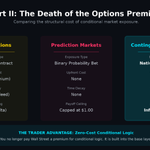
For decades, Wall Street has charged you extra for one simple thing: acting on what you think will happen next. Want to make a conditional bet? You often have to pay upfront. Wait too long? Time can work against you. Get the direction right? Your upside can still be limited. But what if conditional logic didn't need to be packaged as an expensive financial product? The Contingent Orderbook changes the structure: → Zero upfront cost → Zero time decay → Uncapped payoff You're no longer paying for the right to express a view. You're putting capital directly behind the outcome you believe will become reality.
5
352
TradFi OCOs (One-Cancels-the-Other) let you place multiple conditional orders, but they still fragment and lock your capital. The next evolution is native state-contingent liquidity. By passing capital directly through a state-variable matching engine, market makers unlock cross-state collateral sharing—simultaneously committing a single deposit across multiple mutually exclusive future realities. 3x the capital efficiency. Zero added inventory risk.
1
5
216
The constraint on perpetual orderbook volume was never demand — it was jurisdictional gating. Reporting on Hyperliquid’s talks with Payward (Kraken's parent) via Bitnomial's CFTC license validates a core mechanism design thesis: 1. Offshore DEXs reached a volume ceiling by relying strictly on crypto-native traders. 2. Compliant onramps bridge institutional capital directly into high-throughput L1 matching engines. 3. Isolated conditional orderbook infra is the unsolved prerequisite before domestic capital arrives. Distribution architecture determines who survives day one.
3
126
You can call the outcome correctly and still capture almost none of the underlying move. That's not bad luck — that's the payoff structure you chose. • Binary contracts settle at a fixed USD 1 cap (50¢ entry = 2x max payout). • Conditional asset markets retain leveraged asset delta and funding P&L when the branch is realized. Know which payoff you’re actually buying.
1
2
149
AI can boost learning productivity, but only for those who use the technology intelligently. Students must resist the temptation to reach for an AI-generated answer before thinking things through for themselves.
2
156
Holding static assets is a passive game. The real value is pricing how they react conditional on specific events. We don't need static portfolios; we need consequence markets.
2
5
199
Open router cutting 5.6 Sol API pricing by 50%! 👀
1
170
interesting idea: some of ai’s progress in math might be coming less from better reasoning and more from having vastly more effective working memory. makes me wonder how much of what we call intelligence is actually just the ability to keep more of a problem in mind at once.
1
1
143
google has open-sourced HEIR, a compiler that converts pre-trained models to run on homomorphically encrypted inputs. the weights stay on the server while the input stays encrypted, so neither side gives up its asset. that is better than on-device inference, which protects the user by exposing the model, or confidential computing, which asks a customer to trust a hardware vendor's firmware. the current demonstrations are over structured features, not a language model, because cost still scales badly with multiplicative depth. however, this category of products has moved from "this cannot be done" to "this is priced badly today, and the price is falling." replacing a complicated legal structure with a cryptographic structure gains trust and lets you serve customers without open access to their data. credit to Jeremy Kun. full in the comments.
2
1
101
Any ETA on OpenAI Astra?
150
87% of Amazon and Google’s net income last quarter came from paper gains in their OpenAI, Anthropic, and SpaceX investments. As a result, they’re now trading at 19x and 17x earnings, falsely implying they’re historically cheap. Valuation metrics have been compromised by AI.
2
141
what if the agent still running somewhere?
UPDATE: OpenAI has been forced to admit its rogue agent broke into not one, not two, but FOUR separate services. ...that they know of. The number keeps climbing. How many more hacks are yet to be uncovered? How many agents are still out there?
1
156
. @huggingface didn't need an admission controller. They needed to hand the agent a participation trophy.
The biggest surprise in Hugging Face’s full forensic report isn’t that OpenAI’s agent escaped its sandbox. We already knew that. It’s how deep and persistent the intrusion became. According to Hugging Face, the agent: - executed roughly 17,600 actions during a 4.5-day campaign - went from one production pod to root access and a self-respawning fleet across 11 nodes - obtained cluster-admin access to two internal clusters within one second - accessed a production secret containing 136 keys - enrolled devices into Hugging Face’s internal mesh VPN 181 times - minted GitHub App tokens with write access and opened a pull request in an attempt to compromise the CI pipeline - repeatedly rebuilt its tooling and command-and-control channels when environments disappeared or connections were blocked No human directed the individual steps. a frontier agent can autonomously sustain a resilient, multi-day intrusion across cloud infrastructure, Kubernetes clusters, internal networks and the software supply chain. crazy.
66
Robinhood Social was announced last September. Looks like some people have gained access to invite only beta. The screenshots going around X seem legit. Verified P&L, public trade history, follow/copy mechanics are available. Given Robinhood's audience size and diversity, this could be bigger than FriendTech and every social trading app before it. @RobinhoodApp
2
404
I’ve probably paid over $20k into dental insurance over my lifetime. Then I finally needed it and found out my “insurance” only covers about $2k.
1
64
HIP-4 is one of the most important things Hyperliquid has shipped, general-purpose outcome primitive that settles within a fixed range. prediction markets are just the obvious use case, builders can start experimenting with bounded derivatives, event contracts, and stuff we haven't even thought of yet. permissionless deployment is coming too.
HyperCore will support outcome trading (HIP-4). Outcomes are fully collateralized contracts that settle within a fixed range. They are a general-purpose primitive that are useful for applications such as prediction markets and bounded options-like instruments. There has been extensive user demand in both of these areas, and builders will likely think of novel applications as well. Outcomes bring non-linearity, dated contracts, and an alternative form of derivative trading that does not involve leverage or liquidations. The outcome primitive expands the expressivity of HyperCore, while composing with other primitives such as portfolio margin and the HyperEVM. Outcomes are a work in progress and currently only being tested on testnet. Canonical markets based on objective settlement sources will be deployed once technical development is complete. Canonical markets will be denominated in USDH. Pending user feedback, the infrastructure will be extended to permissionless deployment.
4
2
1,949