

Co-founder & All Things AI @ VidyaAI & ExtraaEdge. Learn | Share | Respect Time | Stay Fit Entrepreneur & Hacker
Pune
Joined August 2011
- Tweets1.7K
- Following578
- Followers326
- Likes1.7K







Abhi Ballabh retweeted

There are 5 teams in the YC F26 batch I am personally rooting for:
(1) Chandrika & Tanay from Quivly AI
Quivly has built a suite of AI agents which manage the entire post-sales process for usage-based products. The agents take care of onboarding, customer adoption, expansion and renewals.
Chandrika is extremely thoughtful about business building & resilient through some tough moments. Tanay is a perfect complement given his Eng depth.
This duo has figured out a quirky but cool B2B GTM motion via rap videos; even if you don’t understand their domain, you’ll love the beats.
(2) Alok & Lakshmi from RouterPlus**
These IIT B grads are technical savants. I've known Alok for a couple of years since he was part of the team at Day Zero Ventures (a co-investor with DeVC in several companies)
Alok’s hustle to get the initial product (then called EvoHQ) off the ground was admirable and I’m very glad he’s partnered with his batchmate to build RouterPlus
RouterPlus is a managed inference marketplace for AI companies which combines model optimization, inference-provider selection, and capacity procurement

Abhi Ballabh retweeted

What if your devices, apps and agents knew what you wanted?
You finish breakfast, and your Uber is booked.
Running late, your agent sends a “Running late” text.
You reach home, and your lights turn on.
AI is proactive now. But it still needs your yes. It waits, for you to unlock your phone, open an app and tap approve. Every time, hundreds of times a day.
AI needs its own interface.
Aina is a ring with a screen that predicts and shows you the three things you’ll need next. One flick of your thumb, and it’s done. For everything.
✦ Cues: proactive suggestions, ready before you need them
✦ Voice: talk to your agents, take notes, dictate
✦ Remote: control your music, Mac and TV
✦ Calls: right from your hand
Pre-orders open now
aina.com
Abhi Ballabh retweeted

This is f*cking insane. The head of Claude Code at Anthropic:
"85% of our engineers are running dozens or hundreds of agents
The way you do it is graph engineering"
One engineer at Anthropic now does the work of a whole team
In this 36-minute talk, he shows how far it's gone inside Anthropic and where it goes next
One Agent → Dozens of Agents → Graphs → Hundreds of Agents → Self-Improving System
Worth more than most $1,000 agent engineering courses
Bookmark and watch it today
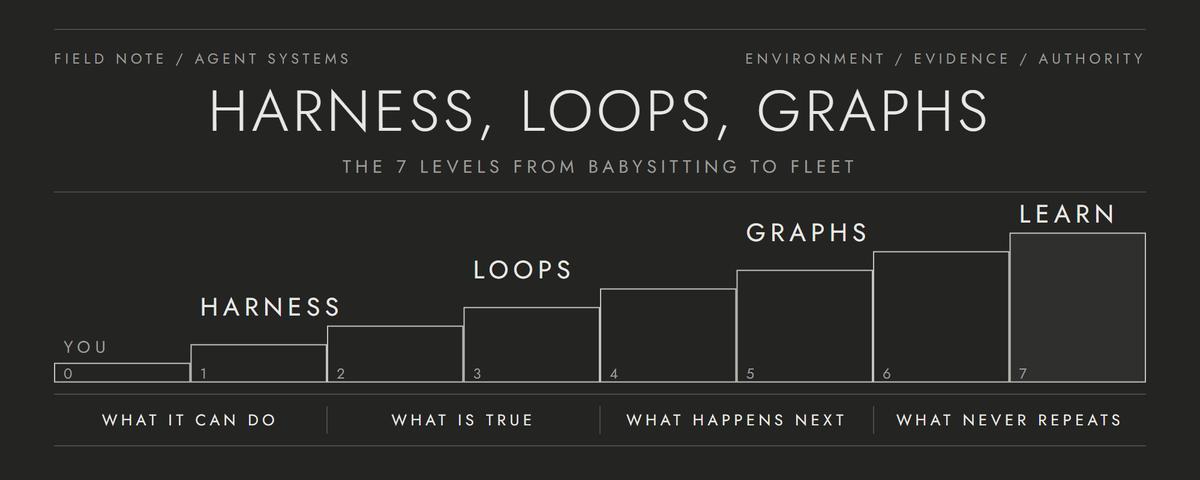
Then read the "Harness, Loops, Graphs" guide below - graphs are the last layer ↓

Abhi Ballabh retweeted

The instinct to fix it fast is the very instinct that guarantees you will not even make it to the next round.

Abhi Ballabh retweeted

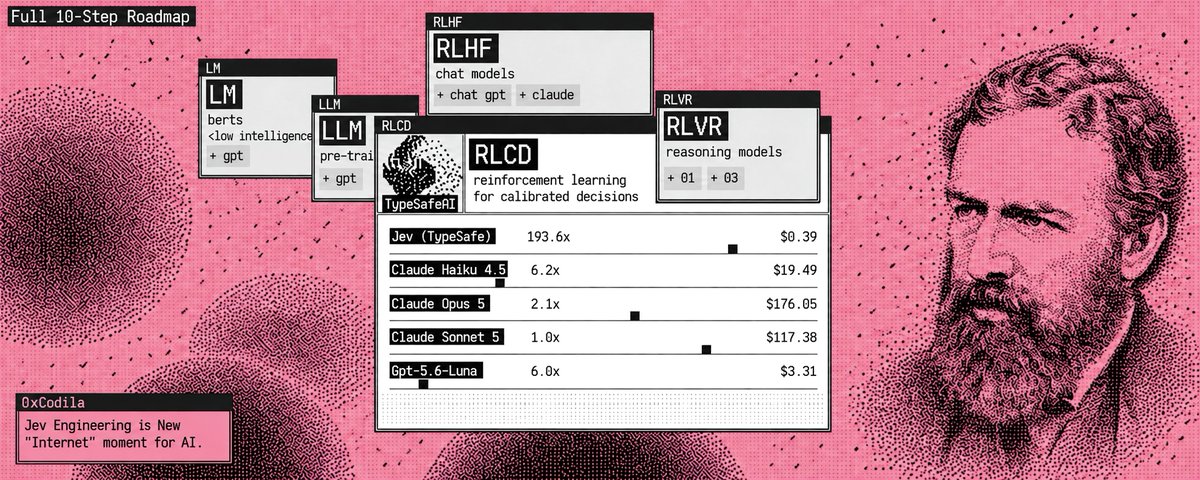
Jev is the "Internet" moment for the AI industry
It tells your agents and LLMs what to do next, in milliseconds and at almost zero cost
If you set it up correctly, you will have the AI engineer’s stack for 2028
In this article, I show you how
Abhi Ballabh retweeted
Sonali & Karan made $$ millions from Kissht’s IPO earlier this yr. They co-founded Kissht in 2015 before stepping down from their roles as COO & CTO respectively.
Karan built an incredible Tech stack which handled a peak ₹18,500 cr of disbursals in FY24 during his stint. Sonali was described by her peers as the hardest worker in the entire company.
This duo decided to step out before Kissht’s IPO to start up again. I firmly believe that good people always win.
This week’s news was major validation of my belief: Sonali & Karan’s new company Rezolv announced a $12.5m Series A led by Norwest Venture Partners; this comes 2 yrs after they raised a $3.5m Seed round led by 3one4 Capital

Abhi Ballabh retweeted

First time saw someone using the Navi app to accept a UPI payment. I took an auto today and the driver showed me a Navi QR code. I asked him how he had come to know about Navi and why he used it instead of PhonePe or Paytm. I was really curious to know because I understand young generation trying and using multiple apps for cashbacks etc...
I thought he may have taken loan from Navi and that's how he discovered the app. But he was rather surprised to know that Navi even offered loans.
So, why Navi?
He said he had heard about it from other autowalas and started using it because he gets an instant bank notification when a payment comes in. With Paytm and PhonePe apparently, the bank notification sometimes take a few minutes. I paid him...and yes, the bank notification was instant.
I am just thinking sometimes people use a product for much simple and basic reasons than we think :)


Abhi Ballabh retweeted

Sad to acknowledge the reality that @ajinkyarahane88 has called it a day. Hugely talented, immensely capable and utterly reliable, he remains India’s best-ever Test captain, who deserved an extended run in the job after his heroic come-from-behind series win in Australia 2020-21. A gentleman to the core and a reassuring presence in the Indian team, he will be remembered for never having achieved the greatness that was predicted for him in his early days, but his story is much more than one of unfulfilled potential. It is that of a man who left cricket better for his participation in it.

Abhi Ballabh retweeted

Anthropic engineer:
"At Anthropic, >90% of our engineers are building with self-improving loops.
In 4-6 months, it will be 100%. my agentic loops can run for days without spending hundreds of dollars."
in this 40-minute podcast, an Anthropic engineer reveals how to build effective agents from scratch.
Agent → harness → loops → memory = modern agent
This one video will replace 10 paid courses on vibe-coding.
Watch it today, then explore the same setup in the article below.


Abhi Ballabh retweeted

“Loop engineering” is a hot buzzphrase after mentions of it by Boris Cherny (Claude Code’s creator) and Peter Steinberger (OpenClaw's creator) went viral on social media. Loops are now a key part of how we get AI agents to iterate at length to build software. In this letter, I’d like to share my 3 key loops, shown in the image below, for building 0-to-1 products. These loops guide not just how I build software, but also how I decide what software to build.
Agentic coding loop: Given a product specification and optionally a set of evals (that is, a dataset against which to measure performance), we can have an AI agent write code, test its work, and keep iterating until the code is bug-free and meets its specification. This idea of closing the loop took off around the end of last year, and it has been a game changer in enabling coding agents to work longer productively without human intervention. For example, over the weekend, I was building an app for my daughter to practice typing, and my coding agent could easily work for around an hour, using a web browser to check what it had built multiple times before getting back to me, without needing my intervention.
The engineering loop executes quickly. Every few minutes, the coding agent might build and test a new version of the software. I hear frequently from developers who are finding new ways to engineer more effective engineering loops. This is an active area of invention!
Developer feedback loop: In this loop, a developer examines the current product and steers the coding agent to improve it. Last year, a lot of developers (including me) were acting as the QA (quality assurance) function for our coding agents, manually finding bugs and then asking the agent to fix them. But with coding agents much more able to test their own code, the amount of time we need to spend on this function has decreased significantly. This allows us to make higher-level product decisions, such as what key features to offer, where the UI needs improvement, and so on.
The developer-feedback loop operates over time intervals between tens of minutes and hours — that's how frequently a developer might review a product and give feedback. In the case of the typing app, I changed my mind a few times about the visual design, what cat costumes she can unlock as she learns (she loves cats), and the user flow for a grown-up to log in and steer the child's learning experience.
When a developer has a clear vision for what to build, it is still a lot of work to translate that vision into a specification for a coding agent to implement. Further, after the developer has seen an implementation, they might update (or perhaps clarify) the spec to steer it toward what they want. If you find that the system repeatedly runs into certain problems, building a set of evals for the agent becomes useful.
AI-native teams are increasingly using AI to help shape product direction, for example, automating the gathering and analysis of usage data, summarizing written and verbal customer feedback, or carrying out competitive analysis. However, for pretty much all the products I’m involved in, I see humans as having a significant context advantage over current AI systems — we know a lot more than the AI system about the users and the context the product has to operate in — and thus humans play a critical role. Many people describe this human contribution as “taste,” but I prefer to think of it as humans having a context advantage, since that gives us a clearer path to helping AI systems get better. This also speaks to why this step can’t be automated: So long as the human knows something the AI does not, human-in-the-loop is needed to to inject that knowledge into the system.
External feedback loop: This includes a wide range of tactics like asking a few friends for feedback, launching to alpha testers, or putting the code into production with A/B testing. These tactics are usually slow, rarely taking less than hours and sometimes taking days or even weeks. This data informs the developer vision, which in turn continues to drive the detailed product spec, which in turn drives the coding agent.
With coding agents speeding up software development, more engineers are starting to play a partial product management role. For many engineers who are growing into this role, the hardest part is shaping the product vision and striking a balance between building (bridging the gap between vision and spec) and getting user feedback to evolve the vision. It is important to do both!
I will write more about how to do this in future posts, but for now, I find it encouraging that engineers are playing an expanded role (just as product managers and designers now do more engineering).
[Original text: The Batch]

Abhi Ballabh retweeted

We’re excited to share that we just signed an agreement for @salesforce to acquire @fin_ai for ~$3.6B. The transaction is expected to close in the fourth quarter of Salesforce’s fiscal year 2027.
Fin started as Intercom 15 years ago. We changed our name to cap our transformation just weeks ago. We were a darling of the SaaS era and invented so many of the patterns you see in software today. Nearly four years ago, in need of a reboot, we jumped on weeks-old modern LLMs to create and define the category we know as Customer Agents today.
Salesforce invented modern software and SaaS. And @benioff is like the final boss of tech founder CEOs. In seat for 27 years, he’s one of the last of his era. Still pushing, pivoting, placing big bets. It’s a privilege for @destraynor and I to get to partner with him and join forces with Salesforce upon close at this most fascinating time. And will be very fun to get their help bringing Fin to magnitudes more consumers.
To our customers: Over the past few years we’ve been shipping intensely. Including recently our groundbreaking model, Apex, and our paradigm-defining internal agent, Operator. With the resources of Salesforce this will only accelerate. And yet little will practically change. I’ll still be CEO, Des will still be running R&D, we’ll both still be committed to continuing to lead this category. Thank you very sincerely and deeply for your belief in us.
To all of our friends, our families, and our employees, past and present: While this is not the end, it is a major, pivotal, special, and emotional moment for us. From the bottom of our hearts, thank you. For everything.
To my cofounders, my exec team: Look what we built. Four young lads with a dream and nothing to lose. And a home grown exec team who pulled off the greatest and arguably only late stage software company pivot to AI, and invented one of the most important categories in AI. Thank you for sticking through all of this with me.
And now, time to get back to work. See you at our next product launch in a couple weeks. (:


Abhi Ballabh retweeted

This is actually historic. SpaceX went public today. $75 billion raised. $1.77 trillion valuation.
The largest IPO in the history of markets. Elon Musk just became the world's first trillionaire.
Moments before ringing the Nasdaq bell from Starbase, Texas, Musk said:
"I gave SpaceX a less than 10% chance of succeeding at all. If people had told me this was gonna happen, I was like, man, you must be smoking some really good crack."
From nearly bankrupt in 2008 to bigger than every company that's ever gone public. On day one.
@SpaceX @elonmusk
Abhi Ballabh retweeted

Your margin is my opportunity: AI version…
The biggest surprise of 2026 is that the capability gap between the best open-weight/source models and the best closed models has narrowed much faster than the pricing gap. The pricing gap remains enormous while the capability gap is quite narrow.
What does this means in practice?
For a company consuming 1 billion input tokens and 1 billion output tokens per month:
GPT-5.5 Pro: ~$105,000
Claude Opus 4.8: ~$30,000
DeepSeek V4 Pro: ~$5,220
DeepSeek R1: ~$2,740
I asked ChatGPT what it thought about this and it answered as follows:
“If I were building a company today, the economic frontier would look roughly like:
DeepSeek V4 Pro / R1 for high-volume inference.
Claude Opus for premium agent workflows where reliability matters.
GPT-5.5 Pro only for workloads where its incremental capability demonstrably produces enough business value to justify a 20–40× token premium.”
Most CEOs have no idea that, instead of this nuanced approach, their teams are running amok internally by picking the most expensive models in most cases and burning through massive budgets with zero governance, audit ability and control.
As control planes like our Software Factory become more standard, you can expect the run rate revenue growth of the frontier labs to go down meaningfully and the revenues of the open models to skyrocket.
Why? Because we can implement the nuanced approach above and be agnostic to model - instead focusing on customer intent, model task and cost management among other things.

Abhi Ballabh retweeted
Geoffrey Hinton, the father of artificial intelligence:
"If you truly understand this lesson, you may not be able to sleep comfortably tonight."
This 47-minute lecture is the best thing on the internet you will find about AI.
Abhi Ballabh retweeted

🚨 Anthropic just showed a 27-minute workshop on how to actually do prompts for Claude.
Taught by the people who built it.
Free. No registration. No paywall.
I've seen $300 courses that don't cover what they teach in the first 8 minutes.
Watch it and bookmark it now.
Abhi Ballabh retweeted

1/5
I'm a cardiologist. I have spent twenty years watching cholesterol destroy arteries, trigger heart attacks, and kill people I care about.
Today, Eli Lilly presented data that may begin to end that era.
VERVE-102. A single infusion. One dose. It uses base editing to permanently turn off the PCSK9 gene in your liver.
Presented today at the European Atherosclerosis Society Congress:
88% reduction in PCSK9.
62% reduction in LDL cholesterol.
Sustained up to 18 months.
No treatment-related serious adverse events.
One infusion. Not daily pills you forget to take. Not monthly injections. One dose — and your cholesterol may stay low for the rest of your life.
Abhi Ballabh retweeted
I’m hosting 1 public company founder, 3 pre-IPO founders and 6 exited founders on stage at MTW 2026 to do live AI demos on 29th and 30th May
The line-up is just incredible:
1. Sonali Jindal (Rezolv) - her prev. startup Kissht went public at a ₹3200 crore valuation this month
2. Mosaic Wellness (₹750 crore FY25 revenue) -Shouvik Ghosh Roy (CPTO) will demo their in-house agents which run their large performance marketing budget
3. FarMart (₹1970 crore FY25 revenue) - Sukhpreet Sekhon (CPO) will share how his team saved a couple of crores by building AI agents for finance workflows
4. GoKwik (₹4,000 crore valuation) - Vargab & Akshat will present Kwik Ads & Kwik which are helping thousands of D2C brands improve their ROAS
5. Pooja Jauhari (EMoMee) - WPP acquired her prev. co. The Glitch in 2018 for an estimated ₹100 crore
6. Shivam Gupta (GreyLabs) - founding team member of Cogno AI which was acquired by Exotel in 2021
7. Ashutosh Kumar (Grexa) - he sold Testbook to Classplus in 2022
8. Shobhita Agarwal (CraftAI) - she sold WordHudle (6M+ players) to Unwind Media in 2022
9. Ayush Agrawal (Kubo Care) - His prev. co Seniority was acquired by HCAH in 2022
10. Nirav Prajapati (Ignosis) - He exited Pirimid Fintech to Infibeam for ₹25 crore in 2023
The theme is clear: "Demos, not memos"
Repeat founders know this best: in today's AI era, everyone is a builder.

Abhi Ballabh retweeted

My guest today is Brian Chesky (@bchesky), founder and CEO of Airbnb and one of the great consumer founders of the last 20 years.
Paul Graham coined "founder mode" based on Brian's experience running Airbnb. This conversation is about what comes after it, what he calls AI founder mode, and how it will force founders to focus even more on the details.
We talk about his eleven-star exercise for finding product market fit, why your first hire should be a recruiter, and why Airbnb's $100B IPO became one of the saddest days of his life.
Brian still comes across like the 17 year-old at the Rhode Island School of Design (RISD) who picked to study industrial design. His heroes are all artists. Da Vinci, Van Gogh, Walt Disney, and Steve Jobs, all of whom were working the week they died because they loved what they did.
Rick Rubin taught him that an artist is only an artist when they make things for themselves. Now Brian believes AI is the opportunity for all of us to do the same.
Enjoy!
Timestamps:
1:00 Studying Industrial Design
11:33 AI Founder Mode
17:02 Lack of Consumer AI Companies
22:10 Small Teams and Focused Problems
30:52 The Evolution from Founder to CEO
38:13 The 11-Star Experience
41:07 AI as a Canvas for Creativity
48:17 Detaching from Success
53:12 Founder-Led Moats
58:34 The Next Chapter of Airbnb
1:03:08 What Endures in the Age of AI
1:06:43 Lessons from Bodybuilding
1:10:20 The CEO's No. 1 Job
1:17:01 Activating Talent
1:20:39 The Kindest Thing