

PDF candidate @PSUSocCrim & @CSoDA_PSU | (Culture + Politics + Sci. of Sci.) x Computational Social Sci. | @sehiruniversite & @BingPoliSci Alum |
🇵🇰 🇹🇷 🇩🇪 🇺🇸
Joined February 2012
- Tweets11.2K
- Following327
- Followers1.2K
- Likes15.4K






Pinned Tweet
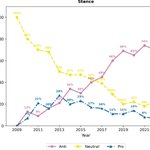
Our new article with @omeratacc and @ienesatac on the public perceptions of healthcare services for Syrian refugees in Türkiye using a decade of twitter data and a fine-tuned Turkish BERT model is now published in the Journal of Medical Internet Research.


Beni çok mutlu eden bir haberi sizlerle paylaşmak istiyorum.
Türkiye’de Suriyeli sığınmacıların aldığı sağlık hizmetlerine toplumun yaklaşımını inceleyen çalışmamız, medikal enformatik alanının en iyi dergilerinden biri olan Journal of Medical Internet Research'te (@jmirpub) yayımlandı.
Konusunda bir ilk olan bu çalışmada; Türkiye’de geçici koruma altındaki Suriyeliler hakkında 2009–2022 yılları arasında Türkçe atılan 116.172 sağlık temalı tweeti LLM ile analiz ederek toplumun duygu ve tutumunu inceledik.
Beklendiği üzere, ilk yıllarda genel olarak nötr ve ılımlı seyreden söylem, yıllar içinde net bir şekilde olumsuza evriliyor. 2021 yılına gelindiğinde negatif duygu düzeyi %79,9’a, sığınmacı karşıtı tutum ise %78,3'e ulaştı.
Maalesef bu duygu ve tutumun arkasında ciddi bir dezenformasyon dalgası yer alıyor.
"Hastanelerde Suriyelilere öncelik verildiği"
"Suriyelilerin sınavsız doktor yapıldığı''
gibi kamuoyunda dolaşan pek çok "doğru bilinen yanlış" olduğunu ve bunların tepkileri doğrudan beslediğini tespit ettik.
Bulgular, sağlık sistemindeki kapasite baskısı ve ekonomik koşulların getirdiği zorluklarda, biriken genel toplumsal hoşnutsuzluğun faturasının zaman zaman sığınmacılara kesilerek "günah keçisi" ilan edildiklerine işaret ediyor.
Bu makalenin alanında ilk çalışma olmasından daha gurur verici yanı ise kardeşim @ienesatac ile birlikte yaptığımız ilk çalışma olmasıydı. Ayrıca, sevgili dostum @abadeeel'in çalışmanın yürütülmesindeki teknik katkıları çok kıymetliydi.
Makalenin açık erişim bağlantısını aşağıya ekliyorum. 👇
Abdul Basit Adeel et al. retweeted

🚨New Research Article🚨
Among US adults, support for more AI development peaked in 2025.
Political polarization emerged following November 2024.
Data center and water use concerns only appeared recently.
🧵
Abdul Basit Adeel et al. retweeted

Check out our recent article on Christian nationalism and government spending preferences!
I'm also on the academic job market for 2026–27! My research focuses on political sociology, intergroup relations, immigration, and culture. I use quantitative and computational methods to study intergroup conflict, exclusionary attitudes, and elite rhetoric.
You can learn more about my research here: enesatac.org/

What Would Jesus Fund?
I. E. Atac, L. Kunjan, @forrest_lovette, & S. L. Perry’s #Socius article uses #GSS data to uncover how #christiannationalism shapes individuals’ government spending priorities, especially regarding #crime and the #military
Read: doi.org/10.1177/237802312614…

Sociology according to my imaginary friends currently residing in delulu paradise 😘

UNC Sociology professor Rosemary Hopcroft: “My husband also had a career as a sociologist. Despite our professional backgrounds, we would not allow our children to major in sociology in college” @rlhopcro
Glenn Loury (Brown Univ.) @GlennLoury:
“Only a sociologist would believe that 70 percent of kids being born out of wedlock in a community is not a bad thing in terms of development. Only an academic sociologist”
Alexander Riley, Professor of Sociology:
“Today’s sociology is so patently devoid of any intellectual rigor that most of it evokes only contemptuous laughter. The arguments advanced, the “evidence” mustered to support its partisan claims, are so weak that it is genuinely amazing to realize that the people making these cases have spent many years in educational institutions and yet have come away from all that with either no understanding of or an utter contempt for careful and rigorous argument.”
i-dislike-sociology.com/facu…
People listen to happier music on Saturdays — and sadder music on Tuesdays😀
Data: daily streaming trends across 70+ markets, 2017–2026 (~39.8M total daily observations).

If you are at ASA 2026, I am presenting a paper (Tuesday - 2:00 pm) on how vulnerable outgroups pay the cost of deliberate electoral disruptions in competitive authoritarian regimes using the 2019 Istanbul Mayoral Elections as a natural experiment w/ @ienesatac.

We show that anti-Syrian refugee discourse on Twitter closely tracked the electoral cycle of two elections held three months apart (controlling for currency fluctuations as a counterfactual), increasing daily until the deadlock was resolved in the second election.
Another example sweeping conclusions based on “counting” keywords.
Sociology “reformers” are doing exactly the same. Counting keywords to conclude sociology should be “liquidated” 🤗


A reminder that this extremely prejudicial article is written on the basis of flimsy evidence (counting keywords).
Sociology published in flagship journals is no less rigorous than other social sciences. What happens at the fringes does not represent the whole field.


It's not just cultural anthropology: The politicization and postmodern obscurantism of the field of sociology is running the discipline into the ground (though some those quoted in the article - al Gharbi, Redstone, McAffree -- are fabulous). | The study of people has a people problem. wsj.com/us-news/education/is… via @WSJ

Inequality is not a taboo topic itself. It is a social fact that should be studied like family, schools, state, church, taste, attitudes etc.
The problem is, however, the rise of census data. It is hammer of convinience that everybody uses to hit the nail of Inequality.
It is mind-boggling how some people have convinced themselves that they are not ideological while everyone else is.
In fact, all of us are eating from the same trashcan of ideology. Only flavor changes (Left or Right).
That's the fundamental lesson from Sociology of Knowledge!

What is scholarship for?
Should academics pursue truth wherever the evidence leads—or should research be judged by its political and social goals?
In this week's Quillette Podcast, @jonkay speaks with sociologist @ashleyrubin about a major new report on the state of scholarship in the humanities and humanistic social sciences. Rubin argues that the greatest threat to academic inquiry isn't that many scholars hold progressive political views—it's the growing tendency to evaluate research according to ideological and political criteria rather than scholarly merit.
Watch or listen now.
quillette.com/2026/08/04/pol…

Ideology is its purest sense is not just the labels of Left or Right, it is the “inverted image” colored by our knowledge, experiences, spontaneous relation with the world.
Every moment, every person, every object we interact with shapes our thoughts, feelings, objectives.
There goes the fuss around "viewpoint diversity".
Across the board the "Left" leaning faculty seems to be more open to diverse ideas (Theories & Methods) as well as diverse backgrounds than anyone else.
If anything, "Right" leaning faculty seems to be less open to everything!


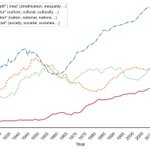
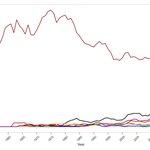
Just a reminder that bulk of this discourse is based on counting keywords (like my figure below).
Bad evidence, but even if we take it on its face value, sociologists seem to be more interested in nation and nationhood (Type I error) than they are in inequality + stratification?


Counting keyword lemma(s) over time in 37,450 titles + abstracts from top 27 sociology journals.
Are sociologists becoming increasingly interested in inequality? Yes!
Is it some sinister ideological takeover? No!
Census data = convinience = inequality pubs ≠ Marxist takeover!