


Marginal analysis is a general optimization technique used in mechanics and industrial planning. Its application to the anthropology of consumption is a different matter. Optimizing the allocation of social labour does not establish a marginal utility theory of value.
.

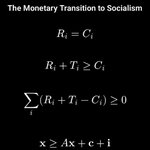
Funny how, in the early 1920s, Soviet economist and statistician Strumilin, while trying to build a planning system based on the labor theory of value, found himself having to account for marginal utility. Essentially, he faced an optimization problem with labor inputs as the constraint and utility as the objective.
This is my analysis of the mass and marginal rate of surplus-value. Although Marx examined the underlying contradiction, he did not explicitly formalize it in differential terms.


1
4
158

The Claims Composition lV
The growing regulatory power of credit within claims composition fosters the institutional basis for "sovereign social credit".
Equity remains unchanged in magnitude while its relative weight diminishes.
—Marx, critically reconstructed

The Calims Composition III
Financiation
Productive accumulation generates financing requirements whose monetary accommodation transforms the composition of financial claims.
What initially emerges to accommodate productive capital may subsequently become a force governing it.


118
The transition beyond capitalism may begin with the transformation of the social relation embodied in the financial claims.
—Where money retains its form; credit retains its function; economic calculation retains its necessity.
.


Sovereign Banking and the Pre-Socialist Transition
The financial insolvency of private capital does not necessarily imply the obsolescence of its productive capacity.
Rather than deploying public credit to restore failed private claims, sovereign banking could facilitate the ++
1
4
181
Sovereign Banking and the Pre-Socialist Transition
The financial insolvency of private capital does not necessarily imply the obsolescence of its productive capacity.
Rather than deploying public credit to restore failed private claims, sovereign banking could facilitate the ++
...transfer of viable productive assets into pre-socialist enterprises.
Their continued financing would be conditional upon monetary reproduction, productive efficiency and measurable human development.
The recurring crises of capitalist accumulation could thereby become ++
1
43
The Constraints of Pre-Socialist Forms
Replacing profitability with human development as the governing objective does not exempt an enterprise from economic discipline.
Social credit must remain conditional upon monetary reproduction and measurable social achievement.


The Calims Composition III
Financiation
Productive accumulation generates financing requirements whose monetary accommodation transforms the composition of financial claims.
What initially emerges to accommodate productive capital may subsequently become a force governing it.
Marx's 'organic composition' concerns the tension between constant and variable capital in production.
The 'claim composition' concerns the debt and equity through which enterprise assets are financed.
These are two distinct interacting dimensions of capitalist accumulation.


The Composition of Claims II
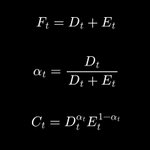
The claim composition incorporates two distinct dimensions: the total magnitude of debt and equity claims, and their relative proportions.
Weighted composite unifies these dimensions, while its normalized form isolates the structural composition.


"Profit ceases to command production; material reproduction remains compulsory"
Socially necessary production need not generate private profit.
Public credit can sustain enterprises at monetary break-even, while social transfers finance essential services below cost.


Capitalism subordinates investment to the expected monetary realization of profit.
A pre-socialist monetary program would progressively reverse that rationality: credit would follow democratically determined reproduction requirements, subject to capacity, and ecological limits.
Any transitional-socialist policy program must include progressive socialization of credit and investment without assuming that monetary sovereignty abolishes material constraints.

Public credit can overcome an individual firm's financial constraint. It cannot abolish society's material reproduction constraints.
Any socialist program requires balancing social needs against society's reproducible productive capacity.
Socialism must overcom the capitalist constraints on the allocation of social labour while respecting the material constraints of social reproduction.
The first is historically constituted—institutionally transformable.
The second cannot be abolished, only progressively relaxed.


Reviewing The Blueprint: How Socialism Can Work in the Real World by Bhaskar Sunkara, Ben Burgis and Mike Beggs, Theryn Arnold (@TherynDArnold) argues that overcoming the market and value relations remains the benchmark for what a feasible socialism must accomplish.
cosmonautmag.com/2026/11/goi…

True, they can produce pesos but they must earn dollars. This external settlement constraints can't be overcome with a permanet zero rate policy.
The country must transform its productive and export capacities.
@wbmosler’s MMT policy proposals for Argentina:
1. Float the peso to preserve FX reserves.
2. Set the policy rate permanently at 0%.
3. Stop issuing govt securities.
4. Introduce narrow banking.
5. Regulate bank interest margins.
6. Regulate asset diversification by state-supported entities.
7. Implement a Job Guarantee to achieve full employment.
8. Fully fund essential public services, including education, healthcare & public transport.
9. Renegotiate the IMF deal: a 3% tax on gross exports, payable in USD, to service IMF debt.
10. Establish strategic buffer stocks and promote energy conservation.
The goal: full employment, price stability & monetary sovereignty.
Source: Warren Mosler, Argentina Inflation (May 2022).
moslereconomics.com/wp-conte…
5
191
The Dynamics of Value V
Average Rate of Profit
Every capitalist wants to dictate prices. Yet none controls the average rate of profit; competition generates this social regulator behind their backs.
Projected prices aren't realized profits. Effective demand must validate them.

The Dynamics of Value lV
—Marx’s theory of price formalized
SNLT regulates value, but does not directly dictate market prices.
The average rate of profit transforms values into prices of production—effective demand determines whether those prices can be realized.

2
194