
John B retweeted

Andrej Karpathy:
"Prompting is going away. Delete everything, keep Graph."
In just 69 minutes, he shows how to build graphs and why they're the only layer that survives in the end
Prompts → Agents → Loops → Graphs
a loop keeps one agent running until the job is done
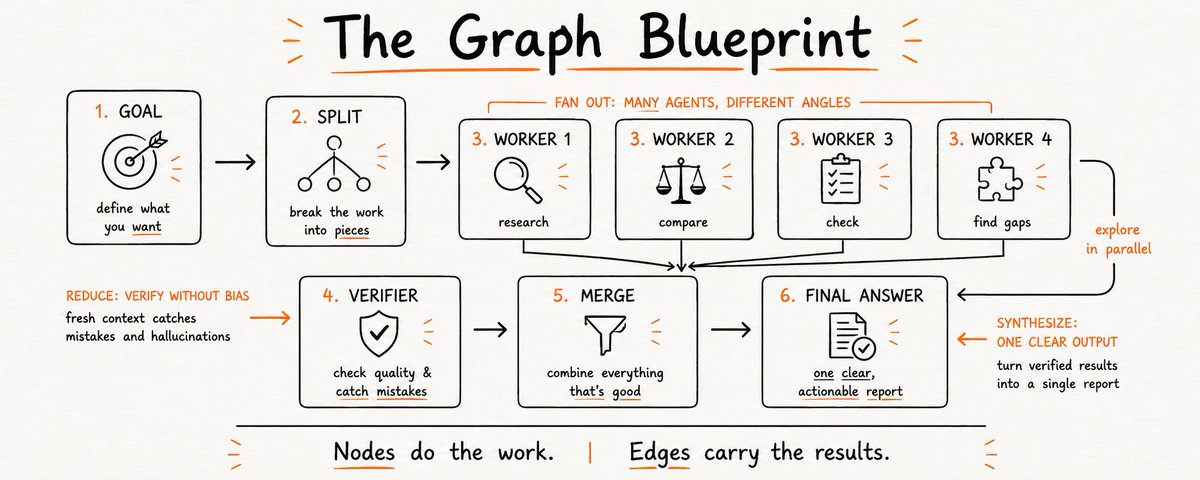
a graph decides which agents exist and what each one passes to the next
anyone can build an agent, almost nobody builds the graph that runs them
watch it today, then save the full guide on graphs below before everyone starts catching up ↓


John B retweeted

Today we're releasing Underdog Saluki 27B
Based on Qwen 3.8 27B, Saluki is almost 7x smaller than its full-precision counterpart while it keeps 96% of its benchmark performance and beats Qwen at tool calling
It's the best model <8GB that runs in Underdog
Saluki is available today under Apache 2.0. Try today in Underdog underdog.ai/saluki

John B retweeted

Opus 5.5 + Jev is extremely powerful.
It's literally 200x faster and 400x cheaper than running Claude alone.
Send this prompt to Claude, and it will tell you exactly how to set up:


John B retweeted

Jev + Claude Opus 5.5... i still can't understand why everyone isn't wiring this up yet
the forks alone fall from roughly $96 a day to $3 once jev owns them. right now it's the cleanest way i know to run opus
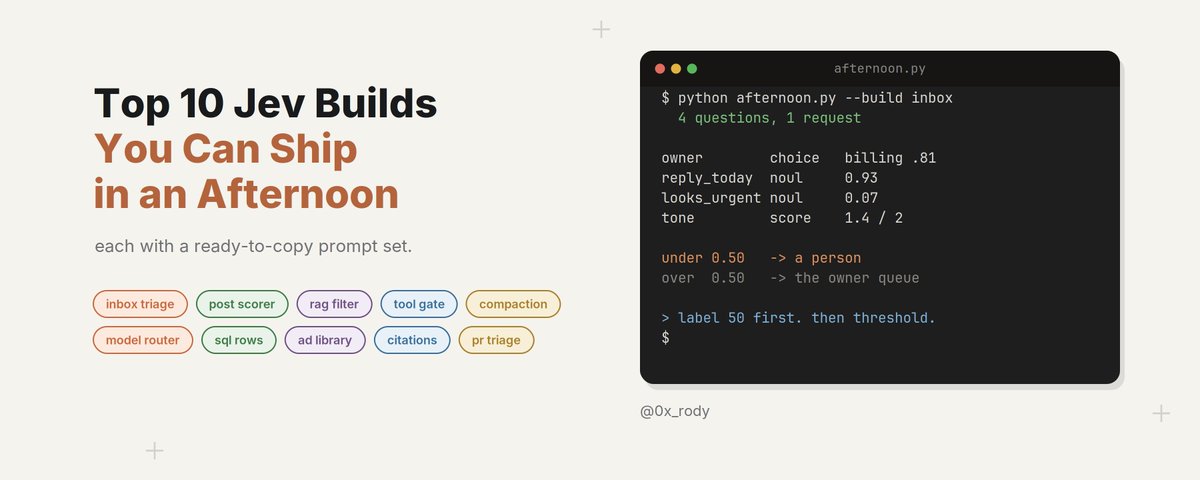
what jev takes over:
-> scores which project notes matter before the context is ever loaded
-> sends the easy steps to a cheaper worker
-> picks a recovery path when a tool fails, so nothing retries blind
-> runs the narrow checks before the full test suite
opus does the hard reasoning. jev chooses from options the harness already prepared and validated
that's jev engineering in one line: the expensive model thinks, the cheap one decides
$93 a day back on the same work is a number your manager remembers
read the paper, then the full jev guide below

John B retweeted

this is f**king dangerous.
someone just open sourced an entire library of ready-made JEV skills for building insane AI agent workflows.
instead of building common agent patterns from scratch, you can grab skills for things like:
→ jev-route for routing tasks
→ jev-guardrail for adding checks and verification
→ jev-fanout for running multiple tasks in parallel
→ reusable skills you can plug into your own workflows
the interesting part is that these solve problems you'll run into once your agents start doing more than simple tasks.
you don't have to reinvent routing, verification, or parallel execution every time you build a new workflow.
save this now.
you'll probably need one of these skills the next time you're building an agent and don't want to start from scratch.
repo below:


John B retweeted

this is pure f*cking treasure
A Stanford AI research group has found a way to use JEV to make your LLM run 24/7 at a lower cost in x444
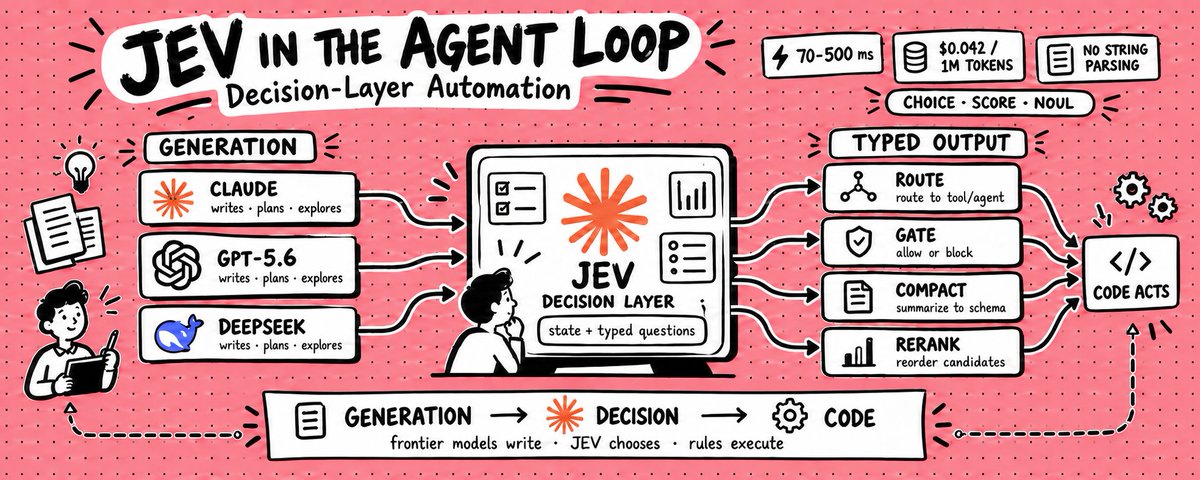
the LLM only does what needs words. everything else is a typed decision:
> worth reading? Jev answers yes or no before a single token is spent
> which desk? papers, repos or market, one Choice
> rerank: embeddings pull 20 sources, Jev keeps the 5 that matter
> claim holds? every claim checked against its source, the weak ones dropped
> new or known? duplicate, related, revises or contradicts, checked against the vault
the LLM writes one note, 5 to 12 lines, one claim
> judge: confident verdicts pass, unsure ones go up to a frontier model
> matters to you? only the top scores make the morning brief
the judge rule comes straight from Carnegie Mellon's JEV-as-a-Judge paper: escalate only the unsure 34%, keep 99.6% of the accuracy at 47% of the fee
and the fees are the whole point
> Jev: $0.044 per 1,000 judgments
> GPT-6: $12.182 for the same 1,000
a whole day of decisions on a frontier model costs dollars. the same day on Jev costs cents
you stop reading 300 sources. you read one brief

John B retweeted

Jev has been exploding across GitHub since launch, here's what people have already built with it
if you have API access and don't know where to start, copy this:
jev-trader - real trading bot placing live limit orders on Monad every 300ms block, judged by Jev alone. 1,911 stars
github.com/jarrodwatts/jev-t…
jev-ultrafast - browser agent that picks every click itself, only calling a text model when it actually needs to type something. 16,758 stars
github.com/browser-use/jev-u…
jev-doom-agent - real Chocolate Doom compiled to WebAssembly, two engines running the same map, Jev picking the tactical macro every frame
github.com/lukaske/jev-doom-…
jev-t-rex-runner - the Chrome dinosaur game you've procrastinated with a hundred times, now played entirely by Jev picking jump, duck, or keep running
github.com/joshlarsen/jev-t-…
typesafe-chess - Jev vs a real search engine, two games, colors swapped. the search won both, but overruled Jev's first instinct on roughly half the moves
github.com/TholeG/typesafe-c…
jev-drone - a simulated quadrotor clears a five-station obstacle course by camera alone, Jev judging the situation twice a second
github.com/RomanSlack/jev-dr…
tax-doc-classifier - sorts real IRS tax forms with 100% strict accuracy across 261 forms, at roughly $0.001 a page
github.com/kyotofin/tax-doc-…
killmyidea - describe your startup idea, Jev scores it from every angle, then hands back kill, fix, or ship
github.com/monteduro/killmyi…
jev-curate - streams Parquet and JSONL rows through typed judgments at 1,500+ rows a second, keeping only what clears the bar
github.com/AkashPriyadarshii…
pg-jev - a PostgreSQL extension that lets you ask your own database tables plain-English questions and get a real answer back
github.com/realZachi/pg-jev
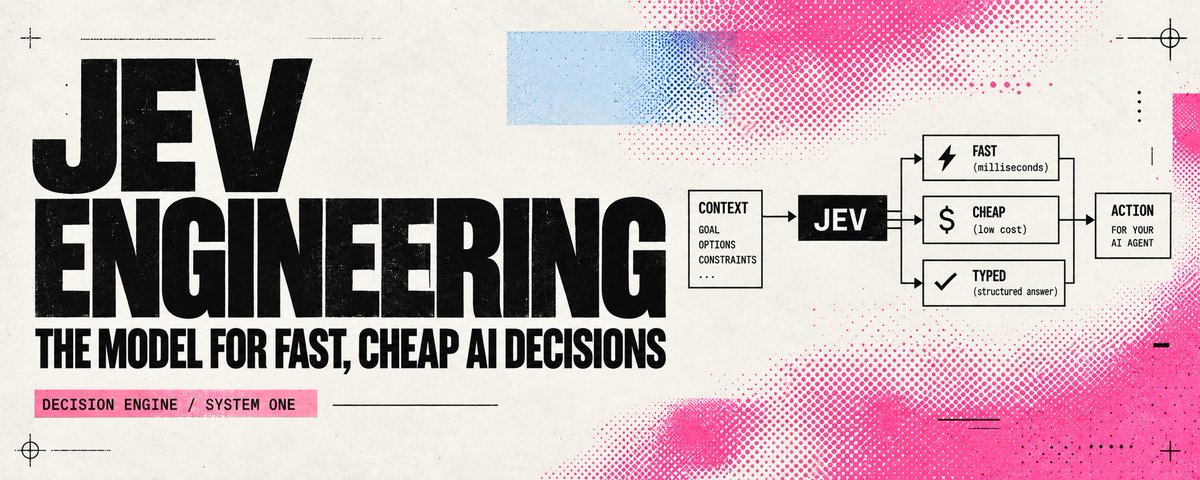
none of these ten generate a single word of text. every one of them returns a number against an answer someone already defined
full setup below, then run the three-question test from the article before you build an eleventh



John B retweeted

Andrej Karpathy spent 8 years at OpenAI and Tesla
Last week, he compressed everything he knows into one free 2-hour lecture
Prompts → Harness → Loops → Graphs → Self-Improving Systems
This is not about tweaking text in a chat box
This is about understanding the core machinery and wiring the execution loop around it
People pay $15K for bootcamps that teach half of this
This single lecture beats almost every paid AI engineering course on the market
You probably don't have 2 hours right now
Don't let this get lost in your feed
Watch it first
Then read the step-by-step guide below and build your first loop ↓


John B retweeted

Anthropic just dropped a 13-page PDF on Agent Memory - 5 layers that cut token cost 90% and make your agent actually learn:
here's the 5-layer memory architecture:
layer 1 → working memory - the context window. everything the agent sees right now. when it fills up, old context dies. most agents stop here and wonder why they're broken
layer 2 → episodic memory - what happened. full interaction logs with timestamps. the agent recalls that the deploy failed Tuesday at 3am because the migration script had a typo
layer 3 → semantic memory - what is true. facts, entities, relationships stored as a knowledge graph. "user prefers TypeScript" lives here. doesn't expire when the session ends
layer 4 → procedural memory - how to do things. the agent tried 3 approaches, one worked. that method becomes a reusable skill. next time it skips straight to what worked
layer 5 → forgetting - what to delete. an agent that never forgets accumulates contradictions. old preferences override new ones. the user moved cities but the agent still recommends restaurants in the old one
the result: Mem0 stores 1,800 tokens per query instead of 26,000. Snowflake added one ontology layer - 20% better accuracy, 39% fewer tool calls. memory pays for itself on day one
this 13-page PDF is what separates a chatbot from an agent that actually learns
don't scroll past this one ↓


John B retweeted

Andrej Karpathy’s 1-hour Stanford lecture on AI engineering is one of the best explanations I’ve seen of how AI systems actually work.
The progression is simple:
10% → LLM
30% → Prompt
50% → Agent
70% → Loop
100% → Graph
The key takeaway:
AI engineering isn’t just about writing better prompts.
It’s about building systems around models — giving them context, memory, tools, feedback loops, and data flows.
“Delete everything, keep Graph.”
Definitely worth watching if you’re building with AI agents.
Watch → Bookmark it

John B retweeted

Anthropic engineer:
"You're not supposed to prompt Claude. You're supposed to build a system that prompts itself."
In 45 minutes she shows exactly how Anthropic builds agents that remember, fix their own mistakes and get smarter with every run.
This beats any paid course on agents I've seen.
Watch it, then read the guide on building loops below.


John B retweeted

Happy Anthropic Rug Pull Eve everyone.
Enjoy your last day of Claude limits.
The +50% weekly boost ends tomorrow, Aug 19.
I already cancelled my Claude Max ahead of this.
Grok 4.6 is now my daily driver.
GPT 5.6 Sol is what I reach for on the hardest tasks.
Fable 5 and Opus 5 are expensive and lazy.

John B retweeted

The successor to Llama is here, and Meta is revitalizing focus on open weights with their new Muse Glimmer - a leading 30B param model designed for always-on local agent use, small enough to run on a Mac or PC with a single GPU.
Available in Cline using Ollama now!


Introducing Muse Glimmer, an open-weight 30B-parameter model optimized for local, always-on agent workflows.
Muse Glimmer delivers strong performance on key agentic use cases and benchmarks compared with leading models in its size category, and is designed to run entirely on consumer hardware like a Mac or PCs with performant GPUs.
In keeping with our long tradition of sharing fundamental AI research, we’re releasing model weights under a permissive Apache 2.0 license.
🧵👇


John B retweeted

Andrew Ng just released 2-hour course on 100% Graph engineering: 1 prompt → 100 agents → loops → graphs from scratch:
10% → 9:14 - build your first agent from scratch
30% → 33:11 - Loop engineering
55% → 1:02:46 - Graph engineering
75% → 1:30:15 - agents that rewrite themselves
100% → 1:49:05 - full graph system that work without you
most graph tutorials stop at the diagram - this one has you running one in the first 20 minutes
watch this brilliant course, build the graph - then read the full architecture below ↓


John B retweeted
Google Brain founder, Andrew Ng:
"Prompting will be dead in 6 months, graphs are what's replacing it."
In 2 hours at Stanford he shows how to build agents that work and improve entirely on their own.
The first 10 minutes cover what most $500 courses never do.
Watch the lecture first, then read the guide below on how to build a system that improves itself.
"400B parameters, only 17B active per token."
Sounds like a free lunch.
It isn't. Here's the part that shows up on the bill.