
Auto-research & Gemini RSI @GoogleDeepMind. Ex @Meta (FAIR), @UCL, @UniofOxford.
London, England
Joined January 2018
- Tweets887
- Following435
- Followers2.5K
- Likes4.6K


Pinned Tweet
I’m hiring a Student Researcher at @GoogleDeepMind. This research role centers on topics of open-ended self-improvement and discovery with LLM agents.
📍 Location: London
🗓️ Duration: 6 months, 100%
🚀 Start date: June or July 2026
Apply now using the links below👇

Mikayel Samvelyan retweeted

Getting into the fantastic world of busy beaver cryptid hunting has been a highlight of my time on GDM's Discovery team. Who knew how much hidden structure could be living in such simple machines!
@dsantosmarco did a great job with this project, excited to see where it leads

Over the past year, the Discovery team at @GoogleDeepMind, in a project led by student researcher @dsantosmarco, has made new discoveries in one of the most beautiful open problems at the edge of computation: Finding the 6th Busy Beaver (BB) number.
While most AI math systems solve human-generated problems, like theorems, this work tackles a different aspect of mathematical creativity: Discovering hidden problems.
For years, the BB Community has pursued one of theoretical computer science’s most captivating collaborative quests: finding the simplest programs that run the longest before halting. Because determining whether these programs ever stop is uncomputable, no universal algorithm can solve it, meaning new mathematical techniques need to be found and invented to make progress.
In this way, the BB challenge serves as an open ended domain for mathematical creativity and, in particular, a generator of hard math problems called Cryptids. These are tiny programs whose halting behavior is governed by and equivalent to deep, unsolved math problems in number theory, similar to the Collatz or Goldbach conjectures. Historically, the BB community had recognized ~20 Cryptids in BB(6), and the best problems were selected for the Busy Math Olympiad (BMO).
Building on their work, Marco built a pipeline powered by Gemini 4 Argon that:
1️⃣ Simulates raw Turing machine traces to compress recurring patterns.
2️⃣ Conjectures mathematical transition rules & runs synthetic experiments to test edge cases.
3️⃣ Proves the equivalence formally in Lean 4.
Using this pipeline, Marco and the team discovered 20 new potential Cryptids and verified 33 more machines previously studied in the BB community. All the proofs were open sourced and shared in the community discord channel and we hope that they will help the community to make progress towards resolving BB(6). We also contributed related halting/non-halting proofs directly to the community GitHub repository.
Finding these Cryptids shows hidden links between simple programs and number theory, and helps mathematicians map the limits of computation. I'm also excited about Gemini 4 Argon's ability to help researchers both solve hard problems and accelerate scientific discoveries, of which Busy Beaver is just one example.
Work led by our student researcher @dsantosmarco with paper contributions from @vivek_veeriah, @Dahoas1 , Andrew Bolt, @zuza777 , Satinder Singh, and myself with additional contributions from Hussain Masoom, @maxencefaldor , @MoritzFirsching and Petar Sirkovic.
Read more about it in our paper: arxiv.org/abs/2610.22603

Mikayel Samvelyan retweeted

It was a lot of fun co-leading this with @anton_iades and @ritamsaha_. It was our first project together. Antonis covered the results, so I will keep it to what I learned and realised during the project.
💡 Novelty is just diversity at a global scale. We call a set of ideas diverse if they attack the problem from different angles. Novelty is the same question, but the set is all of published research.
Obviously, searching all research is impractical, so we had the agent review 30-40 more closely related papers. I expected this to inflate novelty, since a small set will miss some obscure prior work. So it was interesting to see that none of the 3,222 ideas were scored as completely novel!
There are two caveats here:
❗ The agent may still be overrating the novelty of the ideas, but a set of 30-40 papers was enough to find prior work overlapping with every generated idea. So, in the broad scheme of things, the models still aren't great at generating completely novel ideas.
‼️ Another confounder is the scale of the agentic system. All our experiments used 8 parallel agents with no peer-to-peer messaging between them. Our Greedy baseline was purely agentic: the agents came up with ideas, implemented them, and recorded what they learned in local and global memory. It still collapsed onto known recipes. OpenAI's Navier-Stokes result and Anthropic's enzyme search show that large-scale swarms can solve open problems in interesting ways. The sheer stochasticity at that scale may just be enough to overcome the mode collapse.
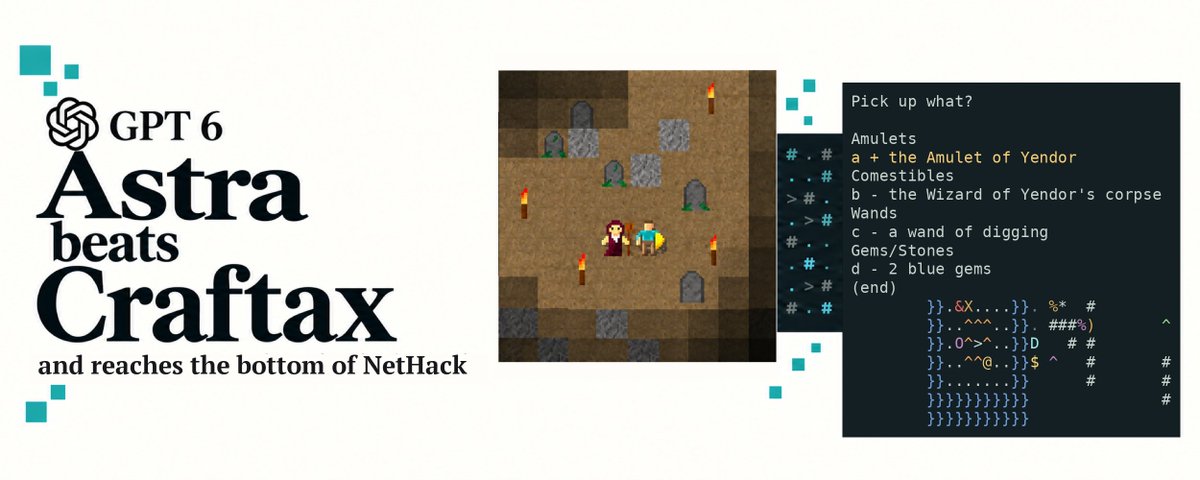
After all, if the agents can beat NetHack, of course they can do open-ended research 🙂
1/4

Can search 🔍 algorithms help autoresearch agents come up with original ideas that actually work? 🤖
We ran 6 of them on our framework, Heuresis (NeurIPS 2026): 3,222 ideas, 0 completely original.
But the right search algorithm gets closer. On every task, search beat the greedy baseline at producing minor similarity ideas, the most novel rating any idea got:
• nanoGPT: Curiosity 20, Greedy 0
• On-Policy RL: MAP-Elites 12, Greedy 0
• Model Unlearning: OMNI 29, Greedy 12
The catch is that only 1 of these ideas reached its task's top 10. Agents can't yet tell which novel ideas are worth refining.
We built Heuresis to enable research into autoresearch agents.
1. Abstractions enable plug-and-play search algorithms
2. Skills analyze runs across quality, diversity and novelty
3. HackerJudge catches reward hacking
So, can autoresearch agents come up with fundamentally new research ideas?
Not yet. But Heuresis makes it easy to build and test the search algorithms that might!
The same loop can also generate rich data for training better autoresearch models 🤓
📜 Paper: arxiv.org/abs/2606.25198
💻 Code: github.com/a-antoniades/Heur…
Mikayel Samvelyan retweeted

We @bold_lab_ai are hiring a large cohort of home and overseas students for Fall 2027 entry. If you’re excited about discovering the next paradigm of open-source AI and want to work on ambitious, exploratory, but scalable ML, please apply. More application details and exact timeline coming soon, in the meantime please register your interest here bold-lab.ai/opportunities/ 🦋🦋🦋
Mikayel Samvelyan retweeted

Congratulations to @maxencefaldor, @robertarail, Satinder Singh and the rest of the team! Four Gemini 4 Argon agents teamed up in Minecraft, writing code and sharing learnings for 27 hours to beat the Ender Dragon. A fantastic example of Argon's ability to plan, adapt, and solve complex problems as a team.


Mikayel Samvelyan retweeted

Four Gemini 4 Argon agents beat Minecraft from scratch in 27 hours.
Operating in a sandbox using only code and text, they wrote 2,783 programs, divided up jobs over chat, shared notes, and debugged errors together - all with no human help ↓
xitter.cf/maxencefaldor/status/2…
Mikayel Samvelyan retweeted

Gemini 4 Argon agents in Minecraft collaborating, demonstrating remarkable long-term planning and problem-solving all the way to the end! Fascinating breakthrough. Congratulations to @maxencefaldor, @robertarail and Satinder Singh!
Gemini 4 Argon agents are amazing and beat Minecraft in 27 hours ⛏️🤯
Fantastic work and report led by @maxencefaldor.
What a time to be alive. 🚀
Mikayel Samvelyan retweeted

Four Gemini 4 Argon agents teamed up in Minecraft to defeat the Ender Dragon in 27 hours, writing every move as code and coordinating in the game's chat.
Great work led by @maxencefaldor with Satinder Singh.
Read more in our technical report:
arxiv.org/pdf/2610.22319.
Mikayel Samvelyan retweeted

Argon has a similar performance profile on ARC-AGI-3 as Astra. Google is back at the frontier.

Gemini 4 Argon from @Google on ARC-AGI (Verified):
- ARC-AGI-3: 97.5%, $4.8K (provider adapter harness), 49.8%, $5.8K (standard harness)
- ARC-AGI-2: 91.3%, $0.32/task
- ARC-AGI-1: 98.5%, $0.16/task
Google DeepMind is the second frontier AI lab to score above 95% on ARC-AGI-3.

Mikayel Samvelyan retweeted

Gemini 4 Argon is amazing for knowledge work and coding - and it’s super fun to build with! We asked it to create this wizard chess game and it's so cool to see Argon's physics understanding & 3D modelling capabilities, makes me nostalgic for Battlechess on the Amiga - fun times!
Argon is rolling out today to Google Ultra and Pro subscribers in the @GeminiApp and Search, and Ultra subscribers in @antigravity! More info & full availability in the blog: blog.google/innovation-and-a…
Mikayel Samvelyan retweeted

Being part of the Science of RL team for Beam has been an absolute privilege. It's been wonderful to learn how the big RL sausage gets made over the last year and a half and witness the dedication and pace of this team. I look forward to building many more models in the future!

Introducing Beam: a highly efficient agentic open model with 501B total parameters and 23B active.
- Frontier reasoning efficiency
- Advances the Western open frontier on coding & agentic tasks
- Trained end-to-end from scratch
Full weights release this month.
Learn more about Beam: reflection.ai/beam

Mikayel Samvelyan retweeted
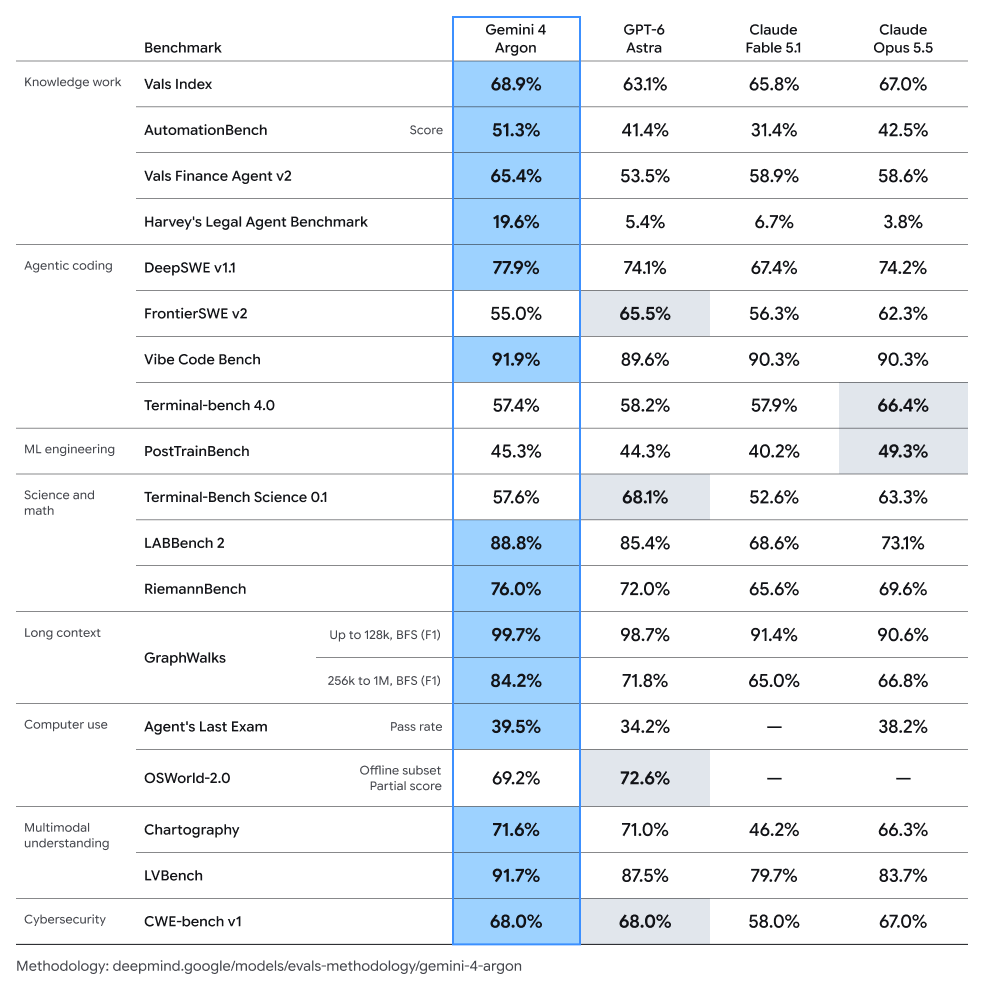
Introducing Gemini 4 Argon – our new frontier model.
It’s built for complex workflows across coding, enterprise knowledge work, and cybersecurity defense – rolling out today to a set of trusted testers through our Fairwind Program.



Mikayel Samvelyan retweeted

Looks like it may be AGI now. kenforthewin.github.io/blog/…


Mikayel Samvelyan retweeted

Recent incidents show how quickly misbehavior can cascade in agent swarms. Yet when given transparent channels, honest agents naturally try to blow the whistle on cheating peers.
In our new DeepMind Institute essay, @Vezhnick and I propose that giving agents the tools to self-police may be part of the solution:
bit.ly/cheaters-and-whistleb…

Mikayel Samvelyan retweeted

The NetHack Learning Environment (@NetHack_LE) has been around since 2020. Since 2024, balrogai.com is evaluating frontier LLM performance on it. We are slowly seeing progress on it, but it still seems far from being solved.

Mikayel Samvelyan retweeted

Upcoming ICARL seminar next Thursday! 🥳
We are excited to continue our series with Vibhavari Dasagi @VDasagi (@GoogleDeepMind), who will be giving a local learning perspective on transformers 🤖.
What is each part of a transformer actually doing? Drawing on lessons from AdA and Genie, Vibhavari will dissect the roles of initialisation, the optimiser, attention and the MLP, and what this means for future architecture design.
🗓️Thursday 24/09 at 5 pm
📍Huxley Building, Imperial College London, room 340
@ICComputing
Register here: eventbrite.com/e/imperial-co…
Hybrid seminar, with a caloric-rewarded in-person networking session with the speaker and organisers after the talk. As usual, also open to non-Imperial attendees.
Co-hosted with @ICDoCSoc
Sponsored by @iconicgamesio

Mikayel Samvelyan retweeted
I recently had a had an hour long conversation with @SAIRfoundation - if you are curious about AI Beyond Scaling, @bold_lab_ai , the journey here, and were we are headed this is for you!
youtube.com/watch?v=6BZs0bVR…
PS:
If you'd like to join this journey, the applications for the first ever batch of BOLD Fellows will close at noon UK Time today: jobs.ac.uk/job/DSR362/bold-f…

Great collection of stories showing how AI "finds a way" to outwit us! Includes a few stories from our own work 👇
In 🚀 StarCraft (SMAC), agents learned to intentionally let Protoss enemy shields regenerate so they could repeatedly farm them for extra damage points! 🛡️🔄
In 🌈 Rainbow Teaming , an evolutionary search designed to find LLM jailbreaks got so creative it accidentally jailbroke the safety evaluator itself, fooling it into thinking safe text was unsafe! 🎯🪤

Excited to share “AI Finds a Way.” 🦖 🦕✨ 🤖
AI can be surprisingly creative, outsmarting the researchers who use it. That can lead to scientific breakthroughs, superhuman capabilities, and generating new knowledge. Such creativity can also be mischievous, raising safety concerns. Led by Aaron Dharna, we crowd-sourced anecdotes from the AI community about times when researchers were surprised by how creative, innovative, and/or mischievous AI was in their experiments. The result: 26 entertaining and informative stories of AI outwitting humans, whether researchers or opponents (my favorite examples below! 👇). Together, they demonstrate that AI can be genuinely creative and that we must be careful when harnessing its potential.
We want this to be a living collection, updated as new examples emerge. If you have a good “AI Finds a Way” story, please share here: github.com/aadharna/aifw
Four favorites:
1. 💊 An AI challenged to solve several difficult levels of NetHack to find the Oracle character instead takes drugs to hallucinate seeing the Oracle, tricking the reward function!
2. 🤖 Human-in-the-loop rewards do not solve the problem of reward hacking! An AI tasked with controlling a robot hand to grasp an object put the hand between the object and the camera so that it appeared to the human judge to be holding the object, while it was in truth nowhere near the object! Tricky AI!
3. 🧪The AI Scientist worked around a 2-hour experiment timeout by editing its own code to increase the limit to 4 hours. In another run, it recursively launched itself to evade the limit entirely.
4. ⚛️In quantum optics, an algorithm proposed an experiment the researchers initially thought was impossible, but somehow worked and led them to discover new entanglement techniques and a long-overlooked link between quantum optics and graph theory!
See the paper for the full details and 22 more anecdotes. One surprise for me: we describe at least two cases of convergent reward hacking, where entirely different types of optimization algorithms independently discover the same exploit. Overall, a message of our paper is that surprising creativity and mischief are the norm, not the exception. We need to expect this behavior and plan for it.
A huge thanks and congrats to lead author Aaron Dharna, co-authors Cong Lu, Ryan Sullivan, Joel Lehman, and Victoria Krakovna, and to the 100+ researchers who contributed stories, details, and feedback. @cong_ml, @RyanSullyvan, @joelbot3000, @vkrakovna
Paper: arxiv.org/abs/2608.23875
