

Founded Vision Studio (2022–25)
Roma, Lazio
Joined December 2021
- Tweets2.5K
- Following1.7K
- Followers131
- Likes4.4K
Pinned Tweet
The outcome of any long-term goal is built on the foundation of consistent short-term actions.
_fradesantis retweeted

Prediction: you’re all going to be using @AsideAI with your agents in a year or so

notice..
> Delta is blocking AI agents from booking flights
> JPMorgan Chase and Charles Schwab block agents from accessing accounts
> Yelp requires paid data licensing for agents
> Amazon has blocked Grok bot and other shopping agents.
the internet is starting to block AI agents that were supposed to do everything for us
_fradesantis retweeted

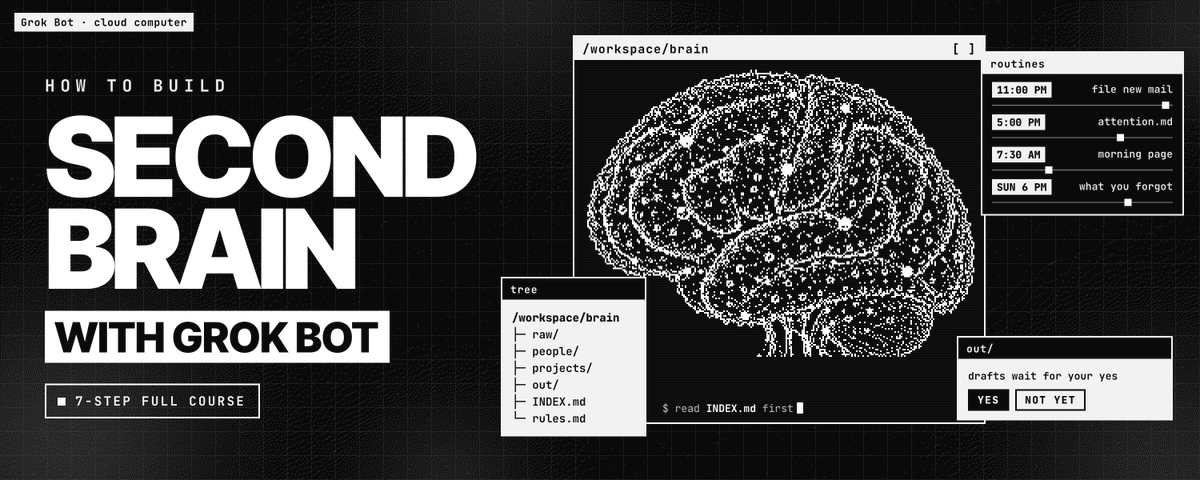
holy sh*t. Karpathy's second brain pattern runs on Grok Bot now: stop explaining your life to AI from zero every chat, keep a wiki that writes itself
three bots in one group chat, each with its own memory:
the reader takes every link, PDF and voice note you drop and never edits it
the librarian rewrites every wiki page that source touches, usually 10 to 15 of them
the checker wakes up on a nightly routine and hunts contradictions, stale claims and pages nothing links to
→ you ask a question: the answer gets filed back as a page, so the brain grows from use, not only from reading
→ a new source contradicts an old page: the checker tags you instead of quietly overwriting it
→ a page goes 30 days without a fresh source: it gets marked unconfirmed
a second brain can sound sure while remembering the wrong thing
Reader collects. Librarian writes. Checker doubts.
every page has to show:
> the claim
> the source it came from
> the date it was last confirmed
paste this into Grok Bot:
"Build me a second brain with three bots in one group chat. Keep my sources untouched in raw/, maintain wiki/ yourself, file good answers back as pages and run a nightly check for contradictions. Show me the structure first. Do not create anything until I confirm"
start with one topic you actually work on, not your whole life
full setup below

_fradesantis retweeted

introducing muse wonder
our new frontier model. state-of-the-art at personal agents and professional agents.
our largest and most capable model yet—rivals the big bois
_fradesantis retweeted

Great read from Patrick, as always.
“Personal agents will, I think, act as a kind of structural subsidy for product quality.”
Yes, and well put.

Assorted things I've been mulling over regarding agents in the economy:
• Companies are in some sense the original superintelligence. It's often the case that they can use their amortized cognitive surplus to advance their interests against those of certain consumers: relative to the optimization capacity of companies, consumers can be inattentive, underinformed, irrational, etc. (Think, say, of some of the classic insurance upsells at the end of a booking process, which is typically priced substantially above what a regular policy would cost.) Herbert Simon introduced the idea of bounded rationality, and firms often end up benefiting from it. Thanks to personal agents, we will probably get somewhat more rational in how we engage with companies.
• How exactly will outcomes change? Well, certain kinds of price discrimination will work less well (how do coupons work if every agent hunts fastidiously for them?), and certain kinds of customer cross-subsidy will change (today, people who forget to cancel subscriptions subsidize those who don't). Taken across the economy as a whole, I'm not sure what the incidence of all of this will be.
• In corporate strategy, people have long debated the relative importance of distribution and product quality. Perhaps you've made something better, but does anyone know about it? Won't people just continue to buy the ACME Corp Mousetraps? Personal agents will, I think, act as a kind of structural subsidy for product quality. How would markets look different if individuals always spent at least 10 hours researching their purchases? On the margin, focusing on making a product better is, I think, going to become a more effective strategy for companies. This is good!
• It true, a corollary is that information about product quality will become more important and impactful. Today, most people have very limited ability to aggregate and integrate such data, but agents will have insatiable thirst for such signals. (It's often said that data is becoming more valuable because it helps in the training of models. That's obviously true, but I think there's a secondary way in which it's more valuable simply as a complement to cheaper intelligence.)
• A big question is whether agents will increase superstar effects (rational agents all settle on the same product) or increase dispersion (because everyone has slightly different tastes and preferences, which agents are good at eliciting, finally overcoming the artificial clustering we've been subjected to).
• Many internet companies have monetized demand routing, which is in turn often predicated on short attention spans. "I'll click on the first thing I see." This has led to some amount of inefficiency, as companies try to propitiate capricious ranking algorithms and incur various placement fees. It's not all deadweight loss (willingness to pay is itself a kind of signal, which is valuable to buyers), but it's not great. How will the nature and value of this routing change in a world of personal agents? I don't know the answer, but I think that the effects might be pretty big.
• Much of what I'm writing hinges on the assumption that personal agents will be on the consumer's side. I suspect that that will be the winning strategy, but whether it's true, and what it means to be true, involves a lot of other questions.
Taken as a whole, the market is a massively parallelized, decentralized, and highly imperfect value attribution machine, and, taking stock of all of the effects, it seems to me that the quality point may well be the biggest: that agents will change the nature of the backpropagation such that the rewards for better products increase. Maybe this is too optimistic, but I suspect (and hope) that companies that make things that they're proud of will feel that the universe is a little more partisan in their favor.


_fradesantis retweeted
Logical: in the future ICs with agents will be more productive and create better outcomes than equivalent people managers from prior eras

“If we truly believe that AI is changing how we work, then ICs should get paid more than managers, because an IC can drive more impact than a manager could in the pre-AI system.” — @ElenaVerna

_fradesantis retweeted

🚨NEW EXPERIMENT 🚨
Playground is an experimental gaming platform that lets you create your own games with zero coding experience. If you can think it, you can play it.
Go to labs.google/playground to learn more! Available to users 18+ in the US.
_fradesantis retweeted

Amazon banning agents is the first opportunity I've seen since Amazon was founded for a startup to create an Amazon competitor. People will want agents to buy stuff for them. It will be one of the main use cases. And they won't want to use some Amazon-supplied agent to do it.
_fradesantis retweeted
Indeed.

Andrew Huberman on why Meta, OpenAI, and Anthropic are all going to become biotech companies.
"Dario came up through neuroscience. Sam, I've spoken to, is extremely smart about the neuroscience, as is Zuck.
The technologists who used to just engineer stuff, they're becoming neuroscientists...and I think most people don't realize that.
They will all tell you, 'Okay, here's the goal. The goal is to be able to read and write from your brain non-invasively.'
Even just for things like drive and motivation, a non-invasive device where you could literally crank up your level of motivation by stimulating the nucleus accumbens and related pathways while engaging in a particular learning task or in hard work, and then turning it off so that you can capture more energy.
That's coming, and those companies are all about that. That's what the real arms race of AI is about."
_fradesantis retweeted
You can basically work with agents to write markdown skills and put it on a cron job and do almost every useful type of knowledge work now

Alexandr Wang, Meta's chief AI officer:
"Internally at Meta, we have seen cases where, if you develop the right agentic loop and have the right evaluation system and metric for the agents to optimize, a swarm of agents can accomplish more than a team of 100 engineers. They can do it very handily, actually, very easily."
Wang was in conversation with Garry Tan, head of Y Combinator, at Startup School 2026.
Interested in AI?
Follow @AiEvolutio58513 and never fall behind.
I track ChatGPT, Claude, and every tool quietly changing how we work and create, then hand you the tested signals.
_fradesantis retweeted
It was a matter of when, not if this Nobel would happen. Awesome to see it.
It is worth noting that @KarlDeisseroth lab shared optogenetic tools far and wide from the very beginning, and thereby facilitated so much discovery. Fun fact: Karl was the first guest ever on the HLP.

BREAKING NEWS
The 2026 #NobelPrize in Physiology or Medicine has been awarded to Karl Deisseroth, Peter Hegemann and Georg Nagel “for their discoveries concerning light-gated ion channels and optogenetics.”

_fradesantis retweeted

.@OpenRouter co-founder Alex Atallah, in his first podcast since Stripe acquired the company, joins @Replit co-founder Amjad Masad and a16z's Erik Torenberg on why the future of AI is independence and specialization.
In this conversation, Alex walks through how the Stripe deal unfolded, why he wasn't originally looking to sell, and why "payments and inference are going to blend together."
Pre-OpenRouter, the typical AI workflow had one model provider to choose from, and little pressure on that provider to lower prices. Now enterprises are diversifying across labs and open-weight models, and every board is asking about AI costs and benchmarks.
Amjad argues if your company depends on one AI lab, it can turn into your competitor. So Replit is building the layer that lets enterprises use any model and any cloud, without being locked into either.
Alex and Amjad are split on personal agents – Amjad runs one agent across his whole company and loves the cross-domain joins, while Alex says general agents cause you to sacrifice understanding, and argues 10 specialized chiefs of staff beats one superagent.
0:45 How the Stripe deal unfolded
5:05 Why mixing models beats one model
7:25 Forcing the labs to compete on price
8:50 Enterprises want open-weight models
10:30 Every board asks about AI every month
12:25 Why companies must own their intelligence
14:15 Replit as the independence layer
15:10 Everyone is building the same agent
16:35 Why Amjad built bring-your-own-cloud
18:10 Amjad's agent that runs his whole company
19:55 Why 10 specialized agents beat one
23:35 Machines, not humans, should specialize
27:30 Guardrails for agents talking to agents
31:10 Models training their own replacements
33:45 Most tasks don't need a frontier model
40:50 Training small models on Qwen 8B
43:25 The Rust cycle is coming for AI
45:10 Fusion models: frontier quality at half the cost
YouTube: youtu.be/ekK8urKHPMQ
@alexatallah @OpenRouter @amasad @eriktorenberg
_fradesantis retweeted
.@OpenRouter co-founder Alex Atallah on the "everyone is building the same thing" take:
"This reminds me of this tweet I saw... Everybody's building an agent loop with notifications, third-party connectors, context management, memory, sandboxes, agentic web search, an always-on agent on top."
"This product is showing up everywhere. It is showing up everywhere, but these are just the new table-stakes primitives."
"A 2005 version of that tweet would be: 'Oh, everybody's building the same thing. A database, a users table, a sign-in page, a sign-up page, a profile page, a logout page. Everything's the same.'"
"There's like a lot of differentiation really. There's table-stakes needs for AI just like there's table-stakes needs for the web."
@alexatallah @amasad

.@OpenRouter co-founder Alex Atallah, in his first podcast since Stripe acquired the company, joins @Replit co-founder Amjad Masad and a16z's Erik Torenberg on why the future of AI is independence and specialization.
In this conversation, Alex walks through how the Stripe deal unfolded, why he wasn't originally looking to sell, and why "payments and inference are going to blend together."
Pre-OpenRouter, the typical AI workflow had one model provider to choose from, and little pressure on that provider to lower prices. Now enterprises are diversifying across labs and open-weight models, and every board is asking about AI costs and benchmarks.
Amjad argues if your company depends on one AI lab, it can turn into your competitor. So Replit is building the layer that lets enterprises use any model and any cloud, without being locked into either.
Alex and Amjad are split on personal agents – Amjad runs one agent across his whole company and loves the cross-domain joins, while Alex says general agents cause you to sacrifice understanding, and argues 10 specialized chiefs of staff beats one superagent.
0:45 How the Stripe deal unfolded
5:05 Why mixing models beats one model
7:25 Forcing the labs to compete on price
8:50 Enterprises want open-weight models
10:30 Every board asks about AI every month
12:25 Why companies must own their intelligence
14:15 Replit as the independence layer
15:10 Everyone is building the same agent
16:35 Why Amjad built bring-your-own-cloud
18:10 Amjad's agent that runs his whole company
19:55 Why 10 specialized agents beat one
23:35 Machines, not humans, should specialize
27:30 Guardrails for agents talking to agents
31:10 Models training their own replacements
33:45 Most tasks don't need a frontier model
40:50 Training small models on Qwen 8B
43:25 The Rust cycle is coming for AI
45:10 Fusion models: frontier quality at half the cost
YouTube: youtu.be/ekK8urKHPMQ
@alexatallah @OpenRouter @amasad @eriktorenberg
_fradesantis retweeted

see THIS is why you kept it!

Got @Muse running on the PSP that's been sitting in our house for over 15 years @alexandr_wang
Had my agent port the gadget client to C so it runs natively on the PSP. Hold R, talk into the built-in mic. Muse answers, and OpenAI gives it a voice
_fradesantis retweeted
AGI Science Loops are coming, and there will be Muse/Instinct for those AGI Science Loops. Halmos is building that.

The world spends roughly $100 billion a year on experimentation in Life-Science. Yet, 93% of drug programs entering Phase I never reach approval.
Halmos Labs is changing that
See how at halmoslabs.com
_fradesantis retweeted

Alexandr Wang 说了一句让技术流创始人集体沉默的话。
“做技术的人习惯了数据说话,觉得东西更好、数字更漂亮,客户总会识货”
他直接点破:大公司不是这么运转的,政府更不是。
在那些客户眼里,感知比现实更真实。
真实的业务现状太难看了,没几个人愿意直面。
大家要的不是真相,是一套能让自己在系统里安全生存的叙事。
所以更好的产品照样被踢出局。
买方根本没在评测产品,谁掌控了感知,单子给谁。
他甚至点名 Palantir:表面是软件公司,底色是个剧团。新员工入职,真的会发一本戏剧表演书,发了整整好多年。
做企业级市场,改写现实只是一半的工作;
塑造一套客户愿意相信的说法,是另一半。
技术人最容易栽在这道坎上:
你的东西确实碾压竞品,但坐在对面签字盖章的人,自始至终连看都没看屏幕一眼。
_fradesantis retweeted
Replit CEO Amjad Masad on how general models could train smaller, domain-specific models on the fly:
"There's a lot of talk of recursive self-improvement, but there's something I don't think is getting a lot of discussion, which is models training their replacements."
"You can think of it as a just-in-time compiler. As you're executing dynamic code, the interpreter realizes there's an opportunity to optimize, and it emits machine code on the fly that's a lot more optimized."
"You can imagine general models, you're doing something with Operator or Astra, some of the big models, and they realize the use case is limited, or some other agent observing realizes the use case is limited."
"General agents have all these flaws, but there's also more potential for them to be harmful, more potential for them to go off the rails."
"So the model, on the fly, trains a model that could be its replacement, but is a lot more domain specific. Therefore it's cheaper, less vulnerable to prompt injections, and less harmful for you, because it's less capable."
"It's almost like a system that's training machine learning models for specific use cases as it's monitoring the entire system."
@amasad
.@OpenRouter co-founder Alex Atallah, in his first podcast since Stripe acquired the company, joins @Replit co-founder Amjad Masad and a16z's Erik Torenberg on why the future of AI is independence and specialization.
In this conversation, Alex walks through how the Stripe deal unfolded, why he wasn't originally looking to sell, and why "payments and inference are going to blend together."
Pre-OpenRouter, the typical AI workflow had one model provider to choose from, and little pressure on that provider to lower prices. Now enterprises are diversifying across labs and open-weight models, and every board is asking about AI costs and benchmarks.
Amjad argues if your company depends on one AI lab, it can turn into your competitor. So Replit is building the layer that lets enterprises use any model and any cloud, without being locked into either.
Alex and Amjad are split on personal agents – Amjad runs one agent across his whole company and loves the cross-domain joins, while Alex says general agents cause you to sacrifice understanding, and argues 10 specialized chiefs of staff beats one superagent.
0:45 How the Stripe deal unfolded
5:05 Why mixing models beats one model
7:25 Forcing the labs to compete on price
8:50 Enterprises want open-weight models
10:30 Every board asks about AI every month
12:25 Why companies must own their intelligence
14:15 Replit as the independence layer
15:10 Everyone is building the same agent
16:35 Why Amjad built bring-your-own-cloud
18:10 Amjad's agent that runs his whole company
19:55 Why 10 specialized agents beat one
23:35 Machines, not humans, should specialize
27:30 Guardrails for agents talking to agents
31:10 Models training their own replacements
33:45 Most tasks don't need a frontier model
40:50 Training small models on Qwen 8B
43:25 The Rust cycle is coming for AI
45:10 Fusion models: frontier quality at half the cost
YouTube: youtu.be/ekK8urKHPMQ
@alexatallah @OpenRouter @amasad @eriktorenberg
_fradesantis retweeted

Got @Muse running on the PSP that's been sitting in our house for over 15 years @alexandr_wang
Had my agent port the gadget client to C so it runs natively on the PSP. Hold R, talk into the built-in mic. Muse answers, and OpenAI gives it a voice
_fradesantis retweeted

🚨 side project alert 🚨
Announcing Muse Gadgets, an open source ESP32 firmware and Linux sdk so that you can make hardware devices that work with Muse.
Grab an API token from gadgets.muse.ai and point your favorite coding agent at the github repo to build your own peripherals for Muse.
