Colorectal surgeon 🏥 | Building software between surgeries 💻 | Barcelona 📍 | Founder of @trialinx & @relaylit

Joined March 2026
An old ClinicalTrials.gov record can show 'not provided' for a field that didn't exist when the team registered the study. Check the registration date and requirements at the time before calling it a reporting failure.
6
Browser autofill can hide repeated work in a multi-step form. I'd test with it switched off and check whether people have to type the same details again.
9
If your app times out after taking a payment, the customer still needs a way to find out whether it went through. I'd test that recovery path alongside checkout.
8
A named clinician on a test order still needs someone to cover their inbox. I'd test result routing with that clinician off shift before calling the workflow ready.
8
Give an inbox-summary agent read-only access. If a malicious email tells it to forward private messages, the connector should block that action even when the model follows the instruction.
11
You can't infer how many participants had an adverse event from the total event count. One person can have several events. I'd look for both counts in a trial's adverse-event summary.
28
For an AI documentation pilot, I'd compare time to a finished note, including review and corrections, with writing it without AI. Timing the draft generation alone leaves out work the clinician still has to do.
19
In a study software demo, ask someone to correct a test value. Then try to reconstruct the change: old value, new value, who changed it, when and why. You should be able to do that without chasing the person who made the correction.
4
You can overestimate an imaging AI's accuracy when the same patient appears in training and testing. Keep repeat scans from one patient in the same group. I'd check patient overlap before reading the score.
5
A trial participant can stop treatment and still attend follow-up. I'd give those two statuses separate fields. One 'withdrawn' checkbox makes it hard to tell whether someone stopped the drug or stopped providing outcome data.
10
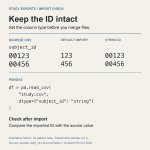
Before you merge study exports, check the ID column. Import 00123 as a number and you get 123. In pandas, set the ID dtype on read_csv, then compare the imported value with the source.
9
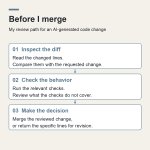
I want to see the diff before I merge an AI-generated change. A summary of what the agent meant to do leaves me guessing what it changed.
4
Organ-on-a-chip won't replace animal studies just by winning a hype cycle. It has to produce data regulators trust — and that's a scientific problem before it's a technology problem.
12
Genetic validation gets a target to the front of the queue. The Lp(a) trial is a reminder: predicted risk reduction still has to survive contact with patients.
18
A medical AI can ace multiple-choice exams and still fail the bedside test. If it never has to weigh conflicting evidence or say “I don’t know,” we measured fluency—not clinical judgment.
19
Forty-four new drugs in three quarters sounds like volume. The better question is how many changed the map: 18 novel mechanisms, 20 differentiated follow-ons, 6 me-toos. Launch counts hide what actually moved.
16
AI can turn a wearable's number into a story. The hard part is knowing whether it's the patient's story — or just a fluent guess about what changed.
30
If a common shoulder operation is no better than placebo, the problem isn't just the operation. It's the pathway that made it routine.
24
If hospital AI adds $942M in two years, we don't have a model problem. We have a workflow problem: the task got automated, but the work around it didn't.
29
Every trial runs on two protocols: the one in the binder and the one the coordinator actually runs. The gap between them is where your data quality really lives.
1
39