

Development Finance| Inclusive business advisor | Market Systems Development | Financial Inclusion Advisor.
Nairobi, Kenya
Joined July 2014
- Tweets38.6K
- Following1.2K
- Followers1.2K
- Likes16.9K






_Chumba retweeted

I've been running this Firm for a decade now, and I have never seen the dust I am seeing now. Gaddem!! Clients hawana pesa, insurance firm ndio hizo zinafungwa, clients who run industries are closing down, hakuna mtu ako na float.... Holy fudge!! Kila mtu analia tu.
_Chumba retweeted

The Finance Bill protests were citizen-led. I think electoral accountability should also be citizen-led, and that is why we built @KuraHuruHQ
Let's take back our power as Kenyans today. Help verify the polling stations you will use in your area of voting.
kurahuru.org/verify
_Chumba retweeted

Problem with a lot of Kenyans is that they are generally extremely ignorant about the economic realities of the country. More than half of our debt is domestic debt, the financial crisis we’d have in the country would be unconscionable. Creditors (incl pensioners) would be finito

_Chumba retweeted

Edwin Sifuna's quest for presidency seems to be awakening tough conversation, and majority question his presidential plan on the current crisis Kenya is in. One thing notable is that even those against his politics appear to be placing hope in him to restore the country.
The attention being paid to Sifuna's utterances on a daily basis is more than that being given to the current president and the regime. It's interesting, though, how a presidential hopeful is being questioned of his leadership "plan" more than how the president is being questioned of "his term" & regime performance.
_Chumba retweeted

Outtastraight Lamu with the Lamu Women For Sifuna. Even when with H.E is outside the country, his wave remains maneuvering.
#LamuWomenForSifuna
_Chumba retweeted

A Kenyan court ruled that the government had breached parts of the constitution in allowing the construction of a US-backed Ebola quarantine facility at a military air base in central Kenya, a project that has sparked deadly protests reut.rs/4AcCEfz

_Chumba retweeted

2024 protests gave rise to a funny group of revolutionaries. When the executive utilises the police to abduct people, we ask the presidency to respect the constitution and rule of law. When another candidate says public debt has to be repaid, suddenly he's bad.

Let me start a problematic discourse that I know will put me in the crosshairs of SODF, but one I feel compelled to initiate nevertheless.
Yesterday, I joined on Zoom the town hall Sifuna held with Gen Z pale Yues. I had asked my friend John to raise some questions about odious debt and what would happen to those who have stolen public monies for far too long. He didn’t quite get to ask them, but the questions came up anyway through other attendees, seeing that many Kenyans share similar concerns.
On the question of associating with people who have allegedly plundered our country since independence, whose questionable accumulation of wealth, tax evasion and irregularly awarded tenders, some of which were outright swindling schemes, are an open secret, Sifuna responded by saying that he would govern on the principles of the rule of law and constitutionalism, which are two distinct concepts.
He also spoke extensively about property rights as a key determinant of investor confidence in a country, on which he is absolutely right. However, he invoked the same property rights argument to say that we cannot simply accuse people of stealing from us without evidence. We must take them to court and prove that they did, in fact, appropriate public money and property.
Secondly, on odious debt, he argued that declaring some of our debt odious would have serious repercussions for Kenya within the international financial system. He would instead pursue those who stole or misappropriated the borrowed funds.
I am not sure if you guys see the conundrum here. If he cannot establish sufficient evidence against those who plundered public resources, which will obviously not be easy given decades of institutional capture, they could walk away scot-free. Meanwhile, we cannot repudiate the debts incurred through that very plunder for fear of upsetting the capitalists in New York and the Bretton Woods institutions.
So the people who allegedly stole retain their wealth, the creditors get their money, and the ordinary Kenyan is condemned to servicing debts from which they derived little or no benefit.
My question is simple, where does justice for the Kenyan taxpayer feature in this equation of rule of law and constitutionalism? We cannot use the law to protect organised gangsters both at home at abroad. @edwinsifuna your response will be appreciated, not just for my benefit but for all Kenyans.


_Chumba retweeted

This is the commitment of the Linda Mwananchi Movement (LMM) Party and H.E Edwin Sifuna to the Kenyans in the Diaspora.
_Chumba retweeted
I think Edwin Sifuna represents more hope to majority of his critics than his supporters. Because how can you criticize Edwin Sifuna for not urgently saying what he will do to sort the challenges kenya is facing and at the same time still claim to support the President who's had time to sort out that mess but has not yet ?
It is legitimate that a presidential candidate must eventually outline a clear plan for his people, which is a robust process but do you want to mean Sifuna's impeding plan is more important than Questioning the Presidents current ability to do things??
The current regime has resources, millions of advisors, majority numbers in Parliament to pass key bills, all taxes are their disposal(NT), all powers are with the current president, why is the economy struggling to reflect peoples lives, why is education unstable, why is health care in shumbles , why are Kenyans broke?Why are majority of old and fresh graduates unemployed? Why is debt ballooning with no tangible ground results? WHY is unemployment rate high than before 2022? Fundamental questions that should be directed to the current regime.
_Chumba retweeted

Respectfully, I disagree. The foundational purpose of any state includes protecting property rights and upholding the rule of law. You cannot simply abrogate sovereign obligations to yourself without due process and expect the system to hold. Sifuna is right on that.
Most sovereign debt is rolled over as it matures. Whoever is buying Kenyan paper today is typically coming in with clean hands, deploying capital earned from their own sweat or their clients’. Refusing to honour those claims does not magically recover what was allegedly stolen years ago; it just punishes current holders and destroys Kenya’s credibility.
The proper remedy is precisely what Sifuna outlined: pursue restitution from those who misappropriated public funds, apply compound interest where proven, and use those recoveries to service or reduce the debt. Leaving the alleged looters scot-free while defaulting on creditors is not justice—it is selective.
Unilateral refusal to pay, outside any recognised legal process, will expose Kenyan assets abroad to attachment and enforcement actions. That is not theoretical; it is how cross-border debt enforcement works. It is a self-inflicted wound.
Our sovereign credit rating is built on the assumption that duly acquired debt will be honoured. A default (or even a credible threat of selective repudiation) would be far more expensive in higher spreads, lost market access, and reduced investment than the status quo. The ordinary Kenyan pays for that too.
Two further points: the odious-debt doctrine is not settled international law and has almost never been successfully applied unilaterally by a court or by markets. And many of these borrowings financed projects with at least partial public benefit, so cleanly isolating the “stolen” portion after the fact is extremely difficult. The realistic path remains better governance, aggressive recovery of misappropriated funds, and fiscal discipline—not repudiation.
@edwinsifuna @LindaMwananchi_
Let me start a problematic discourse that I know will put me in the crosshairs of SODF, but one I feel compelled to initiate nevertheless.
Yesterday, I joined on Zoom the town hall Sifuna held with Gen Z pale Yues. I had asked my friend John to raise some questions about odious debt and what would happen to those who have stolen public monies for far too long. He didn’t quite get to ask them, but the questions came up anyway through other attendees, seeing that many Kenyans share similar concerns.
On the question of associating with people who have allegedly plundered our country since independence, whose questionable accumulation of wealth, tax evasion and irregularly awarded tenders, some of which were outright swindling schemes, are an open secret, Sifuna responded by saying that he would govern on the principles of the rule of law and constitutionalism, which are two distinct concepts.
He also spoke extensively about property rights as a key determinant of investor confidence in a country, on which he is absolutely right. However, he invoked the same property rights argument to say that we cannot simply accuse people of stealing from us without evidence. We must take them to court and prove that they did, in fact, appropriate public money and property.
Secondly, on odious debt, he argued that declaring some of our debt odious would have serious repercussions for Kenya within the international financial system. He would instead pursue those who stole or misappropriated the borrowed funds.
I am not sure if you guys see the conundrum here. If he cannot establish sufficient evidence against those who plundered public resources, which will obviously not be easy given decades of institutional capture, they could walk away scot-free. Meanwhile, we cannot repudiate the debts incurred through that very plunder for fear of upsetting the capitalists in New York and the Bretton Woods institutions.
So the people who allegedly stole retain their wealth, the creditors get their money, and the ordinary Kenyan is condemned to servicing debts from which they derived little or no benefit.
My question is simple, where does justice for the Kenyan taxpayer feature in this equation of rule of law and constitutionalism? We cannot use the law to protect organised gangsters both at home at abroad. @edwinsifuna your response will be appreciated, not just for my benefit but for all Kenyans.
_Chumba retweeted
Kenya breached constitution by allowing US-backed Ebola quarantine site, court says reut.rs/4jajsaR
_Chumba retweeted

James Mulamba: As young people in the Linda Mwananchi Movement Party, we are proud to have an eloquent and articulate leader who can take our grievances to the highest table and ensure our voices are heard.
Host: @dennisaseto
GuestHost: @jkamanya
#TheSituationRoom
_Chumba retweeted

On odious debt, I think there's a fundamental misunderstanding.
A country's debt is not like a debt to a relative, which a family can forgive or argue over. It is a contract. Governments that Kenyans elected signed these loans, on terms Parliament sets by law. The debt binds the state, whoever governs next. Voting has consequences.
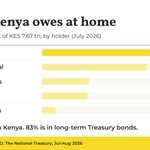
So unilateral default comes off the table. Abroad, the World Bank, the IMF and other multilateral lenders stop lending to any country in arrears to them, and bondholders can take us to court. At home, most of the debt sits with banks, pension funds and insurers, so a haircut would come out of Kenyans' own savings. When Ghana moved to cut what it paid local bondholders, its pensioners picketed the Ministry of Finance in 2023 until the government exempted them.
Where the local debt needs easing, the tool is longer maturities at market rates, which the Central Bank of Kenya already offers through voluntary switch auctions. A haircut backfires even where banks grew rich lending to the state. They rebuild with more government paper and lend even less to people, as Ghana's banks did after the cut. Savings stay tied up financing the state instead of the economy.
None of that recovers a shilling of what the country lost. The rule of law does, and it starts with proof in court. Where Kenya has evidence that a particular loan rests on fraud or a breach of the law, it should challenge that loan.
Kenya can pursue the people behind such a loan under section 55 of the Anti-Corruption and Economic Crimes Act, which works without a criminal conviction. Once the Ethics and Anti-Corruption Commission (EACC) shows a court that a corruption suspect's wealth outruns their lawful income, the suspect must explain it or forfeit its value. To find those suspects, the EACC needs to know where the money went. In my view the bulk of the loss sits in overpriced projects. An audit of every loan-funded project should set what Kenya paid against what the work was worth, and show the EACC where to look.
Constitutionalism is the rule of law's other half: power within limits. The Constitution makes the Auditor-General and the EACC independent and requires Parliament to fund them adequately. Officials who approve unlawful spending must make good the loss themselves. Property that a judge finds someone acquired unlawfully loses its constitutional protection. And under Article 211, either House of Parliament can demand any loan's details within seven days.
Those guarantees bite only when the Parliament we elect funds and enforces them. So voting has a second consequence: a voter needs no proof to remove a leader who will not.
To judge that leader, the voter must see what each loan says. But Article 211's seven-day demand belongs to Parliament alone. What the public can do is ask for the loan's terms, but the government can refuse, because the non-disclosure clause gives it cover. Project and contractor loans from China typically carry one. A study of 100 Chinese state loan contracts found a confidentiality clause in every contract signed after 2014 (AidData, How China Lends, 2021). The Attorney General's office cited such clauses to keep the Standard Gauge Railway contracts secret. The Court of Appeal ruled in May 2026 that they did not justify the secrecy, more than six years after citizens first asked. So the rule that follows is simple: Kenya signs no loan, from any lender, whose terms it cannot publish.
I made the wider case in June. The clauses are not only Chinese, and "if scrutiny is an analytical discipline rather than an emotional reflex, it should scale with opacity." canarycompass.com/p/friday-r…
Now try having that conversation with a "Pan-African": canarycompass.com/p/friday-r…

Let me start a problematic discourse that I know will put me in the crosshairs of SODF, but one I feel compelled to initiate nevertheless.
Yesterday, I joined on Zoom the town hall Sifuna held with Gen Z pale Yues. I had asked my friend John to raise some questions about odious debt and what would happen to those who have stolen public monies for far too long. He didn’t quite get to ask them, but the questions came up anyway through other attendees, seeing that many Kenyans share similar concerns.
On the question of associating with people who have allegedly plundered our country since independence, whose questionable accumulation of wealth, tax evasion and irregularly awarded tenders, some of which were outright swindling schemes, are an open secret, Sifuna responded by saying that he would govern on the principles of the rule of law and constitutionalism, which are two distinct concepts.
He also spoke extensively about property rights as a key determinant of investor confidence in a country, on which he is absolutely right. However, he invoked the same property rights argument to say that we cannot simply accuse people of stealing from us without evidence. We must take them to court and prove that they did, in fact, appropriate public money and property.
Secondly, on odious debt, he argued that declaring some of our debt odious would have serious repercussions for Kenya within the international financial system. He would instead pursue those who stole or misappropriated the borrowed funds.
I am not sure if you guys see the conundrum here. If he cannot establish sufficient evidence against those who plundered public resources, which will obviously not be easy given decades of institutional capture, they could walk away scot-free. Meanwhile, we cannot repudiate the debts incurred through that very plunder for fear of upsetting the capitalists in New York and the Bretton Woods institutions.
So the people who allegedly stole retain their wealth, the creditors get their money, and the ordinary Kenyan is condemned to servicing debts from which they derived little or no benefit.
My question is simple, where does justice for the Kenyan taxpayer feature in this equation of rule of law and constitutionalism? We cannot use the law to protect organised gangsters both at home at abroad. @edwinsifuna your response will be appreciated, not just for my benefit but for all Kenyans.
_Chumba retweeted

Sifuna is talking about how corruption on Kenya has gotten T unsustainable levels.
People steal way too much.
The first agenda for a Sifuna administration will be to eliminate corruption
Hii ya 2027, we will win!
_Chumba retweeted

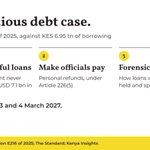
Odious debt is a legal doctrine, and the way out of a debt problem is not repudiation. It is process. This clip responds to a few folks who asked for my thoughts.
1. Count - One public register of every loan, securitisation, pending bill and guarantee, updated monthly.
2. Sort - An independent audit splits the debt into three buckets: lawful and well used, lawful but badly spent, and unlawful or tainted. Only the third is a legal fight, contract by contract, on evidence.
3. Enforce - Article 226(5) already makes officers who cause loss personally liable. Findings go public and get referred.
4. Negotiate - Stay current with bondholders, recover bribes from the sellers, and restructure from strength before it is forced from weakness.
5. Lock - No loan and no securitisation without prior National Assembly approval, published in full before any money moves.
Not a radical standard. It is the one the Constitution already sets.
More on Sunday on "The Second Order Brief" podcast: a full episode on debt and the financial instruments behind it, how they have worked in other countries, case studies, successes and failures, and what Kenya learns from here. New episodes usually go out at 5AM ET (1PM EAT).
For now, some yucky turkey and Thanksgiving football time. ✌🏾
#OdiousDebt #Kenya
_Chumba retweeted

NATIONAL DEBT FIGURES FROM @KeTreasury
Frame 1: Kenya's public debt in June 2022: Ksh. 8,687,534,000,000
Frame 2: Kenya's public debt in August 2026: Ksh. 13,470,000,000,000
Increase: Ksh. 4,782,466,000,000
N/B: We agreed to write it all out in digits, purely so the numbers keep their full weight. Wouldn't want anyone mistaking nearly five trillion shillings for pocket change.


_Chumba retweeted

While others may be trying to downplay our plans or suggest that we have no agenda, the truth is that we have a clear roadmap for addressing the challenges Kenya is facing. Our focus is on practical solutions, meaningful reforms and a better future for all Kenyans.
#Maraga27
