

free and opensource bitcoin data suite built by: @_nym21_ acc manager: @darkfost_coc https://xitter.cf/t.co/0xr76k037h https://xitter.cf/t.co/ZHpXq60EZS https://xitter.cf/t.co/qtnkl6XPh7 https://xitter.cf/t.co/dFhUB9oHUj
on-chain
Joined September 2026
- Tweets70
- Following4
- Followers522
- Likes160




Pinned Tweet
Live Bitcoin data, right inside @claudeai.
bitview has an MCP server: read-only tools for blocks, txs, addresses, mempool, mining and on-chain metrics.
No sign-up. No API key. Free forever.
mcp.bitview.space
It's time to keep an eye on the profits that could be realized now that Bitcoin seems to have shifted its momentum.
There is a large asymmetry between the unrealized profits of LTHs and STHs. On this chart, they are shown as a percentage of Bitcoin's market capitalization.
LTH unrealized profits are estimated at 38% of market cap, while those of STHs are only 1.8%.
This asymmetry is perfectly normal given that most of the supply is held by LTHs. However, unrealized profits for both cohorts remain fairly low.
Comparing LTH unrealized profits with their history, we can see that at 38% they are still at relatively low levels for now.
Probably still too low to trigger large-scale profit-taking.
Chart Link : bitview.space/charts/distrib…


bitview retweeted

added signal (markers) support
starting to run out of ideas for features to add, what else is missing ?
studio.bitview.space


presets are now also available in the sidebar, if you were a user of bitview.space you should feel right at home
studio.bitview.space


bitview retweeted
presets are now also available in the sidebar, if you were a user of bitview.space you should feel right at home
studio.bitview.space
Even though bitcoin:native has recovered well since its low of around $58 000 in June, capital in loss still dominates trading.
That said, the gap has narrowed significantly, and we can see a pattern that tends to appear in every correction.
Today, capital in loss is estimated at $633 billion, versus $449 billion in capital in profit.
Coming out of the last bear market, it took almost a year from the bottom for capital in profit to settle durably above capital in loss.
It's a phase in which the market shows some inertia before it manages to build a more decisive momentum.
Chart Link : studio.bitview.space/#chart=…

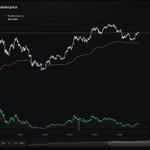
bitcoin:native continues to trade above the STH cost basis, i.e. the cost basis of holders who have held BTC for less than 150 days.
It is currently estimated at around $74 400 and is an interesting level where STHs could step in on the market if BTC were to come back and test their conviction. We can also see that it keeps rising: in mid-August it was at $67 000, a sign that STHs are accumulating as Bitcoin climbs.
On the other hand, the cost basis of STHs who are currently at a loss is $84 000, while the cost basis of STHs in profit is estimated at $70 500.
There is therefore a significant disparity among STHs, implying both realized profits and realized losses.
Chart Link : bitview.space/charts/distrib…

Bitview Signal indicates that Bitcoin has now entered an Early Bull phase after going through a bear market lasting nearly a year.
It is a metric built on an aggregate of indicators and signals, which are then mapped to fairly precise market phases, so you can see at a glance what is happening in the market.
Today, the smart DCA signal is still largely active, even though the best opportunities seem to have passed.

bitview retweeted
presets now browse-able in "All charts"
studio.bitview.space

Since August 19, realized profits have dominated bitcoin:native
The net 24h sum has stayed positive almost the entire time, with positive swings that at times exceeded $2B.
That seems sizable, but it is far from the peaks seen during this cycle, some of which exceeded $10B, again on a 24h basis only.
Today, profits still dominate but are significantly reduced, at $156 million in total. There is therefore nothing alarming in the profit-taking we are witnessing.
Chart Link : studio.bitview.space/#chart=…

Bitview Studio, in one minute.
Every chart in this video was made with it: search any on-chain series, write formulas, color anything by anything, stack, draw, measure, and share any chart as a link.
Right in your browser, no account.
studio.bitview.space

The next iteration of bitview.space is available in preview at:
studio.bitview.space
Try it out !

Miner activity has improved in recent weeks.
Hashrate has just moved back above 1 ZH/s after falling below 900 EH/s and below its annual average.
Hashrate per difficulty is still hovering around 950 EH/s.
This signals that miner activity is doing better and that the difficulty adjustment has allowed them to resume normal operations, which removes economic pressure that could push them to sell their BTC reserves.
Chart Link : bitview.space/c5f15111-9964-…

There has been a lot of discussion recently about the quantum threat, and even superintelligence, being able to break Bitcoin private keys.
Today, an estimated 35.3% of all Bitcoin addresses may be exposed to these risks.
These are the addresses that have revealed their public key, either because they have spent UTXOs (hashed script types), or because they reveal it by design, like P2PK or P2TR.
In short, one Bitcoin address in three is currently exposed to this risk.
What's curious is that since 2021, the trend has shifted from a steady decline since Bitcoin's creation to a continued rise.
Chart Link : bitview.space/charts/network…


Today I call upon the blockchain industry to calmly begin planning for "bunker mode". My personal recommendation is to set in motion a controlled mass migration of assets to fresh addresses, i.e. addresses whose pubkeys remain hidden behind a hash.
Holders, starting with large and sophisticated ones, should consider moving the bulk of their funds to addresses that have never signed a transaction. And when they do sign one, they should also move remaining funds to a new address (possibly generated from the same seed phrase).
Don't rush. While I believe there is cause for action a rushed migration would do more harm than good. Don't panic either. Moving assets to protected addresses is a simple, preventative step which does not require new cryptography or new wallets.
IMO it is now reasonable to brace for the possibility that ECDSA breaks before qday, in the worst case in months not years. By "break" I mean fast private key recovery (e.g. in one week) on available hardware (e.g. a large GPU cluster).
Recent days have been humbling for human mathematical intuition. Long-held, unquestioned hypotheses have fallen. This includes the n log(n) bound for integer multiplication and the 3SUM conjecture. In hindsight, May's unexpected disproof of the Erdős unit distance conjecture was our warning shot.
Yesterday's OpenAI drop made it clear that mathematical superintelligence is upon us. They say there are weeks where decades happen. We are about to live through weeks where centuries of mathematical progress happen. Could our magic 64-byte ECDSA signatures be too good to be true? Was it just security through obscurity all this time?
Elliptic curves feel especially vulnerable to superintelligence. Curves carry rich structure, with room for fancy tricks like Schoof, Frobenius, pairings. (By contrast, hashes are designed to minimise algebraic structure.)
Separately, as Ewin Tang can attest, an efficient quantum algorithm sometimes foreshadows an efficient classical one. We should be open to the possibility of a classical counterpart to Shor that breaks elliptic curves and RSA at once.
Also noteworthy is the striking under-representation of cryptographic breakthroughs among the 722 mathematical results OpenAI published. I've witnessed first-hand the US government censoring academic quantum cryptanalysis results. Backroom interventionism is my base case.
I urge large, sophisticated actors to lead by example. Project11's "risq list" (bitcoin-risq-list.projecteleven[.]com) is a great tracker of exposed BTC pubkeys. Binance, Bitbank, Robinhood, Bitfinex, and Tether have an opportunity to harden their cold storage. Next month I'll address institutions in London in a live Q&A (forum.ethereuminstitutional[.]org/london-2026).
Again, please do not rush. Wallets holding under 50 BTC enjoy partial cover from "Satoshi's shield", i.e. his 20K exposed addresses that hold 50 BTC each. Load-bearing signers like oracles and L2 security councils should consider rotating ECDSA pubkeys with every signed message and/or multi-signing with a hash-based schemes like SPHINCS.
Exiting bunker mode safely will require post-AI cryptography. My inclination is to go all-in on hash-based cryptography and avoid structured mathematical assumptions entirely, whether from curves, lattices, or isogenies. A single battle-tested hash (e.g. from the SHA or BLAKE families) yields plausible post-AI security.
The Ethereum roadmap on strawmap[.]org fully embraces hash-based cryptography with end-to-end formal verification as a response to the quantum threat. Those timelines must now be revisited and accelerated in light of mathematical superintelligence. I'll be pushing for maximum defensive acceleration.