

Research scientist @NVIDIA. PhD from @UCSanDiego. Real-time graphics and light transport. Also a painter (https://xitter.cf/t.co/dRpuV5IFKk). Own opinions.
Redmond, WA
Joined October 2013
- Tweets60
- Following577
- Followers272
- Likes414



Bing Xu retweeted

Today we introduce Open Math Model: open models and tools for mathematics.
Built for everyday research, shaped by the mathematical community, and developed in the open.
Read our co-founder Terence Tao’s blog:
terrytao.wordpress.com/2026/…

Bing Xu retweeted

Graphics Programming weekly - Issue 453 - August 30th, 2026 jendrikillner.com/post/graph…

We are looking forward to seeing you at the Light Transport session at #SIGGRAPH 2026 on Tuesday!
Check out our work with my mentor @marcosalvi, @tzumaoli , @BartWronsk @winmad4869 our labmates @sneezygiraffe, Cheng and Ravi! : A generalizable light transport 3D embedding for global illumination, where we learn light transport in a generalizable, scalable manner. lnkd.in/gsBpmCmy ⚽
#siggraph2026


Bing Xu retweeted

RIP David Hockney 🎨🕊️
The legendary British artist David Hockney has died aged 88, a representative has confirmed.
Hockney, who was due to turn 89 next month, died peacefully at his home in London on June 11th, 2026.
A spokesperson sadly confirmed, “The celebrated British artist David Hockney, one of the most important figures in contemporary art in both the 20th and 21st centuries, passed away peacefully at home on 11 June 2026, one month short of his 89th birthday.”
No cause of death has been revealed.
Bing Xu retweeted

youtu.be/Xolb8DcrbLc
The recorded EUROGRAPHICS 2026 talk for our wave tracing paper. Very honored that this paper received the Günter Enderle Best Paper Honorable Mention award.
Collaboration with Matt Pharr (NVIDIA).

Bing Xu retweeted

You can eat a good Utah teapot model? Here it is!!!! Thanks to @cem_yuksel graphics.cs.utah.edu/teapot/
Guard the tools to create high quality 3D. Otherwise we’ll end up in a recursive loop of low-quality input, low-quality output. Time for monthly donate

Last year, Autodesk made $315 million from mostly 3ds Max and Maya subscriptions. Over the same period, Blender made €3.1M, or 1% of Autodesk's earnings, despite having significantly more users.
This is the wrong way around.
Be someone that supports the next generation of creatives. Become a monthly donor: fund.blender.org/?utm_campai… (It's easy!)

Bing Xu retweeted

Did Blender help you this year? Help back!
If every active user contributed $5 this month, Blender would be funded for the entire year 2026. Professional 3D software. No subscriptions. No limits. Just your support.
Do your part. Donate today.
blender.org/news/give-back-t… #b3d

ALT Oti the penguin, showing a good example of "giving back".
Bing Xu retweeted

Announcing: New @Steam Hardware, coming in 2026:
Steam Controller
Steam Machine
Steam Frame
Watch our jazzy announcement video and wishlist now: steampowered.com/hardware

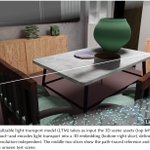
🌲Introducing our paper A generalizable light transport 3D embedding for Global Illumination arxiv.org/pdf/2510.18189.
Just as Transformers learn long-range relationships between words or pixels, our new paper shows they can also learn how light interacts and bounces around a 3D scene.
Building on the analogy of light transport operator and Attention, our fully scalable model learns a generalizable light transport 3D embedding that captures global illumination.
It takes as input the 3D scene assets—geometry, materials, and lighting represented as a point cloud—and encodes the complex light interaction into a 3D latent space, with codes anchored at the sampled scene points.
Remarkably, the model is independent of both viewpoint and resolution, enabling view-consistent rendering across diverse scenes. (See teaser and attention figure.)
(Our team work: with my mentor Marco @marcosalvi, labmates Mukund @mukundvermar, Cheng, NV folks Bart @BartWronsk, Lifan @winmad4869, and Tzu-Mao @tzumaoli & Ravi.)
🧵

We demonstrate the versatility of our framework by reusing a shared pre-trained encoder while introducing task-specific decoders. Using the same model, we accurately estimate diffuse global illumination that generalizes across diverse indoor scenes. With limited fine-tuning on a switched decoder, we further demonstrate preliminary results on glossy materials by predicting spatial–directional incident radiance fields, and explore extensions to jumpstart path guiding for unbiased global illumination.


By the way, we spent a lot of effort curating and will release a large-scale indoor dataset (∼14k
scenes) with diverse floorplans, geometries, and textures, serving as a benchmark for learning light transport.
Checkout the paper for further details! arxiv.org/pdf/2510.18189

Bing Xu retweeted

Physically Based Content irradiance.ca/posts/pbr/



Bing Xu retweeted

HDRView 2.5 is available! Lots of new features, including support for DDS textures and animated GIF/JXL/PNG files, a new animation/playback mode, new blackpoint/offset option when tone mapping, and many UI improvements.
github.com/wkjarosz/hdrview/….
#HDR, #HDRI, #dearimgui
