

Student of the market | Not an expert - just trying to understand the PSX puzzle 🧩
Joined June 2024
- Tweets4.8K
- Following1.5K
- Followers653
- Likes27.1K




Pinned Tweet
📢 Disclaimer
All stock related content shared here threads, insights, or opinions is for educational purposes only. This is not investment advice.
BOOM! 💥 THE CEO ISN'T DONE YET! 🔥
Aftab Ahmad buys another 50,000 #LSEVL shares @ Rs 12.20!
That's 8.59M shares accumulated in 2026 alone! 👀
👀 Potential NCCPL stake sale developments remain on the radar.
Bulls, tighten your seatbelts! 🚀


THE BUYING SPREE CONTINUES! 🔥
#LSEVL CEO keeps accumulating! 👀
📈 Nov 3: 357,743 shares
📈 Nov 4: 446,215 shares
💰 Another 803,958 shares!
Meanwhile, on Nov 5, #LSEVL itself bought 3.79M shares of #LSECL @ Rs 6 via NDM! 🦅
Something is cooking. 🚀


1
15
1,635
THE BUYING SPREE CONTINUES! 🔥
#LSEVL CEO keeps accumulating! 👀
📈 Nov 3: 357,743 shares
📈 Nov 4: 446,215 shares
💰 Another 803,958 shares!
Meanwhile, on Nov 5, #LSEVL itself bought 3.79M shares of #LSECL @ Rs 6 via NDM! 🦅
Something is cooking. 🚀
BOOM 💥 1 MILLION SHARES IN A SINGLE SWING
CEO isn't just buying 100k anymore.Aftab Ahmad snapped up 1M shares.
When the ultimate insider stops nibbling on the open market and starts clearing million-share blocks privately, you know the structural unlocks are imminent.
#LSEVL

Not actually @sulemaniya_ , but let's just pretend he's living out his corporate villain arc here 💀

1
5
533


OPEN YOUR BOOK retweeted
I’ve spent the last week dissecting #LSEVL's Corporate Restructuring Company (CRC) business—from 0 to 100.
I covered the hidden potential of distressed assets, the fastest monetization avenues, and how a CRC scales into a massive cash-flow engine.
Since my inbox is flooded with people losing track of individual threads, I’ve organized the complete 14-part series into a single master index below. 👇
The Core Premise:
When a company defaults, its balance sheet breaks—but the underlying assets don't vanish. There is real gold hidden under the bad debt: prime land, operating factories, machinery, and future cash flows.
As the famous market rule goes: "During a gold rush, don't dig for gold. Sell shovels."
A CRC licence is the ultimate shovel. It unlocks trapped value through a disciplined cycle:
Distress → Acquisition → Restructuring → Recovery → Monetization.
Here is your complete roadmap and master index across all 13 threads:

I’ve spent the last week dissecting #LSEVL's Corporate Restructuring Company (CRC) business—from 0 to 100.
I covered the hidden potential of distressed assets, the fastest monetization avenues, and how a CRC scales into a massive cash-flow engine.
Since my inbox is flooded with people losing track of individual threads, I’ve organized the complete 14-part series into a single master index below. 👇
The Core Premise:
When a company defaults, its balance sheet breaks—but the underlying assets don't vanish. There is real gold hidden under the bad debt: prime land, operating factories, machinery, and future cash flows.
As the famous market rule goes: "During a gold rush, don't dig for gold. Sell shovels."
A CRC licence is the ultimate shovel. It unlocks trapped value through a disciplined cycle:
Distress → Acquisition → Restructuring → Recovery → Monetization.
Here is your complete roadmap and master index across all 13 threads:
Want to see how the US, Korea, Ireland, Spain, and China handled distress?
Mark Twain: "History doesn't repeat itself, but cycles always rhyme."
→ Read #12
xitter.cf/_Iam_Pakistani/status/…
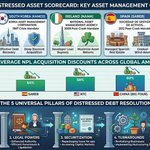
🧵#LSEVL THE INTERNATIONAL DISTRESSED-ASSET PLAYBOOK — 5 GLOBAL PRECEDENTS
From the US Savings & Loan crisis to South Korea, Ireland, Spain and China, major economies have repeatedly faced enormous NPL and distressed-asset crises.
Different countries.
Different institutions.
Different legal systems.
Yet the playbook kept repeating:
Acquire → Restructure → Recover → Monetize
Here are 5 major precedents.
Why does this matter?
Distressed-asset resolution isn't an untested theory.
It is a mature financial discipline that has been deployed across multiple banking crises and ultimately involved hundreds of billions of dollars of distressed assets.
The institutions differed.
But the economics repeatedly revolved around:
→ Buying at a discount
→ Centralizing recovery
→ Using specialized legal powers
→ Mobilizing institutional capital
→ Maximizing recovery value
🇺🇸 1. USA — RESOLUTION TRUST CORPORATION
1989–1995
The crisis:
US Savings & Loan collapse
RTC was created to resolve failed thrift institutions.
Scale
Approximately:
747 insolvent institutions
with roughly:
$394–400 BILLION
of assets.
Recovery
Approximately:
$395 BILLION
of gross proceeds/recoveries across the resolved asset pool.
Innovation
RTC helped develop large-scale secondary-market disposal mechanisms, including the packaging and securitization of distressed real-estate exposures.
The lesson:
Create a market for assets the banking system can no longer efficiently hold.
🇰🇷 2. SOUTH KOREA — KAMCO
1997–2002
The Asian Financial Crisis created a massive banking-sector NPL problem.
KAMCO acquired:
KRW 110 TRILLION
of distressed assets.
At an average discount of approximately:
63.8%
or roughly:
36.2 cents on the dollar
The result?
South Korea's commercial-bank NPL ratio fell from approximately:
17.0% → 2.3%
between 1998 and 2002.
KAMCO also pioneered:
→ Cross-border NPL securitization
→ Joint ventures
→ Institutional/private-capital participation
The lesson:
You don't need to hold every distressed asset until maturity.
You can create a market around it.
🇮🇪 3. IRELAND — NAMA
2009–2025
After the 2008 property and banking crisis, Ireland created:
National Asset Management Agency — NAMA
It acquired approximately:
€74.2 BILLION
of troubled real-estate loans.
Transfer value:
€31.8 BILLION
That's approximately:
57% below face value
NAMA subsequently repaid 100% of senior debt ahead of schedule and generated substantial surplus cash for the Irish state.
The lesson:
Buy distressed assets at realistic values, then maximize the underlying recovery.
🇪🇸 4. SPAIN — SAREB
Spain created:
SAREB
following the European banking and property crisis.
It acquired approximately:
€106.6 BILLION
of distressed real-estate-related assets.
The transfer involved a discount of approximately:
52.7%
and was funded through senior bank bonds.
Again, the same pattern:
Bank distress
↓
Assets transferred
↓
Specialized vehicle
↓
Centralized workout
↓
Gradual monetization
The institution became a mechanism for separating troubled assets from the core banking system.
🇨🇳 5. CHINA — THE BIG FOUR AMCs
China established four major Asset Management Companies, including:
Cinda
Huarong
Orient
Great Wall
to deal with large state-bank NPL portfolios.
The initial carve-out was approximately:
RMB 1.4 TRILLION
of distressed banking assets.
The restructuring approach also included large-scale:
Debt-to-Equity Swaps
Reportedly involving roughly:
RMB 400 BILLION
across hundreds of state enterprises.
The lesson:
Sometimes the optimal recovery is not liquidation.
It is turning excessive debt into sustainable ownership.
THE PATTERN ACROSS COUNTRIES
Look at the acquisition discounts:
🇲🇾 Danaharta → ~55%
🇰🇷 KAMCO → ~64%
🇮🇪 NAMA → ~57%
🇪🇸 SAREB → ~53%
The exact numbers differ.
But the broader principle is striking:
Distressed assets must be transferred at realistic risk-adjusted values.
Pay too much:
Recovery value ↓
IRR ↓
Capital gets trapped.
Pay the right price:
Margin of safety ↑
Recovery economics improve.
THE SECOND UNIVERSAL RULE
Governments didn't solve these crises simply by throwing money at banks.
The successful models also developed mechanisms to mobilize external capital.
Examples included:
RTC
→ Asset sales / securitization
KAMCO
→ NPL securitization + institutional investors
Danaharta
→ Structured funding
India's ARCs
→ Security Receipts
NAMA / SAREB
→ Structured debt funding
The recurring idea:
Use institutional capital to scale the resolution machine.
NOW BRING IT BACK TO PAKISTAN
Pakistan's CRC ecosystem is still in its early stage.
But the international playbook is already well established:
NPL problem
↓
Specialized resolution institution
↓
Discounted acquisition
↓
Legal / restructuring powers
↓
Institutional capital
↓
Corporate rehabilitation
↓
Recovery / refinancing / exit
The exact Pakistani model will be different.
But the economics don't have to be reinvented.
And that is why the emergence of #LSEVL as a licensed CRC is worth watching.
The real question is:
Can Pakistan develop its own private-sector distressed-asset industry—and can early movers capture the AUM, fees and recovery economics as it scales?
The next threads bring the global playbook back to #LSEVL's potential economics

1
2
62
The Grand Finale: LSEVL
After walking through the entire global playbook, only one question matters: What does this mean for LSEVL?
During an economic downturn, balance sheets break across every sector. Most investors run away. A CRC steps in with the institutional machinery and legal mandate to capture that value.
The real story isn't just that LSEVL holds a CRC licence. LSEVL isn't just digging for gold it holds the licence to manufacture and sell the shovels to the entire market.
Want to see how all 14 puzzle pieces connect directly to LSEVL’s future valuation?
→ Read #13
xitter.cf/_Iam_Pakistani/status/…
WHY #LSEVL? — THE CRC LICENSE IS ONLY THE BEGINNING
In high finance, a regulatory licence is only the entry ticket.
A licence gives you permission to operate.
It does not give you:
→ Deal flow
→ Bank relationships
→ Capital
→ Restructuring expertise
→ Turnaround capability
→ Institutional exits
So when evaluating #LSEVL, don't stop at:
"They have a CRC licence."
The real question is:
Who can actually execute?
FIRST: WHAT EXACTLY IS A CRC?
Corporate Restructuring Companies in Pakistan are specialized public limited companies regulated by SECP under the:
Corporate Restructuring Companies Act, 2016
Their purpose isn't simply debt collection.
The broader objective is:
Economic rehabilitation
→ Acquire distressed assets
→ Restructure debt
→ Rehabilitate businesses
→ Maximize recovery
→ Return capital to creditors/investors
THE ENTRY BARRIER IS REAL.
Under the Corporate Restructuring Companies Rules, 2019, CRCs face specific regulatory requirements.
Among them:
Public limited company
A private company cannot simply operate as a licensed CRC.
Minimum paid-up capital
Rs. 500 MILLION
Fit-and-proper / financial standing requirements
Promoters and directors are subject to regulatory eligibility requirements, including clean credit histories.
Relevant professional expertise
The framework requires suitable experience and competence in restructuring / financial matters.
So this isn't a business where anyone can simply wake up and start buying NPLs.
In 2016, the Corporate Restructuring Companies (CRC) Act was enacted to resolve Pakistan's bad debt.
Yet for years, it remained unoperational—hamstrung by tax friction, legal stay orders, and bank officer hesitation.
Between 2021 and 2024, the state quietly overhauled the entire architecture through the CRC Amendment Act and modern SBP/SECP guidelines:
Statutory Enforcement (Sections 6A & 6B): Sweeping powers to enforce security charges without traditional court drag.
Automated Asset Assignment: Clean legal title transfer via statutory Assignment Deeds, bypassing years of stay orders.
Tax Neutralities Unlocked: Exemptions from punitive transfer levies, creating friction-free balance-sheet carve-outs.
Pakistan has three licensed CRCs:
1. Pakistan Corporate Restructuring Company Limited (PCRCL)
2. Awwal Corporate Restructuring Company Limited (ARCL)
3. LSE Ventures Limited (LSEVL)
That's an extraordinarily small competitive universe for a market with roughly:
Rs. 1 trillion of banking-sector gross NPLs
Three regulated platforms.
One enormous distressed-credit pool.
PLAYER #1 — PCRCL
THE PARALYSIS OF THE FIRST MOVERS
Early entrants held a massive multi-year headstart, but fell into the classic First Mover Disadvantage.
The market's initial license holders suffered from structural stagnation
Formed in January 2020 by a consortium of 10 major commercial banks (HBL, NBP, UBL, MCB, ABL, Meezan, etc.) with Rs. 500M initial capital.
Paralyzed by inter-bank committee bureaucracy and conflicting lender agendas, they achieved virtually zero scale.
The ultimate proof of failure: In May 2026, the Competition Commission (CCP) approved the sale of 8 banks' shareholding in PCRCL to an industrial acquirer (United Ethanol), marking a complete retreat by the banking consortium.
The CRC landscape is therefore itself evolving.
PLAYER #2 — AWWAL / ARCL
Awwal Corporate Restructuring Company Limited is another licensed CRC operating within the emerging Pakistani restructuring framework.
Its sponsor ecosystem includes:
Pak Oman Investment Company
Entities backed by bilateral sovereign DFIs (like Pak Oman, a joint venture between the Governments of Pakistan and Oman) operate under rigid, civil-service risk aversion.
They lack the aggressive private-equity turnaround DNA and investment banking speed required to negotiate complex haircuts with defaulting industrial promoters.
A regulatory monopoly is worthless if management treats it like a museum piece.
While Rs. 1.0 Trillion in Non-Performing Loans (NPLs) remained locked in banking courts, the first movers sat on dormant licenses.
AND THEN THERE IS #LSEVL.
On:
January 27, 2026
LSE Ventures Limited obtained its:
SECP Corporate Restructuring Company licence
That alone isn't the thesis.
The thesis is what potentially sits behind the licence.
THE #LSEVL DIFFERENCE: CAPITAL-MARKET DNA
#LSEVL is part of the wider LSE Enterprises ecosystem.
Its leadership and affiliated companies span areas including:
→ Capital markets
→ Investment banking
→ Corporate finance
→ Financial-market infrastructure
→ Credit ratings
→ Custody
→ Commodity markets
→ Venture / SPAC structures
That matters because distressed assets don't live in isolation.
A successful workout may eventually require:
Debt + Equity + Valuation + Financing + Exit
The broader the ecosystem, the more parts of the transaction can potentially be handled internally or through affiliated platforms.
AFTAB AHMAD CHAUDHRY
CEO & Executive Director
Aftab Ahmad Chaudhry has held senior leadership roles associated with the Lahore Stock Exchange and Islamabad Stock Exchange and has extensive experience in Pakistan's capital-market ecosystem.
His professional footprint includes:
→ Exchange operations
→ Capital-market development
→ Deals advisory
→ Equity mobilisation
→ Structured investments
For a CRC, that experience matters because distressed assets eventually need:
Capital formation + transaction execution + monetization.
MUHAMMAD IQBAL
Chairman & Non-Executive Director
Muhammad Iqbal is associated with the establishment and leadership of BMA Capital, one of Pakistan's established financial-services groups.
The relevance isn't merely the biography.
A scaled CRC needs relationships across:
→ Commercial banks
→ Institutional investors
→ Corporate sponsors
→ Capital markets
→ Transaction counterparties
That is the ecosystem in which a distressed transaction gets sourced, structured and ultimately exited.
GOVERNANCE & FINANCIAL OVERSIGHT
The remaining board members add experience in areas including:
→ Audit
→ Financial reporting
→ Risk management
→ Corporate governance
→ Legal / fiduciary oversight
→ Industry relationships
That matters because CRCs handle other people's capital and highly sensitive distressed transactions.
Governance isn't optional.
It is part of the business model.
BUT HERE'S THE MOST IMPORTANT PART:
DOES LSEVL ACTUALLY HAVE DEAL FLOW?
So far, we should distinguish:
Completed public transaction
from
Disclosed upcoming pipeline.
We have not seen a publicly disclosed completed CRC transaction from LSEVL yet.
And that is important to acknowledge.
But the story doesn't stop there.
FEBRUARY CBS DISCLOSURE
LSEVL disclosed:
"Upcoming Corporate Restructuring Transactions"
including:
NFC Marketing — 2026
Big Bird Poultry Breeders — 2026
Grand Parent Poultry — 2026
Big Feed — 2026
Libra Engineering — 2026
Findtech T&D — 2026
GEIS Electric — 2026
Seven names.
Seven potential restructuring opportunities.
The next step is seeing which move from pipeline → execution.
The bullish argument is NOT:
"#LSEVL has a CRC licence, therefore it will become huge."
It is:
Pakistan is finally developing an institutional distressed-asset market, and #LSEVL may be entering at a stage where its capital-market ecosystem, management experience and disclosed pipeline could give it an opportunity to build a meaningful platform.
Now comes the only part that ultimately matters:
EXECUTION.
Licence → Deal → AUM → Recovery → Fees → Earnings
That's where the thesis becomes reality. #LSEVL

2
127