

We research the history of the German Democratic Republic and its enduring relevance for progressive movements today. Run by @ZetkinForum for Social Research.
Berlin, Germany
Joined February 2021
- Tweets1.6K
- Following207
- Followers6.1K
- Likes822






Pinned Tweet
The IF DDR now has a Telegram channel to provide updates on our latest articles and interviews (particularly for the new "Friendship!" research platform dedicated to anti-imperialist strategies and internationalism in the socialist camp).
Follow us here: t.me/IntForschungsstelleDDR

Join us Saturday!

Join us for this important webinar titled:
Socialist Agriculture: Land Reforms and Cooperatives in German Democratic Republic
24th October, 2026 (Saturday) 3:30pm CET | 10:30 am BRT | 07:00 PM IST
Interpretation: English <> Spanish
Register here: us06web.zoom.us/meeting/regi…

Read our new article, to discover how the DDR’s political system worked, and why its model continues to be so fiercely criticised.
ifddr.org/en/plan-together-w…


In our "Studies on the DDR" #4, we'll explore in-depth the development of the DDR's housing sector, including the achievements and problems of the construction programme adopted in 1973. The Study is currently available in German and will soon be available in English.
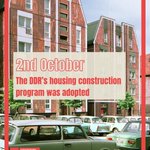
On this day, in 1973, the Central Committee of the SED adopted the DDR's infamous construction programme to address "the housing quesiton". Over the next decade and a half, around 3 million apartments were built and modernised across Eastern Germany.

ALT 📷: Wokrenterstraße 2, Rostock’s northern Old Town, 1986 / Author and licence as indicated on the Wikimedia Commons file page / Wikimedia Commons
On this day, in 1973, the Central Committee of the SED adopted the DDR's infamous construction programme to address "the housing quesiton". Over the next decade and a half, around 3 million apartments were built and modernised across Eastern Germany.
ALT 📷: Wokrenterstraße 2, Rostock’s northern Old Town, 1986 / Author and licence as indicated on the Wikimedia Commons file page / Wikimedia Commons
With an industrialized construction process, the DDR was able to rapidly build new homes and entire neighbourhoods. By the early 1980s, socialist Germany was building twice as many apartments per capita as capitalist Germany does today.
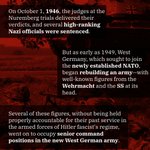
Nuremberg marked a major step toward prosecuting Nazi crimes.
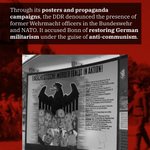
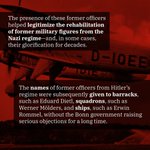
However, during the Cold War, former Wehrmacht and SS officers were reintegrated into West Germany’s new military and NATO structures, while denazification was gradually sidelined by anti-communist priorities. (1/8)


On this day in 1950, the DDR joined the Council for Mutual Economic Assistance ("Comecon").

ALT 📷: Bundesarchiv, Bild 183-1990-0425-023 / Wikimedia Commons / CC BY-SA 3.0 DE.
While it made sense for states to specialize their exports, this approach had the danger of encouraging certain states to remain raw material suppliers for the more advanced industries elsewhere.