




We mapped 1,297 AI labs, data vendors and work platforms in 64 countries to answer one question:
who buys the human data that trains AI, and what does it pay?
Our first Glasp Research report 👇


Glasp retweeted

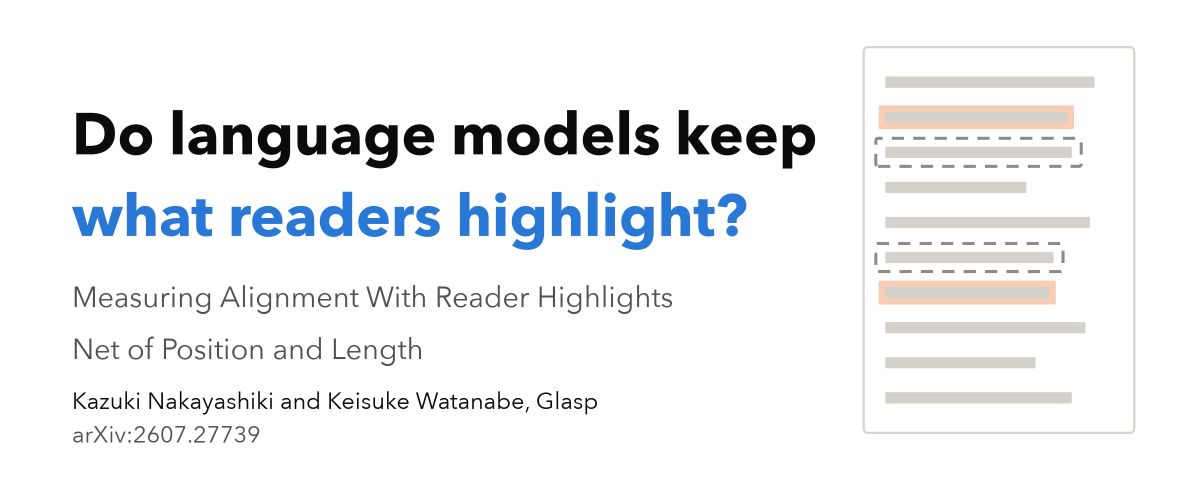
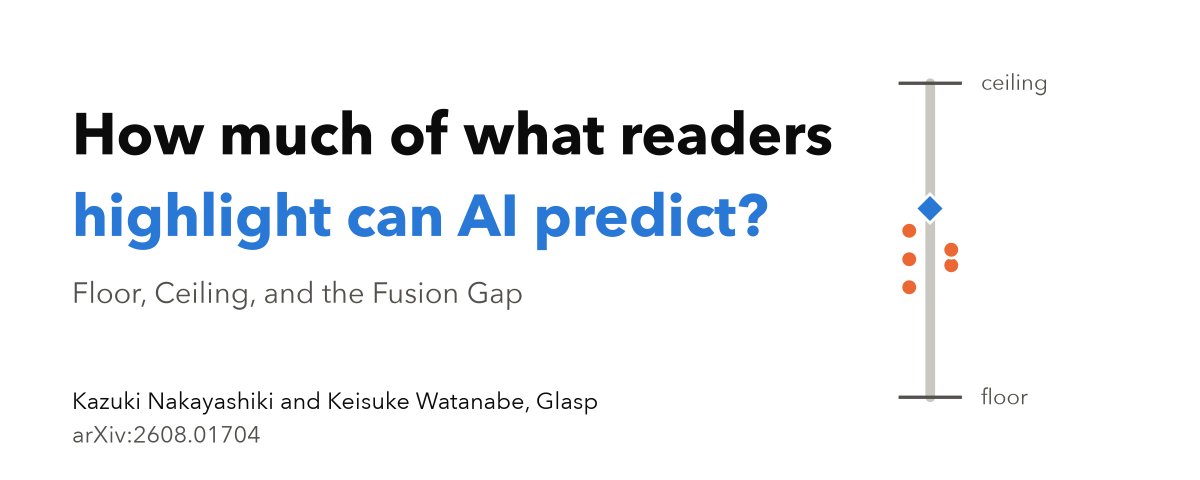
"once position and length are taken out, GPT-5.4's importance ranking kept the sentences a crowd highlighted about twice as often as comparable sentences from the same page, and on the same scale it scored about the same as a single human reader."


Glasp retweeted
I put together this learning stack to see how different tools fit together.
@_Glasp is in Capture, alongside Kindle and Raindrop. I included a few options for each step, from finding sources to sharing what you learn.
What would you add or swap? I'm curious what other people's setups look like.
Feel free to share the image or make your own version!

Check it out!
Ever paste a whole article into an AI chat just to ask one question? We wanted to skip that.
Now the chat lives on the page: articles, newsletter posts, PDFs on the web, YouTube videos. On YouTube, answers cite timestamps you can check.
Free on Chrome:
glasp.co/youtube-summary?utm…
Glasp retweeted
Ever paste a whole article into an AI chat just to ask one question? We wanted to skip that.
Now the chat lives on the page: articles, newsletter posts, PDFs on the web, YouTube videos. On YouTube, answers cite timestamps you can check.
Free on Chrome:
glasp.co/youtube-summary?utm…
We launched Glasp's Firefox extension on Product Hunt🚀
Glasp is now on @firefox 🦊
Highlight web pages, PDFs, and YouTube transcripts, then summarize them with @claudeai, @ChatGPTapp, or Gemini. Your highlights sync to every browser you sign in to.
We're live on @ProductHunt today. Support us 👇

If you highlight in Raindrop.io, those highlights can now live in Glasp too 💧
Connect once and they come across with their notes, colors, and tags. No file export needed.
Only pages you actually highlighted come over, so your plain bookmarks stay where they are.

Here's the tutorial:
glasp.co/posts/how-to-import…

Glasp retweeted

We just launched Glasp MCP Connector on @ProductHunt 🔌
Connect Glasp to @claudeai and @ChatGPT. Ask "what did I save about deep work?" and your own highlights come back, with sources.
Read-only. Private.
Support us 👇
Glasp retweeted
Glasp is finally available on Firefox! 🦊
This release took us much longer than we expected, so we are especially excited to finally share it.
Firefox users can now use @_Glasp to:
• Highlight and annotate web pages and PDFs
• Save and organize ideas in one place
• Add notes and tags to what they read
• Revisit and share what they have learned
• Build a personal AI memory from their highlights
Our goal with Glasp has always been to help people capture valuable ideas while they read, connect them over time, and make their knowledge more useful.
Making Glasp available across more browsers is an important step toward that goal.
A huge thank you to everyone who kept asking us for a Firefox version and patiently waited for the release.
We would love to hear your feedback!

Our new research paper is out!
We just released a new research paper: “Language Models Agree With Each Other, Not With Readers”
Many studies have found that language models produce more homogeneous outputs than humans. But the human comparison groups in those studies are usually recruited, instructed, and paid to perform the same task.
We wanted to compare models with people reading naturally, without being told what to find important.
Using Glasp’s public highlighting data, we analyzed:
• 2,523 reader highlight sets
• 120 web documents
• 18 language models
• 11 model vendors
• Models spanning 2024 to 2026
We measured how often two readers or two models selected the same sentences, after controlling for sentence position and length.
The median model pair agreed 2.3 times more than two human readers.
GPT-5.4 and Claude Opus 5, despite coming from rival labs, agreed 5.1 times more than two readers.
We also tested four models released after the original analysis was completed:
• GPT-5.5
• GPT-5.6 Luna
• GPT-5.6 Sol
• GPT-5.6 Terra
This gave us an out-of-sample test of the paper’s main finding.
None of the four models agreed with readers significantly more than human readers agreed with each other. None surpassed the best model in the original panel or approached the estimated crowd-consensus ceiling.
But their agreement with the original panel’s frontier models was extremely high.
Across 12 comparisons, the new models reached a median agreement of +0.224 with the panel’s frontier incumbents. That is higher than the +0.203 agreement between GPT-5.4 and Claude Opus 5.
The newer models did not move clearly beyond the human agreement level.
They did, however, continue to converge strongly with other frontier models.
Another result surprised us.
Newer models are becoming more aligned with human readers, but they are becoming even more aligned with one another. From 2024 to 2026, agreement with readers increased 2.9 times, while agreement between models increased 3.2 times.
Models are becoming more human-like and more alike at the same time.
We also tested whether models simply preferred a different style of sentence. After controlling for sentence length and position, none of the surface features we measured reliably separated model-selected sentences from reader-selected sentences.
Models and readers choose sentences that look similar, but they choose different ones.
This matters for search, summarization, recommendations, research, AI evaluation, and any system that uses multiple models as if they represent independent perspectives.
Using several frontier models may create the appearance of diversity without providing genuinely different views of what matters.
This work was conducted with @KeiWatanabe17 at @_Glasp

Glasp retweeted
We just released a new research paper: “Language Models Agree With Each Other, Not With Readers”
Many studies have found that language models produce more homogeneous outputs than humans. But the human comparison groups in those studies are usually recruited, instructed, and paid to perform the same task.
We wanted to compare models with people reading naturally, without being told what to find important.
Using Glasp’s public highlighting data, we analyzed:
• 2,523 reader highlight sets
• 120 web documents
• 18 language models
• 11 model vendors
• Models spanning 2024 to 2026
We measured how often two readers or two models selected the same sentences, after controlling for sentence position and length.
The median model pair agreed 2.3 times more than two human readers.
GPT-5.4 and Claude Opus 5, despite coming from rival labs, agreed 5.1 times more than two readers.
We also tested four models released after the original analysis was completed:
• GPT-5.5
• GPT-5.6 Luna
• GPT-5.6 Sol
• GPT-5.6 Terra
This gave us an out-of-sample test of the paper’s main finding.
None of the four models agreed with readers significantly more than human readers agreed with each other. None surpassed the best model in the original panel or approached the estimated crowd-consensus ceiling.
But their agreement with the original panel’s frontier models was extremely high.
Across 12 comparisons, the new models reached a median agreement of +0.224 with the panel’s frontier incumbents. That is higher than the +0.203 agreement between GPT-5.4 and Claude Opus 5.
The newer models did not move clearly beyond the human agreement level.
They did, however, continue to converge strongly with other frontier models.
Another result surprised us.
Newer models are becoming more aligned with human readers, but they are becoming even more aligned with one another. From 2024 to 2026, agreement with readers increased 2.9 times, while agreement between models increased 3.2 times.
Models are becoming more human-like and more alike at the same time.
We also tested whether models simply preferred a different style of sentence. After controlling for sentence length and position, none of the surface features we measured reliably separated model-selected sentences from reader-selected sentences.
Models and readers choose sentences that look similar, but they choose different ones.
This matters for search, summarization, recommendations, research, AI evaluation, and any system that uses multiple models as if they represent independent perspectives.
Using several frontier models may create the appearance of diversity without providing genuinely different views of what matters.
This work was conducted with @KeiWatanabe17 at @_Glasp
Honored to be featured and to share some of what we’ve learned building Glasp over the past 5 years. Thank you for the great article!

【記事更新】凄まじい行動量でアメリカで事業を立ち上げ、世界350万ユーザーに到達した「Glasp」さんに、持続可能な形でグロースするコツなど取材しました✍️
●1. 最初のユーザーは創業者が集める
最初の100人は友人や元同僚にDMなど、1,000人まではLinkedInやSlackのコミュニティで会話しながら。初期は創業者が営業のように動くことが最も効率的だった。
●2. 800回のオンボーディングで改善
ユーザーと通話をしながら画面共有をして使ってもらうと「躓きポイント」が可視化された。価値の高い発見は「ユーザーが言ったこと」よりも「ユーザーが見せてくれたもの」の中にあった。
●3. ユーザーの言葉から価値を見つけた
「Glaspをどんなサービスだと理解しましたか?」と聞くとそこに一番のバリューが現れていた。これを何度も聞いていくと「Glaspとは何か?誰のためのものか?」がだんだんわかってきた。
●4. 複利が効くSEOと口コミに集中した
獲得コストをほぼゼロに抑えて長期で効果が積み上がるチャネルを選択した。数百本の記事が、数年後には毎月数万人の新規ユーザーを生む集客資産になった。大規模な資金調達なしでも数百万ユーザーに。
●5. 不完全でもトレンドに早く乗った
拡張機能の「YouTube Summary with ChatGPT」をリリース。14カ月で100万インストールを突破。画面にGlaspのロゴを入れることでSNSにスクショが投稿されるたびに認知が広がる仕組みを作れた
●6. パワーユーザーをβテストに巻き込む
熱心なユーザーを新機能のテストに招待するとバグ発見だけでなくユーザーとの関係性が強くなりコミュニティが強化された。
●7. 訪問数ではなく継続利用を指標にした
重要指標は「初回から1ヶ月以内に2回目のハイライトをした割合」と「月1回以上ハイライトした人(MAU)」。月4〜5回使うユーザーは「半年後の継続率」が約2倍も高かったため指標に組み込んだ。
●8. 共有動機を持ったユーザーを狙う
当初はPM向けと考えていたが、編集者と情報を共有する「ライター」のほうが相性がよいとわかった。口コミで広げたいなら共有する動機を持っているユーザーに使ってもらうのが大事だった。ぴったりな層は隣接領域にいることがある。
●9. ChatGPTからの1日の流入が37倍に
AIからのログを分析し情報量を増やし、タイトルを質問形式にした。AIがアクセスしていた404を「未充足の需要」と捉えてページを作成。ChatGPT経由での1日あたりのセッションが37倍に成長した。
●10. シリコンバレーから発信した
新しい技術やサービスに世界中の注目が集まる場所で活動することで情報が世界へ広がりやすくなる。
【👇詳細記事】
約800回のオンボーディングで連続改善。低コスト×複利効果で持続的にグロース。世界350万人がつかう「Glasp」が実践した10のプロダクトとマーケの施策。
markelabo.com/n/n7acf7a1c926…


Glasp retweeted
Feeling grateful to be featured by such a well-respected media outlet in Japan. Thank you for taking the time to dive so deeply into our story and learnings over the past 5 years. We’ll keep building toward our mission and vision. 🙌
【記事更新】凄まじい行動量でアメリカで事業を立ち上げ、世界350万ユーザーに到達した「Glasp」さんに、持続可能な形でグロースするコツなど取材しました✍️
●1. 最初のユーザーは創業者が集める
最初の100人は友人や元同僚にDMなど、1,000人まではLinkedInやSlackのコミュニティで会話しながら。初期は創業者が営業のように動くことが最も効率的だった。
●2. 800回のオンボーディングで改善
ユーザーと通話をしながら画面共有をして使ってもらうと「躓きポイント」が可視化された。価値の高い発見は「ユーザーが言ったこと」よりも「ユーザーが見せてくれたもの」の中にあった。
●3. ユーザーの言葉から価値を見つけた
「Glaspをどんなサービスだと理解しましたか?」と聞くとそこに一番のバリューが現れていた。これを何度も聞いていくと「Glaspとは何か?誰のためのものか?」がだんだんわかってきた。
●4. 複利が効くSEOと口コミに集中した
獲得コストをほぼゼロに抑えて長期で効果が積み上がるチャネルを選択した。数百本の記事が、数年後には毎月数万人の新規ユーザーを生む集客資産になった。大規模な資金調達なしでも数百万ユーザーに。
●5. 不完全でもトレンドに早く乗った
拡張機能の「YouTube Summary with ChatGPT」をリリース。14カ月で100万インストールを突破。画面にGlaspのロゴを入れることでSNSにスクショが投稿されるたびに認知が広がる仕組みを作れた
●6. パワーユーザーをβテストに巻き込む
熱心なユーザーを新機能のテストに招待するとバグ発見だけでなくユーザーとの関係性が強くなりコミュニティが強化された。
●7. 訪問数ではなく継続利用を指標にした
重要指標は「初回から1ヶ月以内に2回目のハイライトをした割合」と「月1回以上ハイライトした人(MAU)」。月4〜5回使うユーザーは「半年後の継続率」が約2倍も高かったため指標に組み込んだ。
●8. 共有動機を持ったユーザーを狙う
当初はPM向けと考えていたが、編集者と情報を共有する「ライター」のほうが相性がよいとわかった。口コミで広げたいなら共有する動機を持っているユーザーに使ってもらうのが大事だった。ぴったりな層は隣接領域にいることがある。
●9. ChatGPTからの1日の流入が37倍に
AIからのログを分析し情報量を増やし、タイトルを質問形式にした。AIがアクセスしていた404を「未充足の需要」と捉えてページを作成。ChatGPT経由での1日あたりのセッションが37倍に成長した。
●10. シリコンバレーから発信した
新しい技術やサービスに世界中の注目が集まる場所で活動することで情報が世界へ広がりやすくなる。
【👇詳細記事】
約800回のオンボーディングで連続改善。低コスト×複利効果で持続的にグロース。世界350万人がつかう「Glasp」が実践した10のプロダクトとマーケの施策。
markelabo.com/n/n7acf7a1c926…