

Nanoscience and Molecular Materials Group of the Spanish Chemical and Physical Royal Societies
España
Joined July 2013
- Tweets4.9K
- Following1.1K
- Followers1.4K
- Likes5.1K





GENAM RSEQ-RSEF retweeted

Meet the WATOC 2028 International Advisory Committee!
We are pleased to introduce Prof. @miquelsola (Universitat de Girona).
Join us in Mérida, Mexico, January 9–14, 2028!
🌐 watoc2028.org
#WATOC2028 #Mérida


GENAM RSEQ-RSEF retweeted

I have found these two papers that are the same paper published in two different journals more or less at the same time. Do you know other examples?
pubs.acs.org/jpcafh/article/…
chemistry-europe.onlinelibra…

GENAM RSEQ-RSEF retweeted

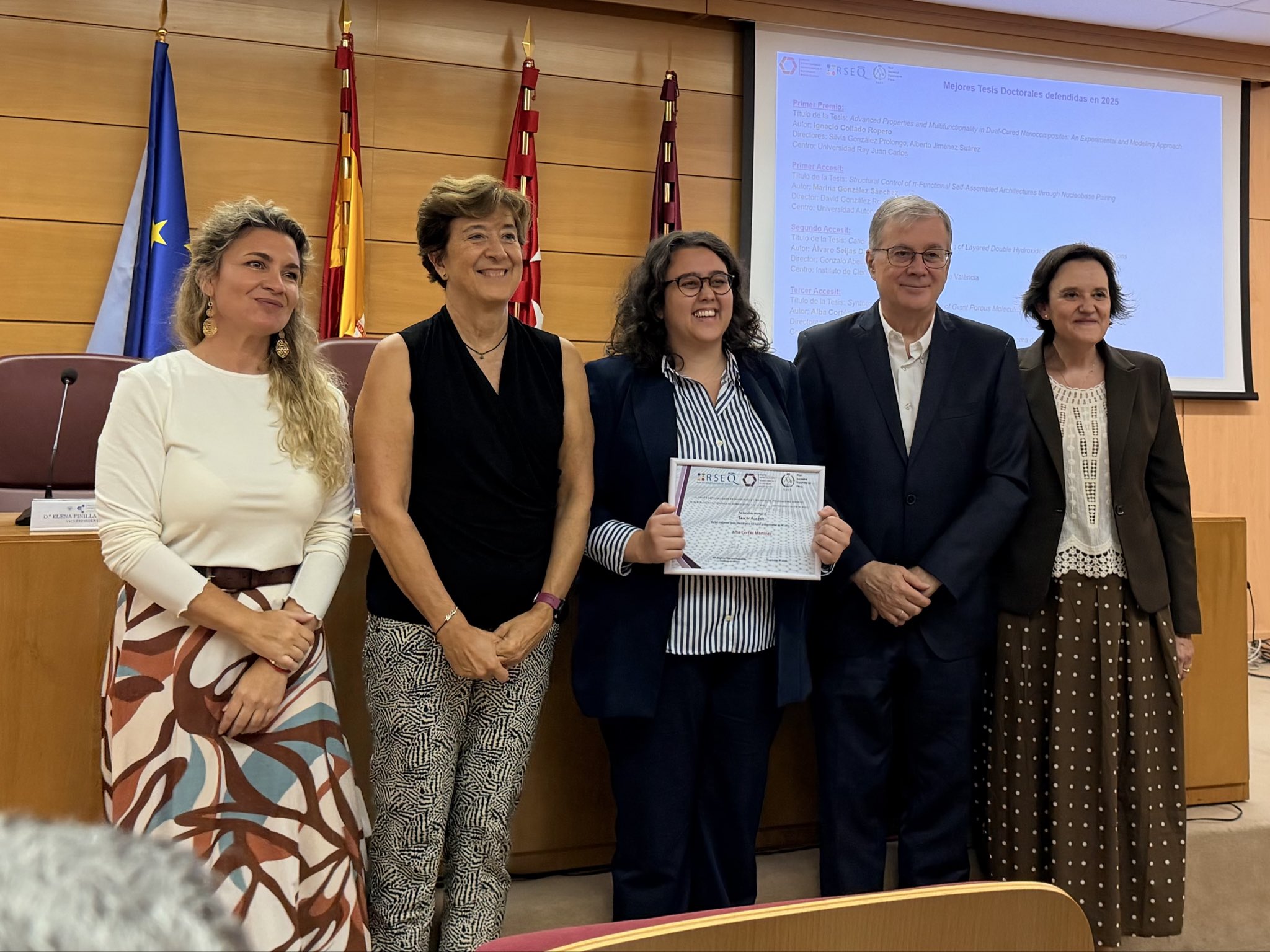
Very happy to have received this recognition for my PhD thesis! 🏆 It was a pleasure to present my work during @_GENAM’s 25th anniversary celebration. Thank you to the committee and to everyone who has been part of this journey


GENAM RSEQ-RSEF retweeted

A new strategy for modulating the electronic, optical and magnetic properties of metal-organic radical frameworks by tuning the content of trityl organic radicals within the framework!⚡️ Just out in @MaterChemFront @RoySocChem: pubs.rsc.org/qm/article/doi/…
🤖 Made with AI

GENAM RSEQ-RSEF retweeted

“Our prime minister wants to call me…”
2026 chemistry laureate Kenso Soai needed to cut short our interview when he learnt that the Japanese prime minister was trying to reach him. Before then, the new laureate spoke to us about his excitement on being awarded the #NobelPrize.
Soai also explained how it feels to have researchers all over the world studying his famous Soai reaction – one of the most spectacular chemical experiments ever conducted.
GENAM RSEQ-RSEF retweeted
“In basic research, we want to learn more and more about how molecules behave and how they can interact – this year's prize fits into that.”
Immediately after the announcement, Peter Somfai, Member of the Nobel Committee for Chemistry, was interviewed by freelance journalist Sharon Jåma regarding the 2026 Nobel Prize in Chemistry.
GENAM RSEQ-RSEF retweeted
Learn more about the 2026 #NobelPrize in Chemistry
Press release: bit.ly/3SZAbEH
Popular information: bit.ly/4h1xPxd
Advanced information: bit.ly/4h2P6pG

GENAM RSEQ-RSEF retweeted
Thanks to the discoveries that are being recognised by the #NobelPrize in Chemistry 2026, chemists have gained fundamental new tools for use in their daily work but, above all, these discoveries have contributed to solving one of chemistry’s greatest mysteries: how homochirality – like that found in all living beings – can be created.
The Soai reaction – developed by 2026 laureate Kenso Soai – has awakened new enthusiasm in chemists who want to understand the life’s origins. Around the world, researchers are now trying to repeat Soai’s achievement, but with the aim of producing homochiral amino acids and sugars.
The non-linear effects that fellow laureate Henri B. Kagan discovered have become an important tool for chemists when they design new reactions. The fact that a reaction is non-linear provides chemists with information about how it occurs. This information can be used to optimise the reaction, so they can obtain the purest possible enantiomers of the product. This is vital for every company that manufactures substances that are intended to interact with living beings, such as pharmaceuticals, flavours, scents and agricultural chemicals. In some cases, it is also important in the production of new materials.

GENAM RSEQ-RSEF retweeted
Kenso Soai – awarded the 2026 #NobelPrize in Chemistry – designed the first chemical reaction in which only one of the potential mirror images was formed. Other than life itself, no one had ever achieved this feat. The Soai reaction is one of the most spectacular chemical experiments ever conducted.

GENAM RSEQ-RSEF retweeted
2026 #NobelPrize laureate Henri Kagan discovered a new way of manipulating chemical reactions, allowing a greater excess of one of the mirror images to be created than was previously assumed possible. His discovery has been revolutionary for chemists who develop reactions for the manufacture of pharmaceuticals, flavours, scents and new materials.

GENAM RSEQ-RSEF retweeted
The #NobelPrize in Chemistry 2026 recognises discoveries that have enabled chemists to drive chemical reactions that lead to homochirality.
Life’s chemistry is what chemists call homochiral, after the Greek words for “same” and “hand”. Like hands, all amino acids exist as two mirrored variants, but only one of them is found in the proteins in your cells. The other is rarely found in nature.
For a long time, chemists wondered how homochirality can emerge. When they began to experiment with chemical reactions that can form two mirrored molecules, they always obtained equal proportions of both in their test tubes. However, chemists strived to produce only one of these mirror images, because in the development of molecules that will interact with living beings – such as in pharmaceuticals – only one mirror image will have the desired effect.
Thanks to laureates Henri Kagan and Kenso Soai, we now know how homochirality can emerge. Their discoveries have been decisive for chemists who design reactions for the manufacture of pharmaceuticals.

GENAM RSEQ-RSEF retweeted
Some molecules, such as amino acids, exist as two variants that are each other’s mirror image. However, living organisms only contain one of these mirror images. How chemical asymmetry such as this could have emerged was long a mystery to chemists. Henri B. Kagan and Kenso Soai have been awarded the #NobelPrize in Chemistry 2026 for discovering a solution to this puzzle.

GENAM RSEQ-RSEF retweeted
BREAKING NEWS
The Royal Swedish Academy of Sciences has decided to award the 2026 #NobelPrize in Chemistry to Henri B. Kagan and Kenso Soai “for the discovery of non-linear effects and autocatalysis in asymmetric organic synthesis.”

GENAM RSEQ-RSEF retweeted

🔬 "Siempre hablamos de transferencia del conocimiento desde la universidad a la empresa, pero si queremos tener éxito, esa transferencia debe ir en las dos direcciones".
Avelino Corma (Instituto de Tecnología Química ITQ (CSIC/UPV), analizó en la Jornada de Sociedades COSCE las diferentes vías para la transferencia de conocimiento.
GENAM RSEQ-RSEF retweeted

Nanographenes assemble through weak van der Waals interactions into 🔶 crystalline framework with permanent porosity 1108 m² g⁻¹ 😎 👇
An honour to have contributed to this work with @nazariolab and J. Perles @UAM_Madrid @imdeanano @IMDEAInstitutes
onlinelibrary.wiley.com/doi/…

GENAM RSEQ-RSEF retweeted
We had a fantastic day celebrating the 25th anniversary of @_GENAM at @quimicasUCM! Inspiring talks by PhD award winners and invited speakers, plus a roundtable with former presidents on GENAM’s history and future challenges. Here’s to the next 25! @RSEQUIMICA @RSEF_ESP


We had a fantastic day celebrating the 25th anniversary of @_GENAM at @quimicasUCM! Inspiring talks by PhD award winners and invited speakers, plus a roundtable with former presidents on GENAM’s history and future challenges. Here’s to the next 25! @RSEQUIMICA @RSEF_ESP
GENAM RSEQ-RSEF retweeted

🎊 It’s a double celebration today, as we mark the 25th anniversary of the foundation of @_GENAM, and @albacortes6 received one of the Best Thesis prizes at its ceremony! Congratulations 🥳

GENAM RSEQ-RSEF retweeted
📢 Actualizamos esta publicación con la inclusión de todos los miembros de la RSEQ reconocidos con los🏆🇪🇸 Premios Nacionales de Investigación 2026: Daniel Maspoch, Jesús Martínez de la Fuente, Katherine Villa y Miguel Anaya entre los galardonados.
➡️ shre.ink/Ga3s
