

Imperial Japanese naval fighter pilots, their aircraft and their war. 📖 SAMURAI! New Annotated & Illustrated Edition Now available on Amazon👇
Joined September 2023
- Tweets222
- Following1.3K
- Followers534
- Likes5.4K





Pinned Tweet
𝗦𝗔𝗠𝗨𝗥𝗔𝗜! 𝗡𝗘𝗪 𝗔𝗡𝗡𝗢𝗧𝗔𝗧𝗘𝗗 & 𝗜𝗟𝗟𝗨𝗦𝗧𝗥𝗔𝗧𝗘𝗗 𝗘𝗗𝗜𝗧𝗜𝗢𝗡 𝗜𝗦 𝗡𝗢𝗪 𝗔𝗩𝗔𝗜𝗟𝗔𝗕𝗟𝗘!
This new edition enriches the classic memoir with a more accurate historical framework through more than 130 editorial notes drawing on Japanese primary sources and leading modern scholarship. It also features a carefully curated collection of wartime photographs accompanied by detailed captions.
Whether you are discovering Samurai! for the first time or returning to this classic, I hope this edition offers a deeper understanding of Saburo Sakai’s remarkable combat career.
Available on Amazon:
a.co/d/031091FB

Aboard an aircraft carrier flight deck, an A6M5 Zero Model 52 from an unidentified unit displays the kanji 鍋 (Nabe) inside its fuselage Hinomaru. Used as a carrier landing practice identifier, similar temporary markings—a single kanji character from the pilot’s surname applied in water-soluble white paint—were observed on 653 Kokutai Zeros around September 1944.
Photo: Shigemichi Kinoshita
#zerofighter #零戦 #零戦52型 #a6m5 #a6mzero

19
299
Zero Fighter Pilots retweeted

Japanese Mitsubishi A6M Zero fighter on a kamikaze mission torn up by gunfire from a US Navy warship circa early 1945
Mitsubishi-built A6M5 Zero Model 52, manufacture number 4340, captured by US Marines at Aslito Field, Saipan, in June 1944. The aircraft was one of twelve Zeros shipped to the United States aboard USS Copahee for evaluation. American intelligence coded the aircraft as TAIC 7, later FE-130 and T2-130. It was later restored and placed on display at the National Air and Space Museum.

A Japanese naval fighter pilot in full flight dress poses in front of an A6M2 Zero from an unidentified unit.

An A6M2 Zero Model 21 of the Tsukuba Kokutai, equipped as a target-towing aircraft for gunnery training. A fabric banner target was folded into a cylindrical canister mounted on the small bomb rack under the wing and attached to a tow cable connected to a mount at the tail. When airborne, the canister was dropped, and the banner was pulled from the canister and deployed for towing.

B-24J Liberator “Dog Patch” of the 392nd Bombardment Squadron is hit by antiaircraft fire and attacked by Zeros during a mission over Taroa in the Marshall Islands on December 20, 1943. All nine crewmen were killed in action.
Photo: via Harrison Humphries

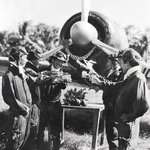
Zero pilots toast during a New Year ceremony at Lakunai airfield, Rabaul, in front of an A6M2 Zero Model 21, its propeller decorated with a sacred rope. The bananas used as a ritual offering give the scene a distinctly tropical feel.
Photo: Hajime Yoshida

On this date in 1942, Lt(jg) Junichi Sasai was lost while leading a formation of nine Zeros escorting “Betty” bombers on a mission to strike Henderson Field. He may have been shot down by US Marine Corps ace Capt Marion E. Carl, who claimed two Japanese fighters during the action.
About two weeks earlier, Sasai had presented Saburo Sakai—who was being sent home for hospitalization—with his tiger-engraved silver belt buckle for good luck.
Coincidentally, Sasai was killed on August 26, the same date on which Saburo Sakai was born.
Sasai’s combat career in the Tainan Air Group is covered in great detail in 'SAMURAI! New Annotated & Illustrated Edition'.

Mitsubishi A6M3 Model 32, “X-152,” of the 3rd Kokutai, at Koepang, Timor Island, circa August–September 1942. The aircraft bears the Hokoku No. 1000, whose subscript indicates that it was donated by the Hiroshima Prefectural Medical Association.
Photo: via Scale Aviation Magazine

Saburo Sakai explains the mindset of Imperial Japanese naval aviators toward the use of parachutes in combat.
Interview recorded in June 1975.
Via -Juno- TakaLeon
A6M2 Zero Model 21s aboard the aircraft carrier Zuiho (瑞鳳), October 1942, shortly before the Battle of Santa Cruz. The aircraft at left, tail code “EIII-117,” was flown by Lt Moriyasu Hidaka.
Photo: Moriyasu Hidaka

On June 1, 1942, Tainan Kokutai pilot FPO3/c Masami Arai had his A6M2 Zero badly damaged over Port Moresby while flying a bombing escort mission. Despite a huge section of his left wing being blown off, Arai managed to fly the crippled fighter all the way back to Lae. More than two months later, on August 14, Arai was killed by B-17 gunners northeast of Buna.
Photo: Hajime Yoshida

Nakajima A6M2-N “Rufe” floatplanes seen in gun-camera footage captured by US Navy fighters during the large-scale attack on Truk on 17–18 February 1944.
Credit: NARA
Eighty-four years ago today, on August 7, 1942, a severely wounded Saburo Sakai is seen shortly after returning from his near-fatal mission over Guadalcanal. Despite being gravely injured, he flew 4 hours and 47 minutes to cover 560 nautical miles back to base. Having lost sight in one eye, he spent much of the remainder of the war as an instructor until the increasingly desperate military situation allowed his brief return to combat duty in June 1944.
Explore Sakai's combat career in greater depth in SAMURAI! New Annotated & Illustrated Edition, now available from Amazon:
amazon.com/dp/B0H59PL8RX

A6M3 Zero Model 32, tail code V-187, of the Tainan Kokutai at Lakunai Airfield, Rabaul. The yellow diagonal stripe on the rear fuselage behind the Hinomaru—running across the black Hokoku stencil—is not visible in this photograph. Abandoned at Buna airfield and captured in December 1942, this aircraft later supplied its engine and other components for the reconstruction of a flyable A6M3 Zero by personnel of the Allied Technical Intelligence Unit (ATIU) at Eagle Farm Field, Australia.

36
951
With Mount Fuji in the background, SFPO Kuga flies an A6M2 Zero Model 21 of the Kasumigaura Kokutai. The photograph was taken by Lt Cdr Hachiro Yanagisawa during a return training flight from Usa, Kyushu, to Kasumigaura on March 26, 1944.
Photo: H. Yanagisawa
#zerofighter #零戦 #a6m2 #a6mzero #mitsubishizero

39
827
A6M2 Zero Model 11—tail code “3-182”—of the 12th Kokutai during operations over China, June 1941. The photograph was taken by FPO1/c Saburo Sakai with the Leica camera he routinely carried on combat missions throughout his service in China and the early stages of the Pacific War. The two-tone effect of the paintwork was caused by protective covers placed over the canopy and mid-fuselage area to protect the aircraft from the intense sunlight.
Photo: Saburo Sakai via Ryu Koakimoto
#zerofighter #零戦 #saburosakai #a6mzero #mitsubishizero

