

Teaching Elder at Trinity Church Kennesaw (ATL) | Author: "Charles Simeon: Parish Pastor" (@wipfandstock, 2025), available on Amazon.
Joined February 2012
- Tweets2.9K
- Following188
- Followers735
- Likes5.5K


One of the great projects of the Christian life is seeking to please our Savior in everything we do.


Permission structures are powerful. Taboos are more powerful.
One of the most powerful and unquestioned taboos among conservative evangelicals is that pastors should never speak to partisan politics.
I’ve tried for over a decade to steel-man this taboo, but I’ve simply never been able to understand why it’s wrong, ungodly, or imprudent for a pastor to openly discourage Christians from supporting a party whose central platform elements clearly defy the law of God.
I believe if a robust permission structure were established for conservative evangelical pastors to prudently speak into partisan politics—as they freely do with almost every other matter of basic practical ethics—extraordinary good could be accomplished for the nation.
Tens of thousands of children have breath in their lungs today because of Georgia’s heartbeat bill.
Bottoms has campaigned on repealing the bill. Ossoff opposes it as well.


Zack DiPrima retweeted

Contra those who think there’s no way to be Baptist while affirming some forms of Christian nationalism, Charles Spurgeon was undoubtedly a Christian nationalist, and of a fairly stout sort (stout in more ways than one!). There’s a thesis here for a thoughtful PhD student.
I’m a pastor who lives in Georgia.
Let me make plain to my Georgia friends as a matter of basic Christian ethics:
It displeases Christ to vote for Keisha Bottoms and Jon Ossoff.
Yes, I aim to bind your conscience. As I would if you were a man cohabiting with your girlfriend.
Texas pastor friends: voting for Talarico displeases Christ. If your public ministry ever touches basic ethics—and it must—then this should be clear to your people.
Texas pastors, if it’s not obvious to your people that supporting James Talarico is sinful, this may reflect a deficiency in your public ethics and fidelity to Christian application. Just because something touches partisan politics does not make it a magical “conscience issue” you’re forbidden to address. This is a basic matter of loving your neighbor and Christian ethics.

Zack DiPrima retweeted

That was no accident. Bach was a Christian and often signed his music with “SDG,” meaning “Soli Deo Gloria” or “Glory to God Alone.”

Ryle on the willingness of Christ to suffer:
"He did not bleed, and suffer, and die, because He was vanquished by superior force, and could not help Himself, but because He loved us, and rejoiced to give Himself for us as our Substitute. He did not die because He could not avoid death, but because He was willing with all His heart to make His soul an offering for sin."


Love the 1662 Prayer Book on Communion — “to such as rightly, worthily, and with faith, receive the same…”

Evangelicals do have a deficient understanding of the ordinary means of grace. But most of what we call “spiritual disciplines” are the ordinary means—meditation on Scripture, prayer, the gathered church, and the communion of saints etc.
Every evangelical teacher I’ve heard on this has pointed people to Christ through these means, not to the means themselves. The real danger is that people hear us saying the opposite—that the means are the end of Christian experience.
As evangelicals we also need a more robust theology of the sacraments. That’s one reason my church practices weekly communion.

Theological differences aside, I think this identifies a real problem in much of evangelicalism.
We’ve placed such an emphasis on spiritual disciplines, cultivating affections, etc., that we’ve neglected the ordinary means from which they flow.
Spend less time looking inward to measure your affections and more time looking outward to Christ, who meets us through the means.

This is an unfortunate misread of Piper’s ministry. He literally wrote a whole book (“When I Don’t Desire God”) addressing this misunderstanding.
Moreover, virtually the entire Reformed tradition is united: the objective means of the sacraments are fruitless if taken without faith.

Piper Taught Me To Desire God, But Never How To Grow In Grace
I recently heard a snippet from a John Piper sermon, and it brought back a lot of memories.
As a new believer, I found Piper quite influential. I still remember leaving a youth adults group with a copy of Don’t Waste Your Life. “Oh, Piper is a good one,” someone told me. I had never heard of him, but I soon became a huge fan.
In my college ministry, you couldn’t go a day without hearing someone quote his famous line, “God is most glorified in us when we are most satisfied in him.” Some of my friends religiously listened to Ask Pastor John and even quoted him in discussion as if he were the magisterium.
I’m thankful for how his work fired me up as a new convert. Eventually, though, his theology became a real spiritual burden and left me with more questions than answers.
You may be wondering, “How on earth do you become burdened by the idea of desiring and delighting in God?” Great question. Let me explain.
Where Christian Hedonism Comes From
Piper’s Christian Hedonism draws heavily on Jonathan Edwards, who emphasized individual religious experience. In this view, faith is primarily about personal experience, moral transformation, and heartfelt devotion. If you talk to any fan of Edwards or Piper, you’ll hear a lot about “the affections,” a fancy phrase for the deep-seated desires that guide and govern you.
The Problem
I came to feel this problem long before I could put it into words. Piper tells you to delight in God and to grow in faith, but he gives you no way to do that apart from mustering up faith yourself: read more, pray more, fight harder for joy. He gives you a destination, but no roadmap for how to get there. His theology points you inward, toward the mental and volitional side of faith, and that leaves your faith and assurance resting on your own subjective state.
Feeling spiritually dry?
You aren’t desiring God enough.
Still struggling with sin?
You still have disordered affections.
In a season of doubt, depression, or distance from God?
God is most glorified in us when we are most satisfied in him, so start cultivating satisfaction in God.
Piper captures this inward focus in Desiring God when he writes, “Where feelings for God are dead, worship is dead.”
Now, I’m not saying that delighting in God is bad. Rather, my concern is making those feelings the measure of faith. Feelings are subjective, and when they fade, as they do for everyone, a faith built on them has nothing left to stand on.
I still remember attending Christian conferences (one where Piper actually spoke), getting spiritually hyped up and riding the “conference high” for a few weeks. But eventually ordinary life set back in, and I forgot all about that conference.
We need a faith anchored in something not found within, but outside ourselves.
What I Found Instead
I knew I wanted to desire, delight in, and enjoy God more. I just didn’t know how.
I remember thinking, "Wait, I do know how. Grace. We are saved by grace, so the real question is where I receive that."
Herein I discovered the idea of “means of grace”: the ordinary channels God has appointed to give his grace to us, most notably Baptism and the Eucharist.
The sacraments gave me what I’d been missing and longing for. They are objective channels of grace. Their value doesn’t depend on how fervent I am, how well I prayed this week, or whether my heart is joyful. Christ promises to give himself in them, and the promise holds even when my feelings waver. The Eucharist also nourishes. Bread feeds a body that is hungry, and the Eucharist feeds a faith that is weak.
For the first time, my faith felt like something received, not something produced.
Conclusion
To be fair to John Piper, not everything he says is wrong. In fact, there is some stuff that isn't half bad. The problem is that it only takes you so far. Without a robust theology of the sacraments, a Christian is given half the picture. The faith has subjective, volitional elements that each person experiences. But, more importantly, there are objective, tangible elements that we can hold fast to: things God does for us and gives to us, whether or not we "feel" anything.
In Desiring God, Piper leans heavily on the first and never once mentions the second.

"We will never live in a homogeneously Christian society."
I like Miller a lot, but this reads as wildly pessimistic and historically ignorant. England was a homogeneously Christian society for centuries. America obviously was as well. Both became so in places that were thoroughly non-Christian before.
You can doubt the likelihood of a homogeneously Christian society, but to deny the possibility is a rather strange black pill to swallow.

Zack DiPrima retweeted

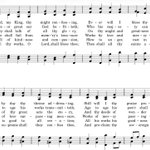
The opening words of 'Immortal, Invisible, God Only Wise' come directly from 1 Timothy 1:17. Written in 1867 by Scottish Presbyterian minister Walter Chalmers Smith, the hymn celebrates God's eternal, unchanging nature. Its final stanza reminds us of a profound truth: though God is invisible and beyond our comprehension, He is worthy of all our praise.