

One good U.P. story every day. News, history, outdoors, and community from across Michigan's Upper Peninsula.
- Tweets323
- Following30
- Followers25
- Likes330




ALT Crisp Point Lighthouse standing on the Lake Superior shoreline.

ALT The Gwinn Community Clubhouse, a two-storey red brick building with a tall arched window, white columned entry porches and a brick chimney, standing on a lawn under a partly clouded sky. The Community Clubhouse in Gwinn, Michigan, built as part of the Cleveland-Cliffs model town. Photo: rossograph, CC BY-SA 4.0, via Wikimedia Commons.


ALT A white clapboard church with a square tower and open belfry topped by a weathervane, standing behind a picket fence on Mackinac Island around 1900, with a wooded hillside and a large hotel building behind it. Old Mission Church, Mackinac Island, Michigan, circa 1900. Photo: Detroit Publishing Co., public domain, via Wikimedia Commons.


ALT A two-storey cream and green clapboard building with a long covered platform canopy along its front, hung with ICE CREAM and Coca-Cola signs and a DAIRY BAR sign under the canopy, with picnic tables on the gravel lot outside. The former Houghton County Traction Company streetcar station in Ahmeek, Michigan, now a dairy bar and gift shop. Photo: Paul R. Burley, CC BY-SA 4.0, via Wikimedia Commons.

ALT A preserved black steam locomotive and tender standing on a short length of track under an open timber shelter, the number 5 visible on the cab, with gravel underfoot and autumn trees behind. Nahma and Northern Railway locomotive number 5, preserved at Nahma, Michigan. Photo: Andrew Jameson, CC BY-SA 3.0, via Wikimedia Commons.


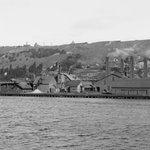
ALT The Quincy Smelting Works on the waterfront at Ripley, Michigan, around 1906, with smokestacks venting and the hillside of Quincy Hill rising behind it. Photo: Detroit Publishing Co., public domain, via Wikimedia Commons

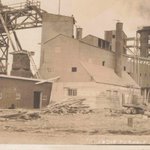
ALT A sepia 1910 photo postcard of the Ardis Furnace plant in Iron Mountain, showing a timber headframe, a tall concrete building and a smoking stack, with the word SUCCESS hand-lettered in white on the building and the caption ARDIS FURNACE, IRON MT MICH along the bottom edge. Photo: unknown author, public domain, via Wikimedia Commons


ALT A concrete breakwater runs from the foreground straight out into Lake Superior to a small dark lighthouse, with the far shore low on the horizon under a clear blue sky. Photo: Chadrjohnson, CC BY-SA 3.0, via Wikimedia Commons


ALT 14 female nurses wearing white uniforms and black capes standing in four staggered rows in front of a red brick building with a stained glass window above wooden doors.

ALT Historical illustration of an armed highwayman stopping a four-horse stagecoach on a wooded road above Lake Gogebic. Text reads: "Lake Gogebic, 1889. The East's last stagecoach robbery happened in the U.P." A circular Yooper logo appears in the upper-right corner.

ALT AI-assisted editorial illustration of an enormous early-20th-century log estate glowing through dark pines above a rocky Lake Superior shoreline at blue hour. Text reads, “Granot Loma, Lake Superior. The world's largest log cabin is hiding near Marquette.” A circular Yooper logo appears in the upper-right corner. The illustration is evocative and does not claim to reproduce Granot Loma's exact architecture.

ALT A vertical image of Kitch-iti-kipi's clear blue-green spring surrounded by forest. Text reads, "Kitch-iti-kipi, 1920s. A five-and-dime owner invented its ancient legend." A circular Yooper logo appears in the upper-right corner.
