

XMax Inc. (NASDAQ: XMAX) | Advancing AI software, cloud and GPU infrastructure, and enterprise AI solutions.
Joined May 2025
- Tweets1.8K
- Following12
- Followers1.7K
- Likes2.4K






Pinned Tweet
We are proud to announce that XMAX has been officially added to the Russell 2000® Index. This milestone reflects our sustained growth and commitment to delivering long-term value. Thank you to our investors and team for making this possible.
$XMAX #Russell2000 #Milestone #FinancialGrowth



Maxo and Maso are back from their business trip through space and the future.
Meet XMax’s official mascots and future exploration team. They’ve mastered time travel. Landing is still a work in progress.
Welcome back, you two. Your next mission is wall repair.


Nice summary! A few clarifications on the numbers:
• $106.3M is total stockholders’ equity, not the total value of our technology portfolio.
• $73.82M is the carrying value of our fund investments, not a standalone valuation of our SpaceX and xAI holdings.
• $4.08M represents assets in our API services segment, not spending on AI infrastructure.
All three figures are as of June 30, 2026. Stay tuned for our Q3 report for further updates ❤️
On the business side, XMax AI recently signed a Letter of Cooperation with apM Group to explore AI infrastructure and specialized models for K-Fashion.
On October 9, XMax also announced an agreement to acquire 100% of Hexa Creation, which develops 1200V vertical gallium nitride (GaN) technology for AI data center power systems and other high-voltage applications.
Thanks for putting this together! Please refer to our SEC filings and latest announcements when updating the infographic.

Wall Street sees @XmaxGlobal a furniture company.
@SpaceX, @SpaceXSI, @Figure_robot... $100M+ in tech holdings and announced deals.
Guess $XMAX makes superintelligent furniture now lmao😂


This is interesting. But how exactly did you pull this off? @vladtenev @hookefun @RobinhoodCrypto would love to hear your thoughts on the tech behind it.

No institution should control stock tokenization.
Hooke launches with its first permissionless stock pool: $hXMAX/$USDG. We seed it with $5M $USDG totaling $10M in pool liquidity. @XmaxGlobal $XMAX
Hooke lets anyone issue price-tracking tokens and build derivatives through open protocols—no centralized gatekeepers.
Permissionless Algorithmic Stock Tokenization.
Coming to @RobinhoodApp Chain.
hooke.fun
$hXMAX CA: 0x71796aad4cdff942d3ee8bb1227f779255f89dbc


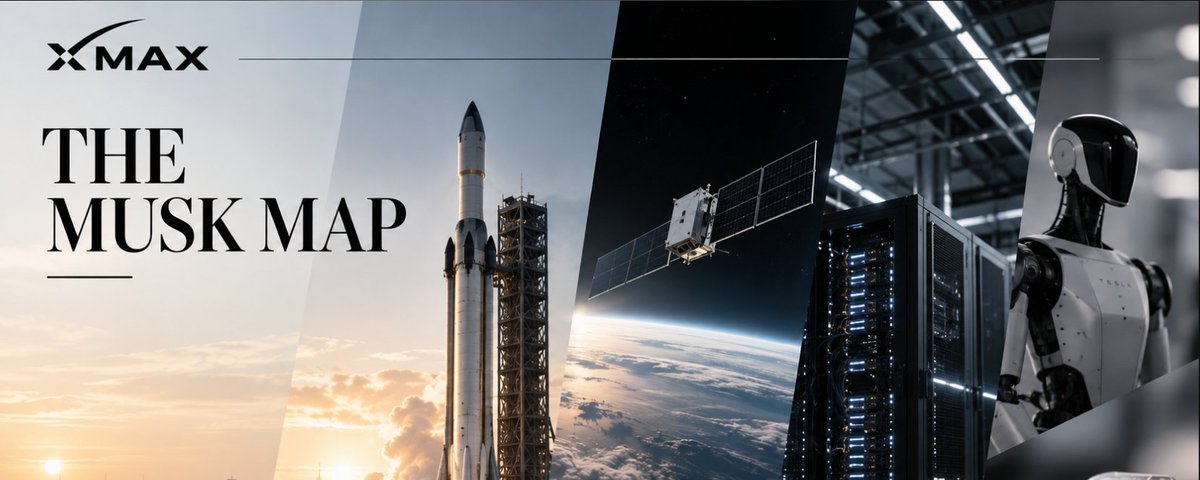
THE MUSK MAP EP.01| Why Is Elon Musk Building So Many Companies?
Elon Musk has built businesses that manufacture electric vehicles, launch rockets, develop artificial intelligence, operate satellite networks, and explore brain-computer interfaces. At first glance, these industries seem to have little in common. But when we examine the engineering challenges behind them, an interesting pattern begins to emerge: many of these companies are solving different parts of the same technological puzzle.
Tesla: Teaching Machines to Understand the Physical World
Tesla's ambitions have expanded beyond electric vehicles into autonomous driving, robotics, and AI. Consider what it takes for a vehicle to drive itself. Cameras must interpret the surrounding environment, AI models must predict what happens next, and onboard computers must make decisions in real time. Now consider a humanoid robot performing tasks inside a factory. It faces similar challenges, with the additional complexity of manipulating physical objects.
This overlap matters because advances in perception, prediction, and machine control can potentially benefit multiple applications. Tesla's work on autonomous driving and Optimus reflects a broader effort to develop machines capable of operating in complex physical environments.
SpaceX and Starlink: When Infrastructure Creates Its Own Demand
SpaceX approached the aerospace industry with a fundamental question: what if rockets could be reused? By developing reusable launch vehicles, the company has changed the economics of reaching orbit. That capability has also supported the expansion of Starlink, its satellite internet business.
Building a global satellite network requires launching large numbers of satellites, replacing aging spacecraft, and continuously expanding capacity. SpaceX provides the launch infrastructure, while Starlink generates recurring demand for satellite deployment. This creates a reinforcing relationship between transportation capability and communications infrastructure.
The significance extends beyond space exploration. It demonstrates how controlling a critical part of the supply chain can influence the economics of an entirely different business.
xAI: Intelligence Meets Infrastructure
Artificial intelligence adds another dimension to Musk's technology strategy. Through Grok, xAI has developed large language models capable of reasoning, generating content, writing code, and processing information. But as AI systems become more capable, their usefulness increasingly depends on access to computing infrastructure, data, and real-world applications.
In 2026, SpaceX acquired xAI, bringing advanced AI development and space infrastructure under the same corporate structure. This creates potential opportunities for collaboration across AI computing, communications, and other technologies, although the commercial benefits will depend on actual implementation.
Meanwhile, Tesla continues developing AI for autonomous vehicles and humanoid robots. These efforts highlight two important directions in artificial intelligence: systems that process digital information and systems that interact with the physical world.
Both require substantial computing resources, efficient hardware, reliable infrastructure, and increasingly sophisticated models.
Neuralink: Connecting Human Intelligence With Computers
Neuralink explores another frontier: how humans interact directly with digital systems. Its brain-computer interface technology aims to translate neural activity into commands that can control external devices, initially focusing on people with severe physical disabilities.
Although Neuralink operates in a very different field from Tesla or SpaceX, its research addresses a related technological challenge: enabling information to move more effectively between humans, computers, and machines.
As AI systems become more capable, the ways humans communicate with technology could become just as important as the intelligence of the systems themselves.
The Bigger Picture: A Technology Ecosystem Taking Shape
Looking across these businesses reveals several recurring themes. Tesla focuses on intelligent machines and physical automation. SpaceX develops transportation and space infrastructure. Starlink provides satellite connectivity. xAI advances artificial intelligence, while Neuralink investigates new forms of human-computer interaction.
There are also important differences. These businesses operate under different corporate structures, face different regulatory environments, and have distinct commercial priorities. Technological overlap does not guarantee successful integration.
Still, the connections are worth examining. AI requires computing power and electricity. Autonomous machines need advanced intelligence and efficient hardware. Satellite networks depend on launch capacity and communications technology. Each industry creates demand for capabilities being developed elsewhere in the ecosystem.
As AI expands from chatbots into robotics, transportation, industrial automation, and other physical applications, the importance of these underlying technologies is likely to grow.
Perhaps the most interesting question is how advances in one part of this ecosystem could reshape the economics and capabilities of another.
The Musk Map | Exploring the technologies, businesses, and connections shaping the Musk ecosystem.

From AI Computing to Power Infrastructure: Why We're Looking at 1200V Gallium Nitride
For years, the AI industry has been focused on computing power. From NVIDIA GPUs to hyperscale data centers, much of the conversation has centered on who has the most advanced chips and who can build the largest computing clusters.
But as AI infrastructure continues to scale, another challenge is becoming increasingly important: how do we deliver electricity to thousands of high-performance GPUs efficiently, reliably, and at scale?
A large AI data center can operate tens of thousands of GPUs simultaneously. These processors require continuous power to handle demanding AI training and inference workloads. Before electricity reaches the servers, it passes through multiple stages of power conversion and distribution.
Every conversion stage introduces some degree of energy loss.
Consider a simplified example. If a power conversion system processes 10 megawatts of electricity at 95% efficiency, approximately 500 kilowatts are lost during conversion. Improving efficiency to 98% would reduce that loss to approximately 200 kilowatts under the same input conditions.
That's a difference of 300 kilowatts at a single conversion stage.
At data center scale, even relatively small improvements in power efficiency can have meaningful implications for electricity consumption, cooling requirements, and operating costs.
This growing emphasis on power efficiency is also drawing attention to advanced semiconductor technologies.
Why 1200V Gallium Nitride?
Gallium nitride (GaN) is a wide-bandgap semiconductor material increasingly used in power electronics, including fast chargers, industrial power supplies, and energy conversion systems.
Compared with conventional silicon-based devices, GaN technology offers potential advantages in switching speed, power conversion efficiency, and power density under suitable operating conditions.
Today, many commercially available GaN power devices operate at voltage ratings of 650V or below. However, as AI data centers move toward higher power densities, the industry is exploring higher-voltage power distribution architectures, including 800V DC systems.
Higher distribution voltages can reduce current when delivering the same amount of power, helping reduce resistive losses and supporting more demanding computing environments.
These developments create opportunities for advanced high-voltage power semiconductor technologies.
1200V GaN is one area attracting our attention.
The 1200V designation refers to a device's voltage-blocking capability. It does not mean that a data center must operate at 1200V. Higher-voltage-rated devices can provide additional design flexibility for power conversion systems, subject to their performance, reliability, and cost characteristics.
Expanding Our Presence Across AI Infrastructure
On October 9, 2026, we announced that XMax Inc. (NASDAQ: XMAX) had entered into a definitive share purchase agreement to acquire 100% of the issued and outstanding shares of Hexa Creation Inc. (HexaGaN), a U.S.-based developer of 1200V vertical GaN power semiconductor technology.
HexaGaN is focused on developing advanced power semiconductor technology targeting AI data center power infrastructure and other high-voltage applications.
Our existing AI business initiatives span AI software, platform services, and GPU infrastructure.
As AI adoption accelerates, growing computational demand is placing additional pressure on data center power delivery, energy conversion efficiency, and infrastructure reliability.
AI software and applications generate computing demand. GPU infrastructure provides the processing capacity needed to support those workloads. Efficient power infrastructure helps sustain the operation of those computing systems.
Each represents an important component of the broader AI infrastructure ecosystem.
Our planned acquisition of HexaGaN reflects our continued efforts to expand our strategic presence across these interconnected areas.
At the same time, 1200V vertical GaN technology remains subject to further technical validation and commercialization development. Its potential adoption will depend on factors including device reliability, manufacturing economics, system integration, and customer requirements.
The Next Phase of AI Infrastructure
As AI training and inference workloads continue to grow, the industry is increasingly focused on the efficiency and reliability of the infrastructure supporting computational performance.
The future of AI data centers will depend on advances across multiple technologies, from processors and networking systems to power conversion and distribution.
We continue to explore technologies closely connected to the expanding requirements of AI computing, building on our existing business initiatives and strategic investments.
Our planned acquisition of HexaGaN represents another step in broadening our technology focus within the AI infrastructure ecosystem.
As computing environments become more power-intensive, we believe the technologies responsible for delivering and managing electricity will play an increasingly important role in supporting the next generation of AI infrastructure.
The future of AI computing will depend on how efficiently we can power it.

Elon Musk spent years making rockets reusable. Now he's buying something he can't manufacture: radio spectrum.
On October 8, SpaceX announced a deal to acquire nationwide 800 MHz spectrum rights. The company also secured approval for a 15,000-satellite next-generation mobile constellation.
For years, Starlink's biggest advantage was geographic. Traditional carriers had to build infrastructure where people lived. Starlink could reach customers from orbit.
That worked especially well in places where building towers made little economic sense.
But winning rural coverage and competing for America's mainstream mobile customers are two very different businesses.
Satellites face real constraints: limited spectrum, capacity shared among users, and signals weakened by buildings. Physics doesn't disappear because launch costs fall.
So SpaceX is adding terrestrial infrastructure and scarce low-band spectrum.
Reusable rockets reduce the cost of deploying orbital capacity. Spectrum determines which frequencies a network can legally use. Ground infrastructure adds coverage and capacity where satellite service alone faces limitations.
Each solves a different bottleneck.
The competitive advantage comes from coordinating all three.
There's a familiar pattern across Musk's companies. Tesla invested in charging infrastructure because the vehicle experience depended on it. SpaceX developed reusable launch systems because satellite economics depended on access to orbit.
Starlink Mobile is now confronting the same question from another direction: What parts of the network must SpaceX control to deliver the service it wants to sell?
Of course, owning spectrum doesn't guarantee a profitable mobile network. SpaceX still faces enormous capital requirements, regulatory approvals, terrestrial deployment costs, and established competitors with millions of customers.
The next phase of competition may be decided less by who builds the most impressive technology and more by who can remove the bottlenecks preventing that technology from reaching customers at scale.

XMax Expands AI Strategy with Planned Acquisition of Hexa Creation
We are pleased to announce that XMax Inc. (NASDAQ: XMAX) has entered into a definitive share purchase agreement to acquire 100% of the issued and outstanding shares of Hexa Creation Inc. (“HexaGaN”), a U.S.-based developer of 1200V vertical gallium nitride (GaN) power semiconductor technology.
HexaGaN is focused on advancing next-generation power semiconductor technology for AI data center power infrastructure and other high-voltage applications.
From AI software and platform services to GPU infrastructure, and now high-voltage power semiconductor technology, we continue to expand our strategic presence across critical areas of the AI ecosystem.
We are not only focused on the future of AI, but also on the critical technologies that will power it.
Additional details regarding the transaction and subsequent developments will be disclosed through our official filings and announcements.

Elon Musk has spent two decades learning the same lesson: the biggest bottleneck eventually becomes the business.
At Tesla, it was batteries. At SpaceX, it was the cost of getting to orbit.
Now, it might be chips.
On October 7, Musk made something very clear about Terafab: Tesla and SpaceX intend to build and operate the semiconductor facility themselves. TSMC could potentially lease space, but ownership and control would remain with Musk's companies.
That detail matters more than it sounds.
For years, the AI race has been measured by model performance, GPU clusters, and how much money companies can spend on compute.
But imagine building an autonomous driving system, a humanoid robot, and an AI platform, all at once. Every improvement in intelligence creates another demand for computing power.
Eventually, buying more chips becomes a constraint on how fast the entire operation can grow.
This is where Musk's strategy gets interesting.
Tesla is pushing AI into the physical world. SpaceX is expanding the infrastructure needed to support increasingly ambitious technologies. Grok is moving deeper into coding and enterprise workflows.
Different products. Different markets. A growing dependence on compute.
Terafab suggests Musk wants greater control over one of the most critical inputs behind all three.
Of course, designing and manufacturing advanced chips at scale is an entirely different challenge from building cars or rockets. The execution risk is enormous.
But there's a bigger question here:
If intelligence becomes the foundation of the next industrial era, how valuable will it be to control the infrastructure that produces it?
