

Crypto Enthusiast.
Joined January 2018
- Tweets1.4K
- Following422
- Followers497
- Likes2.6K




X Crypto retweeted

From sign-up to KYB in one flow.
Create a business account, claim your Keeta tag, then verify your company, its owners, and its documents in one guided process. Review completes in 1 to 2 business days.
Open an account for your business today: wallet.keeta.com
X Crypto retweeted

As discussed during our weekly team call today, we’ve built nearly all the pieces of the puzzle. Now it’s time to connect them and unlock the full range of functionality and capabilities that we, along with several external parties, have known for some time our technology is capable of delivering.
X Crypto retweeted
Development velocity will only continue to accelerate. The priority now is building the foundation necessary to enforce quality, reliability, and accountability in an increasingly autonomous development environment.
At this point, hesitation to adopt these technologies is career suicide.


X Crypto retweeted

Nice to see @AmalfiJets complete their first KYB transaction on the keeta:native network today 🛩️
roslingdata.com/account/keet…

X Crypto retweeted

20 years in payments. What the decks never say.
AI agents will spend money soon. The winners won't be the fastest rails. They'll answer: who is this agent, who approved it, who is accountable. Trust scales payments.
#PaymentsPlainly #Fintech #AI #UAE
X Crypto retweeted
After 20 years in payments, one thing is clear:
Financial inclusion isn’t another polished banking app. It’s helping a worker move money home quickly, affordably and with the phone and documents they already have.
The next fintech opportunity is outside the app store.

X Crypto retweeted
Read between the lines here because I think Ty just gave us a lot more information than it might seem like at first.
There are three parties involved in KUSD.
Keeta, LayerZero and Bivo.
We know Keeta isn’t the issuer. We know LayerZero isn’t the issuer. Bivo is.
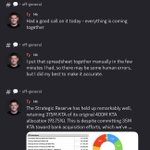
Ty says in the Discord update below that they’ve been waiting five weeks for their issuance partner to enable the ACH Debit API so they can finish testing and launch.
So unless I’m missing something, Bivo is the holdup right now.
They had already gotten the green light from all parties involved before an additional compliance review came up because of the complexity of supporting multiple currencies. Something that was supposed to take three days ended up taking three weeks.
Now they’re still waiting on ACH Debit, and Ty says they’ve been told week after week that it would be enabled.
The plan is still to launch 10 stablecoins in parallel.
It sounds like the compliance hurdle is behind them and the thing standing between where they are now and finishing testing is Bivo enabling ACH Debit.
Five weeks waiting on one API after being told week after week it would be enabled.
At this point, Bivo isn’t exactly sounding like a very efficient partner.
@KeetaNetwork $KTA


X Crypto retweeted
(1/4) BlackRock's new paper draws attention to something Keeta has been focused on for years.
As AI systems move from generating content to executing multi-step work, they will need to make payments. That shift doesn't fit the rails we’ve built the payments industry on.
xitter.cf/BlackRock/status/21024…

Our latest research paper explores the growing connection between AI and digital assets and explains why broad AI adoption may drive new demand, utility and applications across the digital asset economy. blackrock.com/us/individual/…


X Crypto retweeted
My deepest condolences to the Al Maktoum family and all those mourning Sheikh Ahmed bin Rashid Al Maktoum. May his legacy endure and may he rest in peace.

لطيفة بنت محمد: إنا لله وإنا إليه راجعون..
فقدنا اليوم عزيزاً على قلوبنا، وفقدت دبي والإمارات واحداً من رجالها المخلصين.. رحم الله الشيخ أحمد بن راشد آل مكتوم.. من سيبقى حاضراً في ذاكرتنا، وذاكرة دبي وناسها.. بما عرفناه فيه من طيبٍ ووفاء، وبما تركه من مسيرة محبة وعطاء لن يغيب أثرها. اللهم ارحمه واغفر له، وأسكنه فسيح جناتك، وألهمنا وأسرته ومحبيه الصبر والسلوان.

X Crypto retweeted
I’m incredibly excited to keep pushing the network forward. We’re still early in the work we’re exploring with Ziru Labs, and there’s a lot left to learn, but the potential is genuinely exciting. I believe this points toward where the industry is heading, and it’s a privilege to be at the cutting edge, exploring what’s possible and helping shape what comes next.


X Crypto retweeted

$KTA : Review 📜
What if a blockchain built compliance, identity, and bank connectivity into its foundation from day one, and the hardest part turned out to be getting anyone to notice?
Meet Keeta, a Layer 1 designed for regulated finance rather than DeFi, backed by former Google CEO Eric Schmidt and partnered with Google Cloud.
Through 2026 it has been quietly assembling real payment rails, tokenized bank deposits, cross-border corridors, and Gulf commodity ventures, while the market has largely looked the other way.
Let's explore the widest gap between infrastructure and attention in the series. 👇
⚪ Keeta at a Glance
Marketplace Insight: Keeta competes with Ripple, Stellar, Canton, and Circle's Arc for the regulated settlement position, and its architecture is genuinely differentiated, with compliance, identity, and tokenization built into the base layer. Eric Schmidt's investment and the Google Cloud partnership are credentials most projects this size cannot obtain, and the rails are real: LayerZero tokenized bank deposits, HopNow covering 150-plus corridors, and Amalfi Jets embedding the wallet in private aviation bookings. The clean contrast is between the infrastructure being built and the market's response to it. Partnerships kept landing through 2026 while the token fell 95%, and an August security incident required nearly a percent of maximum supply from reserves to make users whole.
⚪ Mission
Keeta exists to make blockchain usable as settlement infrastructure for regulated finance. The argument is that existing rails, SWIFT and correspondent banking, are slow and expensive, while public blockchains are fast but cannot satisfy the compliance obligations banks operate under. Keeta's answer is to build identity verification, compliance controls, and tokenization directly into the protocol so institutions can settle instantly without leaving their regulatory framework, connecting any payment system or currency through a single layer.
🔵 A Brief History
Keeta was founded in 2022 by Ty Schenk, who came from fintech and software development, and spent its first years in stealth development. The project raised $20 million from a notable investor base that included Eric Schmidt, the former CEO of Google, a credential few projects at this scale can claim.
The token arrived before the network. KTA launched in March 2025 as an ERC-20 on Base, an unconventional sequencing that put a tradable asset in the market six months ahead of the chain it was meant to power. It peaked at $1.68 in June 2025 during the early enthusiasm.
Mainnet went live on September 22, 2025, enabling asset transfers from other chains, on-chain swaps, and simplified off-ramping, with the project claiming over 28.7 billion testnet transactions. The token rallied briefly to around $1.11 before beginning a long decline.
2026 has been a year of building rails against a falling chart. January brought an agreement to acquire an undisclosed bank using 35 million KTA to secure fiat rails and licenses, with regulatory approval still pending. Mid-year delivered genuine integrations: LayerZero for tokenized bank deposits and Keeta Stablecoins, an ASK Group joint venture for Gulf real-world assets, and an opened anchor ecosystem.
August tested the network directly. On the 18th, a security incident forced Keeta Mainnet into read-only mode. The team disclosed publicly, said the issue was isolated to one component without affecting anchors, external connections, or KTA on Base, identified the attacker's infrastructure, and issued a 72-hour return demand with a bounty offer.
On the 25th, mainnet resumed full operation with affected balances restored from the Strategic Reserve at a cost of roughly 9.3 million KTA, alongside the launch of Keeta Sentinel, an outflow guard checking asset movements against configurable limits and rolling budgets. The month closed with a HopNow partnership across 35-plus currencies and 150-plus corridors, and Amalfi Jets becoming the first private aviation company to embed Keeta Wallet in its booking flow.
🔵 Ecosystem Narrative
The organizing idea is that regulated institutions need settlement infrastructure that satisfies compliance at the protocol level.
➛ Compliance-first architecture. Identity verification, KYC controls, and permissioning are built into the base layer rather than added through applications, which is the design choice that differentiates Keeta from general-purpose chains.
➛ Anchors and interoperability. The Anchor SDK creates bridges connecting Keeta to external networks including Base, with continued releases through 2026 and an opened anchor ecosystem aimed at making the network a hub rather than an island.
➛ Payment rails and corridors. A HopNow partnership extending currency acceptance, conversion, and settlement across 35-plus currencies and 150-plus countries and corridors, including RTP-style settlement and stablecoins, addressing the on and off-ramp problem directly.
➛ Tokenized deposits and RWAs. LayerZero integration for tokenized bank deposits and Keeta Stablecoins, alongside an ASK Group joint venture tokenizing Gulf real-world assets including physical commodities.
➛ Keeta Sentinel. An outflow-guard service built after the August incident, requiring signed API submission for outbound flows, valuing them in USD with live FX, and checking against configurable limits and rolling budgets, a structural response rather than a patch.
➛ The bank acquisition. An agreement signed in January 2026 to acquire an undisclosed bank using 35 million KTA, intended to give the network direct fiat rails and banking licenses, with regulatory approval still outstanding.
⚪ Token Utilities
$KTA serves two primary functions on the network.
➛ Transaction fees: pays for network operations and acts as the spam-prevention mechanism.
➛ Governance: holders participate in decentralized decision-making across the network's development.
➛ Strategic reserves: the treasury holds KTA used for corporate actions, including the 35 million allocated to the bank acquisition and the 9.3 million used to restore balances after the August incident.
➛ Note on form: tradable KTA remains an ERC-20 on Base rather than a native mainnet coin, which affects custody, wallet support, and how
holders actually access the asset.
⚪ Key Features
➛ Compliance, identity, and permissioning built into the protocol layer.
➛ Claimed throughput of up to 10 million TPS with sub-second finality, unverified by third parties.
➛ Anchor SDK and an open anchor ecosystem for bridging to external networks.
➛ Real-world asset tokenization including tokenized bank deposits and physical commodities.
➛ Keeta Sentinel outflow guards on asset-movement anchors.
➛ A fixed 1 billion maximum supply with no inflation.
🔵 Meet the Team
Keeta is led by a compact core team, with the founder as the primary public voice and an investor roster adding institutional weight.
▶️ Core Members:
➛ Ty Schenk [ @schenkty ] - Founder and CEO | Founded Keeta in 2022, bringing a background in fintech and software development, and has led the project through stealth development, the token launch, and the mainnet rollout. He personally led the public communication during the August security incident, posting the investigation, attacker identification, and recovery plan in real time rather than through a delayed statement.
➛ Roy Keene [ @yourpal ] - CTO | Owns the technical architecture behind the network's compliance layer, the Anchor SDK, and the interoperability work connecting Keeta to external chains, alongside the Sentinel outflow guard built after the August incident.
➛ Gabe Schenk [ @gabe_schenk ] - Head of Communication | Runs communications across the ecosystem, the function that carried the incident disclosure and recovery updates that did much to hold the community together through a difficult month.
➛ Eric Schmidt [ @ericschmidt ] - Investor | The former CEO of Google is an investor and has publicly endorsed the project's technical and regulatory approach. This is a genuine and verifiable credential, though an investor endorsement is distinct from operational involvement.
🔵 Ratings
➛ Use Case: ★★★★ (4/5). Keeta targets a genuinely valuable problem with a differentiated architecture, putting compliance, identity, and tokenization at the protocol layer rather than the application layer, and 2026 turned that design into shipped integrations rather than roadmap items. LayerZero tokenized bank deposits, a HopNow partnership spanning 35-plus currencies and 150-plus corridors, an ASK Group joint venture for Gulf real-world assets, Amalfi Jets embedding Keeta Wallet in private aviation bookings, and an agreed bank acquisition to secure fiat rails. Eric Schmidt's backing and the Google Cloud partnership add institutional credibility few projects this size obtain, and ChainSpect data showed roughly 21% daily transaction growth in late August. The 1-point deduction is adoption scale. The headline throughput claims derive from testnet without third-party verification, the bank acquisition remains pending, and Keeta competes against Ripple, Stellar, Canton, and Circle's Arc, all with far greater institutional volume.
➛ Tokenomics: ★★★ (3/5). The structure has genuine positives: a fixed 1 billion maximum supply with no perpetual inflation, roughly 60% now circulating, and clear utility as both the fee mechanism and governance token. The 2-point deduction is overhang and accrual. Unlocks run through August 2029 across 52 events, meaning years of scheduled supply still ahead, roughly 60% of eligible airdrop wallets remained unclaimed as of late 2025 creating a latent overhang that would activate on any price recovery, and there is no burn or fee-capture mechanism, so value accrual depends entirely on network adoption that has yet to materialize at scale. The August incident also consumed 9.3 million KTA from reserves, a real cost to the treasury.
➛ Audits: ★★★⯪ (3.5/5). Keeta holds a verified CertiK Skynet Score of 76.22, grade BBB, with six passed security checks, which is real third-party assessment rather than none. The response to August's mainnet incident also deserves genuine credit: the team disclosed publicly, isolated the affected component, confirmed anchors and the Base token were unaffected, identified the attacker's infrastructure, restored user balances in full from the Strategic Reserve rather than socializing losses, and shipped Keeta Sentinel as a structural outflow guard within a week. The 1.5-point deduction is the grade and the incident together. BBB sits two bands below the AA scores that earn 4.5, five medium-severity alerts remain unresolved on the panel, and an exploit costing roughly 1% of maximum supply is a demonstrated failure that a strong recovery mitigates without erasing. A named-firm audit and a lifted grade would move this meaningfully.
➛ Community: ★★★★⯪ (4.5/5). Keeta's community has been tested harder than most and has not dispersed. It held through a 95% drawdown, a week of the chain sitting read-only after the August security incident, and a long stretch where integrations kept landing while the chart kept falling. The team's handling of that incident is a large part of why: the CEO posted the investigation, the attacker identification, the return demand, and the recovery plan publicly and in real time rather than through a delayed statement, and users were made whole from reserves within a week. That kind of transparency under pressure builds the sort of loyalty most projects never earn, and the founder remains directly accessible to holders in a way larger projects rarely sustain. The 0.5-point deduction is reach rather than conviction: daily volume near $1M and a rank around #390 mean the committed base is real but small, and the network's visibility has not yet caught up to its ambitions.
🔵 Conclusion
Keeta is attempting something genuinely difficult and has assembled credentials most projects its size never obtain. Compliance, identity, and tokenization built into the protocol rather than layered on top. Eric Schmidt as an investor, a Google Cloud partnership, and through 2026 a run of shipped integrations rather than announcements: tokenized bank deposits through LayerZero, payment corridors across 150-plus countries through HopNow, a Gulf commodity tokenization venture, and a private aviation company embedding the wallet directly in its checkout.
The risks are substantial and specific. The token is down roughly 95% from its high while comparable projects rallied, making this an idiosyncratic decline rather than market weather. Daily volume sits near a million dollars with barely a hundred trades on a major exchange. The performance claims that anchor the pitch come from testnet with no third-party verification. Unlocks run to 2029 with a large unclaimed airdrop overhang on top, the bank acquisition has been pending for over a year, and in August the mainnet was exploited, costing nearly 1% of maximum supply from reserves to make users whole.
But the bull case has not disappeared, and the rails are becoming real. The response to the August breach, full disclosure, users made whole from reserves, and a new outflow guard shipped within a week, was better than most projects manage after a security failure. Keeta has built the architecture, secured serious backing, and is now assembling genuine payment infrastructure.
What it still has to produce, four years in, is verifiable evidence that volume is flowing through it.

X Crypto retweeted


For most of stablecoins’ short history, the key question was whether on-chain dollars could work at all.
That question has been answered, decisively, and at a scale few would have predicted.
A different question
has now taken its place, one that matters for billions of people and businesses around the world: What does adoption look like for everyone who doesn't transact in dollars?
Our latest research, The Case for Non-USD Stablecoins, explores this question.


X Crypto retweeted

🚨Some VERY surprising names are leading crypto developer productivity in 2026!
With @KeetaNetwork and @tezos coming in #1 and #2!
Now surprise to see $ICP is right near the top, while @StellarOrg, @avax and @hedera all rank ahead of $ETH on commits per developer. 👀
Would you have expected this list?
Data @chainspect_app 🔥
$HBAR $XLM $AVAX $KTA $XTZ

X Crypto retweeted
A keeta:native member saw (SAPEUR) moving on the network explorer today, and people already discovered something 👀
Artabos connects SAP ERP, the system most large corporates use for payments, to Keeta. They cite ~€600k FX savings on a typical €40M EUR spend
B2B flows about to 🚀

X Crypto retweeted

After listening to the @Kee_Talk space with @Sukukfi ( well educated) and hearing him speak so positively about Keeta, I walked away with one main takeaway.
He said:
“I don’t hold $KTA tokens, but we’re going to be using KEETA Network for our benefit. We’re coming from a selfish point of view because this is a better solution than the majority of Fintechs we’ve worked with in the past.”
That statement is one I loved hearing, its validation to what a lot of us have been saying for quite sometime…
Keep in mind, they also referenced testing hundreds of other networks since 2019. They’ve had years to compare different technologies, architectures, and solutions, yet after all of that, they still see #Keeta as the better option!!
This isn’t someone promoting a token they own. It’s someone looking at the network from a purely practical standpoint and saying, essentially, “This works better for what we need.”
To me, that says far more than any marketing campaign ever could
🤙
NETWORK OF NETWORKS

X Crypto retweeted
Just listened to Ty on Kee Talks discussing the security incident. There was a lot in there, so here are my biggest takeaways.
First, the response.
Within about 20 minutes of the issue, the team was on a call working it. They identified the problem within roughly 30 minutes and had a fix in less than an hour. That fix has been undergoing testing while they work on additional safeguards around the system.
One example Ty specifically mentioned was essentially a circuit breaker. If an anchor detects activity that isn’t normal, it could pause before more damage can occur.
Ty also talked quite a bit about what they’re learning from this.
Keeta is new technology in the sense that many of the individual ideas aren’t necessarily new, but they haven’t been combined into a system like this before. Ty said the system as a whole is something very few humans fully understand.
That makes what happened particularly important from a security standpoint. The affected component had been through multiple audits and reviews by credible auditors and engineers, yet none of them found the issue.
Ty said there is reason to believe AI may have assisted in the attack. His takeaway was pretty clear: the safeguards going forward need to go far beyond what they’ve relied on in the past, including ways of analyzing the system from perspectives humans may not think to look from.
They are also working with authorities, pursuing every avenue to identify the source, and looking at recovery options.
Ty said when he reached out to a series of partners, they responded within minutes asking how they could help. More importantly, he said those partners are continuing to work with Keeta on the initiatives already underway.
Considering everything we’ve talked about regarding partner risk after an incident like this, that’s about as good of a response as you could hope to hear.
Ty also confirmed something we’ve been talking about for a while. Prior to this incident, the team had been shifting from building to onboarding partners and facilitating volume. They still have a long list of partners to onboard and a lot of volume to facilitate.
This incident unfortunately adds another major item to that list and takes resources away from those core problems, but it doesn’t change what they’re working toward.
As for those affected, Ty reiterated that they will take care of affected participants. Exactly how that happens is still being worked through from the funding, technical, insurance and legal sides, so there isn’t an exact update on that yet.
Ty also acknowledged that simply using the reserve to replace the affected funds isn’t an ideal solution. If the reserve is ultimately used as part of making people whole, he said they will evaluate a buyback as well. I thought that was an important point to address because using the reserve was an obvious concern after the initial update.
Ty made clear that while this was severe, Keeta is in a position where they can recover from it. He said this could have easily been catastrophic, but fortunately they’re not in a position where they can’t recover.
I think that’s ultimately what matters now.
The incident happened. You can’t undo it. What matters is how you respond, whether your partners stick with you, whether affected people are taken care of, and what you learn from it.
So far, I think we’re seeing the response we needed to see.
Ty said Roy has completed the technical incident report and plans to share it after Kee Talks. That’s where we’ll get a much deeper look at exactly what happened and the actions taken.
I’ll be digging into that one when it drops.
@KeetaNetwork $KTA