

On the frontier of AI, robotics & science. Reading what's next before it trends.
Transmitting from 2030
Joined March 2021
- Tweets70.7K
- Following5.2K
- Followers55.5K
- Likes157K







New slopcore

As all programmers start taking the work of their coding agents completely for granted, the AI notices who still reads every line. 😍
New slopcore from yours truly!
h/t @anabology for Claudia


👀👀👀👀

We’re releasing a broad range of new mathematical results produced by an internal frontier model.
We’ve been consulting with the independent Advisory Group on Mathematics and Artificial Intelligence at the Institute for Advanced Study, and we have drawn on their advice and public recommendations to inform how we release these results.
github.com/openai/math

Would you post pics from your bedroom if your location could be instantly discovered?

Computer built a GeoGuessr LLM that poinpoints the location of an image, and shows all of its thinking steps.
It used the Perplexity SDK for web search, local place lookups, source page retrieval, and visual clue extraction.
It also used browser control to set up a Cesium account and API key for the 3D globe and satellite imagery.
Humanoid hype has the shape wrong. The first robots doing real work at scale will probably be wheeled bases with two arms, because wheels beat legs on any flat floor and factories and warehouses are mostly flat. Legs only pay off on stairs, and most work doesn't happen there.
Are you more excited or more scared about the future because of the rapid AI developments right now?
Always listen to Andrej

We'll be spending a lot more time trying to understand the outputs of language models. A few thoughts, tips & tricks:
Writing. Something I've had success with: Ask your LLM to explain something in ASD-STE100, it's a controlled language specification originally developed for aerospace maintenance documentation. LLMs well-versed in this language and it comes with heavy constraints on clean writing style that I often find a lot more readable. Sometimes I've tried to soften it a bit e.g. ask for "80% of the way to ASD-STE100" because the spec is quite stringent. But even better:
Diagrams / images. Instead of writing, ask your LLM to create a diagram. These can be a lot easier to process, parse, and understand. But even better:
Web pages. Ask for output "in HTML" to get a beautiful, interactive webpage. LLMs are getting really good at frontend and can create beautiful experiences, animations, etc. But even better:
Explainer videos. The output format I am most bullish on is fully custom / bespoke explainer videos generated on any arbitrary topic. Experiment with things like "Create a 3b1b style video explainer on X. Use my ElevenLabs API key for audio narration". (you'd need an API key for the latter or you can ask your LLM to find you decent free alternatives that use your local compute). This is actually starting to work!
In summary:
- As LLMs get better, they will do more and more of the legwork autonomously, and a lot more of our work will rise up the abstractions into oversight and understanding.
- Luckily, LLMs can help here too because as intelligence and code are increasingly abundant, you can ask for large, custom, discardable software artifacts (e.g. web apps, video explainers) that would have never made sense to create before. Push the boundaries here and you'll be surprised.

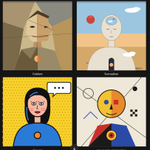
I asked Claude to draw a portrait of Claude and here's what I got:
Claude doesn't have a face, so I made one up: a calm, attentive figure with a small warm light at the chest. The same sitter appears in every style. First, the old masters and early modern work:
🧵👇

And finally, the 20th-century avant-garde, where the portrait stops trying to look like anyone at all:

"If you want to make a simulation of nature, you'd better make it quantum mechanical"
- Richard Feynman, 1981
Video by @GoogleQuantumAI
I wish Richard was alive today...
The power law is stronger than ever. The top 1% of exits make up 84% of all exit value, and the top 10% make up 94%. Among VC funds, the gap between the top decile and everyone else has never been wider.
23/n


