Theoretical Quantum Scientist
Joined May 2015
- Tweets1.4K
- Following167
- Followers1.1K
- Likes2.9K



Pinned Tweet
1/3 New work with Pablo Gaviria!
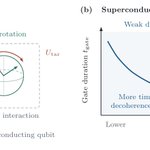
Quantum gates face a gate-speed/error tradeoff: stronger pulses make gates faster, reducing decoherence—but increase leakage, off-resonant excitation & crosstalk.
Can quantum resources break this tradeoff?
arxiv.org/abs/2609.19280

2
6
405
youtu.be/3yXtXTwz4J4?is=tO4d… Scott Aaronson has a good point here "we are not the arbitrators for who gets to work on our problems, the whole point of posing an open problem is that [...] it's open for absolutely anyone in the world to work on."
169
Nice that some mathematians are excited about LLM results in math

On 6 October, James Maynard was nervously checking his phone under the table throughout dinner. He’d heard rumors of a tsunami heading for the shores of math. When he checked in one last time from bed, the swell struck: OpenAI had released more than 700 math papers, generated with an advanced version of its AI model. They appeared to topple hundreds of long-standing problems, forcing researchers to face the reality that no problem in math is off-limits for machines.
At first, Maynard, a mathematician at the University of Oxford and recipient of the Fields Medal, math’s most prestigious prize, feared for colleagues whose work would be upended. But then he spotted a paper that offered progress on one of his favorite pastimes: the Riemann hypothesis, a puzzle about prime numbers and one of seven famed Millennium Prize Problems, often considered the most formidable in all of math. “I was like a kid at Christmas,” Maynard says. “Even if it was some scary monster giving me a gift, I was just so excited.”
The release comes less than 1 month after OpenAI announced a solution to the Navier-Stokes equations, another Millennium Prize Problem. OpenAI’s latest proof solves only a weaker version of the Riemann hypothesis. But Maynard, who made the most recent notable Riemann advance in 2024, says it is “groundbreaking” and likely to have payoffs for other problems across math. “Within analytic number theory, it’s obviously the best headline result for the past 100 years in the field.”
Learn more: scim.ag/4s9F8Ip

ALT A ScienceInsider headline reads, "AI edges closer to solving the Riemann hypothesis, one of math’s hardest problems."
139
Interesting perspective on why to do a PhD I math (should apply to quantum theory also) youtube.com/watch?v=LKrwhjOI…
2
191
Nice to see AI advancing quantum computing in practice. It will dramatically bring forward the date in which a useful quantum computer is achieved (assuming we reach this milestone one day)

An AI agent now tunes our lasers. Claude, working with @Anthropic, tuned 12 interdependent parameters on a QuEra testbed, found a ~220 kHz resonance the manual tune missed and cut it ~1000x. 19-hour soak, zero unattended lock drops. buff.ly/NBgJHKR

ALT Image from QuEra's story on AI agent laser calibration
1
112
1/ New paper with Tim Hoffreumon!
Does real quantum theory (RQT) remain experimentally indistinguishable from ordinary quantum theory once we include fermions and superselection rules?
Yes.
arxiv.org/abs/2610.06767

1
123
1/2 Our work is now published in PRX!
We show that the logical paradoxes associated with the Frauchiger–Renner experiment—and, more generally, any Wigner’s friend experiment—can be fully resolved without imposing extra assumptions or restrictions.
journals.aps.org/prx/abstrac…

The key is simply to account for the full knowledge available to each observer in carrying out their part of the protocol.
Unlike earlier partial resolutions, ours is fully general: it applies to all such protocols without additional assumptions.
Coverage quantumzeitgeist.com/ewfs-qu…

3
97
IBM want to develop silicone qubits
newsroom.ibm.com/2026-07-23-…

1
172
In preprint scirate.com/search?utf8=%E2%… Tim & I prove that the main conclusions of this Nature paper [600, 625–629 (2021)] are wrong: they claimed Real Quantum Theory (RQT)—an alternative theory to quantum theory proposed in the 80s and 90s—can be experimentally falsified... (1/4)

1
7
416

(1/3) If you've missed Sabine's @skdh recent take before the holidays on my co-authored work on why Quantum Theory doesn't need complex numbers, here it is youtube.com/watch?v=OPerW6YP… I think it's quite accurate.
1
185
quantamagazine.org/physicist… Quanta covers our work scirate.com/arxiv/2504.02808 & the German team showing that quantum theory doesn't need complex numbers. In addition to the discussion here, we actually showed that quantum theory based on real numbers is consistent with the postulates!

3
188
"So it looks as though we have entered the brief but enjoyable era where our research is greatly sped up by AI but AI still needs us."

I crossed an interesting threshold yesterday, which I think many other mathematicians have been crossing recently as well. In the middle of trying to prove a result, I identified a statement that looked true and that would, if true, be useful to me. 1/3
1
268
Great choice 👏

BREAKING NEWS
The Royal Swedish Academy of Sciences has decided to award the 2025 #NobelPrize in Physics to John Clarke, Michel H. Devoret and John M. Martinis “for the discovery of macroscopic quantum mechanical tunnelling and energy quantisation in an electric circuit.”

155
@dsfranca and I are looking for a joint Postdoc to work on aspects of quantum computing towards a quantum advantage. Applications are now open. Funding via the EU TouQan consortium grant quantera.eu/touqan/ Please retweet!

David Elkouss talking at QMQI about quantum networks @OISTedu. Full conference schedule here Https://workshop.oist.jp

1
6
557
V. Villasını talking at QMQI @OISTedu about Wigner's Friend: all agents can reason consistently without contradictions

100
@OISTedu Giulio Chiribella giving a talk about resource theory applied to quantum computing at QMQI Https://workshops.oist.jp/. He answers the question: what are the fundamental costs of implementing energetic gates with idealised control

35
Just left Singapore. Was Visiting Nelly Ng's and Mile Gu's groups at Nanyang university. We discussed fascinating ideas in quantum frequential computing.

1
27
2,618
Was great to talk about quantum frequential computing at FQC. I thank the organisers for their invitation and hosting the event in such a magnificent building.

Our next speaker is Mischa Woods, speaking about quantum frequential computing with a quadratic runtime advantage for all algorithms!
#FQC2024

4
398


