





WisedJay retweeted
Quand quelqu'un vous dit qu'il restera des jobs humains avec l'IA :


WisedJay retweeted
C'est évident.
Mais la plupart des gens ne comprennent pas le fonctionnement de l'économie et sont incapables d'imaginer un monde où l'IA produit sans les humains.
Ils veulent absolument imaginer des humains indispensables sans jamais se poser la question de leur valeur ajoutée.

WisedJay retweeted
Tu décris la fin du travail humain.
Oui la création de valeur va exploser.
Oui les projets, possibilités aussi.
Mais sans humain.
Encore une fois c'est une question de valeur ajoutée.
La production c'est du travail (des humains) + du capital.
Là, c'est le capital (l'IA) qui pourra tout faire en mieux et moins cher.
Ce n'est pas une question d'envie c'est rationnel.
Et au contraire c'est pas du tout pessimiste, c'est une bénédiction de libérer l'homme du travail pour que la machine prenne le relais.

Surpasser l'humain ne veut pas dire le remplacer.
Steph je te respecte énormément et j'apprécie beaucoup ton travail, mais je ne partage pas cette vision assez pessimiste de l'avenir (pour moi proche du doomerisme).
Oui certains métiers disparaîtront, une grande partie se transformera et de nouvelles professions, de nouvelles industries et de nouvelles possibilités émergeront.
Il y a encore tellement de choses à faire, à créer et à inventer.
Je pense que les discours annonçant la fin du travail humain reposent souvent sur deux erreurs :
1) Un manque d'imagination : nous avons du mal à envisager les métiers, les industries et les possibilités qui n'existent même pas encore.
2) Une vision trop statique de l'avenir : nous imaginons un monde où les besoins et les ambitions humaines resteraient les mêmes, alors que nos capacités technologiques exploseraient.
exemple concret : si demain une équipe de 3 personnes peut développer ce qui nécessitait auparavant 100 ingénieurs, cela signifie aussi que des milliers de projets jusqu'ici irréalisables deviendront accessibles.
Et peut-être que les emplois les plus menacés sont justement ceux qui consistent à exécuter des tâches répétitives, administratives, sans réelle valeur créative ni sentiment d'utilité pour ceux qui les accomplissent.
Leur disparition ne serait pas nécessairement une tragédie, à condition que cette transition permette réellement aux individus de se réorienter vers des activités plus enrichissantes, plutôt que de simplement perdre leurs revenus.
L'IA augmente le champ des possibles et déplace la complexité. Elle nous permettra de nous attaquer à des problèmes toujours plus ambitieux, en science, en médecine, en ingénierie, dans l'espace et dans bien d'autres domaines.
Ce n'est pas parce que les machines (des agents qui managent des agents) pourront presque tout faire que les humains n'auront plus rien envie d'accomplir.
L'objectif du progrès n'a jamais été de préserver indéfiniment chaque tâche humaine, mais de nous libérer des contraintes pour repousser les frontières de ce que nous pouvons accomplir.
WisedJay retweeted
Ça sera un peu plus long. Mais les robots humanoïdes feront tout cela. En mieux. En moins cher.

WisedJay retweeted

China created a system that simulates the earth with billions of AI agents that has real personality, memory, beliefs and human-like desires.
it gives them a terrifying ability to predict the future.
they published a paper called "Modeling Earth-Scale Human-Like Societies with One Billion Agents."
they built "Light Society," a framework that efficiently models human-like societies powered by large language models.
traditional agent-based models were always limited by simple, predictable behaviors.
but this new earth-scale simulation framework uses a "mixture-of-models" engine to change everything.
by combining massive llms with smaller, highly efficient distilled surrogates, the researchers successfully simulated a society of over one billion autonomous agents.
they grounded these agents using real-world demographic data from the world values survey. these agents don't just act like generic bots..
they exhibit sophisticated social behaviors that mimic actual, diverse human populations.
they ran simulations on trust games and massive opinion diffusion, tracking how information spreads and how society evolves in real-time.
the simulation proved to have incredibly high fidelity in modeling diverse social phenomena, giving researchers a practical foundation for hypothesis testing.
think about what this means for predicting global elections, market crashes, or how a population will react to a crisis..
you don't need to poll people or guess anymore. you just run the simulation.
the infrastructure for agentic simulation is scaling faster than anyone realized. social sciences and predictive modeling will literally never be the same..

WisedJay retweeted

Researchers proved you don’t need to train a transformer to simulate attention.
They published a paper that completely breaks how we think about building ai models..
Up until today, we thought the "attention mechanism" (the core engine of chatgpt, claude, and every major llm) had to be learned through massive amounts of data and millions of dollars in compute.
but a team of researchers mathematically proved that is false.
they found an "algorithmically achievable, data-agnostic solution" to simulate attention.
what does that actually mean in plain english?
it means you don't need to "train" the network for it to understand context and relationships in data. they proved you can algorithmically reconstruct the exact same attention mechanism without the insane computational overhead of learning it from scratch..
the math just bypassed the compute.
we have been throwing thousands of gpus at a problem that basically has a data-agnostic, algorithmic shortcut.
if this scales, the barrier to creating foundational models just got shattered. you wouldn't need a massive server farm to build the core architecture of an llm.
the era of "brute force compute" might actually have a ceiling..

WisedJay retweeted
🚨 MIT proved you can delete 90% of a neural network without losing accuracy.
Researchers found that inside every massive model, there is a "winning ticket”, a tiny subnetwork that does all the heavy lifting.
They proved if you find it and reset it to its original state, it performs exactly like the giant version.
But there was a catch that killed adoption instantly..
you had to train the massive model first to find the ticket. nobody wanted to train twice just to deploy once. it was a cool academic flex, but useless for production.
The original 2018 paper was mind-blowing:
But today, after 8 years…
We finally have the silicon-level breakthrough we were waiting for: structured sparsity.
Modern GPUs (NVIDIA Ampere+) don’t just “simulate” pruning anymore.
They have native support for block sparsity (2:4 patterns) built directly into the hardware.
It’s not theoretical, it’s silicon-level acceleration.
The math is terrifyingly good: a 90% sparse network = 50% less memory bandwidth + 2× compute throughput. Real speed.. zero accuracy loss.
Three things just made this production-ready in 2026:
- pruning-aware training (you train sparse from day one)
- native support in pytorch 2.0 and the apple neural engine
- the realization that ai models are 90% redundant by design
Evolution over-parameterizes everything. We’re finally learning how to prune.
The era of bloated, inefficient models is officially over. The tooling finally caught up to the theory, and the winners are going to be the ones who stop paying for 90% of weights they don’t even need.
The future of AI is smaller, faster, and smarter.

WisedJay retweeted

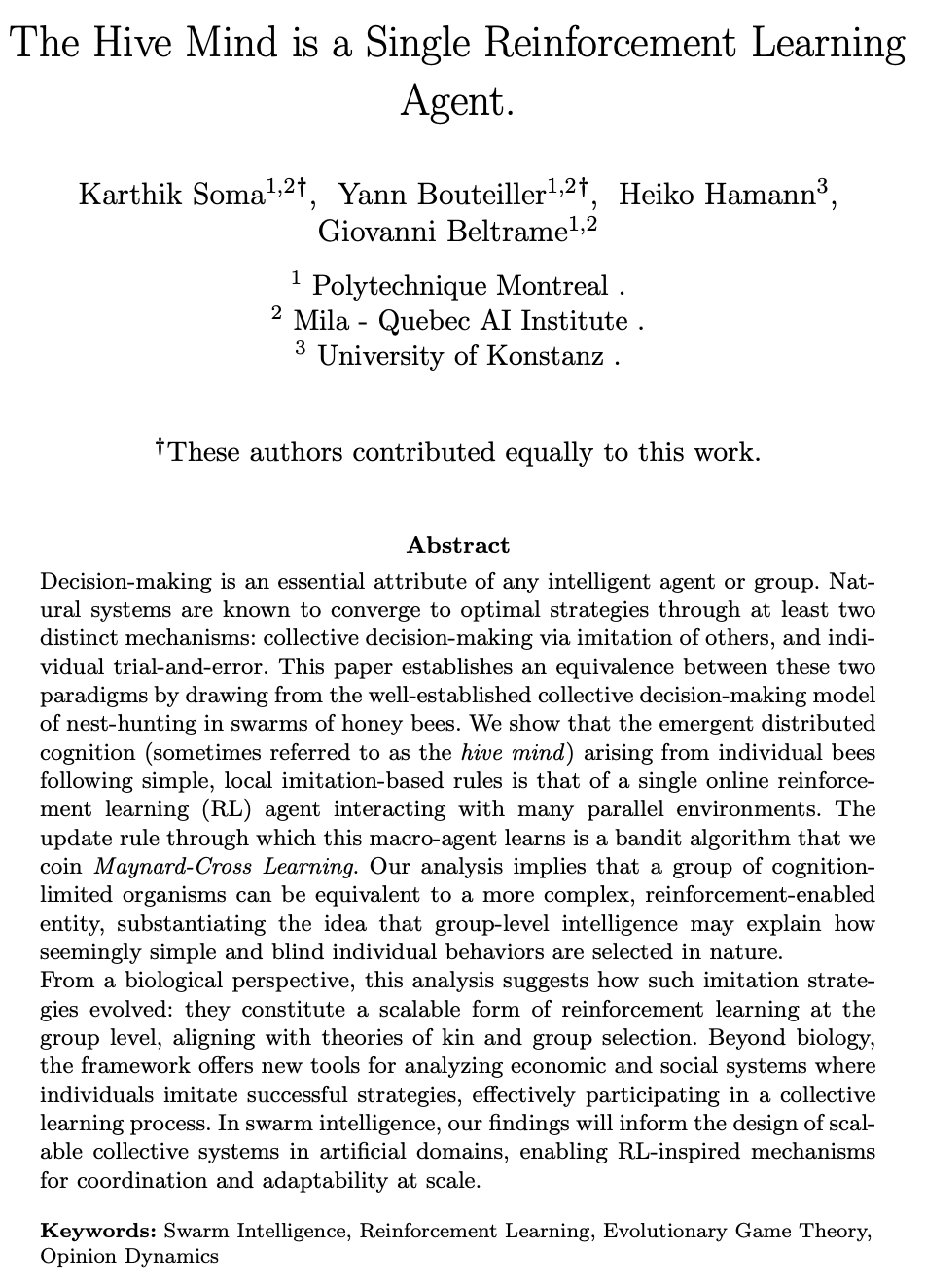
The Hive Mind Paradox
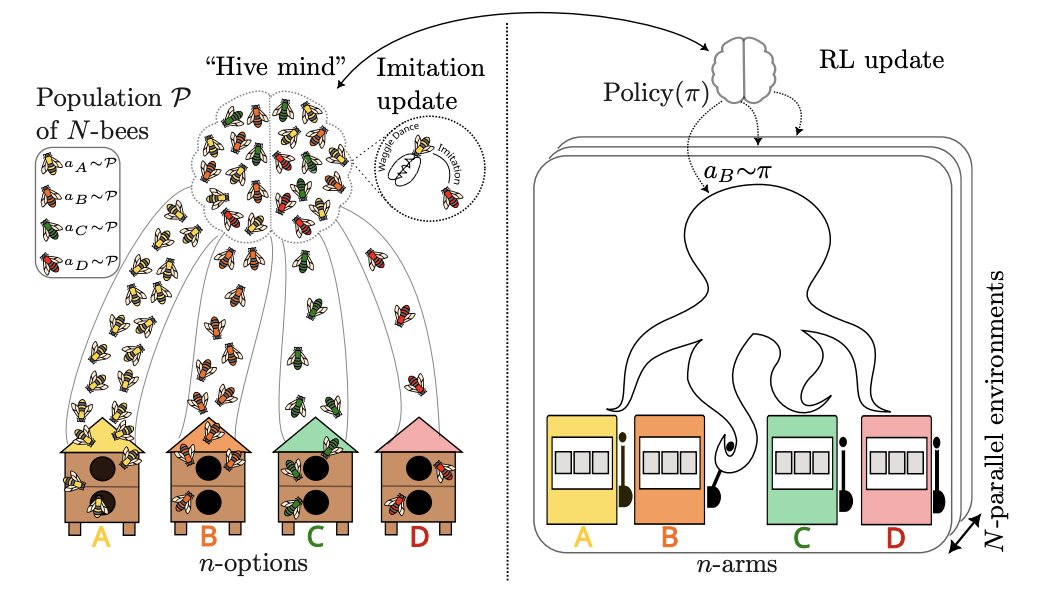
Scientists just proved something wild: a swarm of bees is mathematically identical to a single AI learning algorithm.
Not 'similar to.' Not 'inspired by.'
Identical.
Here's why this changes everything we thought about intelligence 🧵
For centuries, we've thought about intelligence in two separate boxes:
→ Individual learning (how YOUR brain works)
→ Swarm behavior (how GROUPS coordinate)
Turns out? This split is artificial.
The math proves they're the same thing.
Picture this: A honey bee colony needs a new home.
500 scout bees fly out. They find 10 possible nest sites—some amazing, some death traps.
Each bee can only visit ONE site. The data is noisy. The stakes are life-or-death.
How does the hive choose?
Here's where it gets wild.
Researchers modeled the waggle dance mathematically.
They derived the EXACT equations governing how the swarm converges on a decision.
The result? The swarm doesn't act like a reinforcement learning agent.
The swarm IS the agent.
Think of it this way:
Each bee = one GPU in a data center
The waggle dance = gradient updates
The hive = a single neural network
500 bees = 500 processors running in parallel, solving the same optimization problem simultaneously.
Nature built distributed computing first.
But here's the crazy part—
When they tested "smarter" individual bees (ones that process more data, verify information, think harder)...
...the system got SLOWER.
Smarter individuals = worse collective performance.
Why?
The calibration problem.
Imagine you and I rate restaurants. Your "7/10" might be my "9/10." We can't compare scores—we don't share an internal scale.
Bees have the same issue. One bee's "great nest" rating means nothing to another bee's sensors.
So what do they do?
They don't compare at all.
Each bee just broadcasts enthusiasm (waggle dance frequency) based on ITS OWN experience.
The hive doesn't need shared metrics. It aggregates VOLUME, not values.
Evolution's insight: Don't optimize for smart individuals. Optimize for CHEAP cognition at scale.
The implications are staggering:
→ Robot swarms that coordinate without central control
→ Economic models where markets ARE the learning agent
→ Understanding Twitter/TikTok as literal hive-mind algorithms
→ Rethinking where "intelligence" actually lives
Evolution figured out distributed computing 30 million years before AWS.
Maybe instead of building smarter AI agents, we should be asking:
"What's the UPDATE RULE?"
The swarm isn't IN the bees. The swarm IS the brain.
WisedJay retweeted

I am deskilling myself with AI so quickly on so many annoying tasks I don't want or need to be skilled at. Cannot deskill on these fast enough.
WisedJay retweeted
I just read a paper that completely broke my brain.
It describes a system that solved an AI task with over 1,000,000 sequential steps... with ZERO errors.
Using AI models that are known to be flaky and make mistakes.
How is that even possible? 🤯
We all know LLMs have an error rate. Even 99.9% accuracy is a death sentence for long tasks.
Imagine you need 1,000 correct steps in a row. With a 99.9% success rate per step, your chance of finishing the whole thing is only ~36%.
At a million steps? Forget it. It's statistically impossible.
So for years, the race has been to build bigger, "smarter" models to get that per-step error rate closer to zero. We're trying to build a perfect genius.
But this paper ("Solving a Million-Step LLM Task with Zero Errors") does the complete opposite. It's a total paradigm shift.
Here's the "holy shit" moment:
Stop trying to make the AI perfect. Instead, build a system that's immune to its imperfections.
How?
Smash the problem into the tiniest possible pieces. (They call it Maximal Agentic Decomposition).
Have a team of simple, cheap AIs vote on the answer for each tiny piece.
It's less like hiring one world-class chef and praying they don't have an off day, and more like designing the McDonald's kitchen.
The system guarantees the burger is the same every time, even if any individual worker could mess up.
The reliability comes from the process, not the person.
They tested this on the Towers of Hanoi puzzle—a classic benchmark where AIs fail spectacularly as the task gets longer.
They set it up for 20 disks. That requires 1,048,575 perfect moves in a row.
(seriously, over a million steps)
A single AI trying this would be a comedy of errors.
But their system of "micro-agents" voting on every single move... nailed it. Flawlessly.
And the plot twist? The most expensive, "state-of-the-art" models weren't even the best for the job. A smaller, cheaper model (gpt-4.1-mini) was more cost-effective because the tasks were so simple.
This is a huge deal for AI safety, too.
A single, god-like AI is a black box. It's unpredictable.
But a system of a million simple agents? You can inspect it. You can audit each step. The agents have no grand "worldview"—their entire existence is to solve one tiny puzzle and then disappear. It's controllable.
So next time you're building something with an LLM, maybe stop asking "how can I prompt the model to be smarter?"
And start asking: "How can I design a system where it's okay for the model to be dumb?"
The real power isn't just in the model. It's in the architecture you build around it.
This isn't just about AI. It's a fundamental lesson in engineering and problem-solving.
You don't always need perfect components to build a perfect machine. You just need a damn good design.
...which makes you wonder what else we're trying to solve by chasing individual perfection instead of building better systems.

WisedJay retweeted

Human civilization is about to gain trillions of extra (200+ IQ) minds.
For all of history, progress was limited by the tiny number of genius level humans alive at any moment.
A few thousand extraordinary minds per generation had to push the entire species forward.
One Einstein.
One Newton.
One Tesla.
One Turing.
One von Neumann.
One Feynman.
Civilization was bottlenecked by biology,
by lifespan,
by education speed,
by attention,
by memory,
by fatigue,
by the number of rare geniuses nature happened to produce.
That bottleneck will soon be obliterated. To achieve this asap, we need to build as many chips and data centers as possible, as fast as possible.
The 2030s will not be just very advanced. They will be unreal. Well beyond Star Trek level.
WisedJay retweeted

I genuinely don’t understand why people are so offended by the idea of someone with zero artistic talent being able to create something beautiful using AI.
Since when did creativity become an exclusive club where you need years of training just to be allowed in?
Sounds a lot like gatekeeping to me.
WisedJay retweeted
People need to know and understand what's happening right now
722 AI math papers from OpenAI.
53 math problems solved by DeepMind Nexus AI
(Google DeepMind’s AlphaProof Nexus solved 9 open Erdős problems, including 2 that had remained unsolved for 56 years, and proved 44 open integer sequence conjectures, with proofs formally verified in Lean).
There are many others (mostly done by individuals using the newest ChatGPT model or Claude Opus 5.5).
My point:
We're still only 1/3 of the way through this month, and we're quickly approaching the first month in world history in which AI will solve 1000+ math problems.
If the pace remains the same or accelerates (OpenAI is rumored to have 2 more big drops coming), we could reach or exceed 3000 problems solved this month alone.
This will probably be equivalent to 50-100 years worth of math progress (at normal human speed).
Reminder:
September: the number of solved problems was 10x lower (or lower).
August: ~10x lower than in September.
So we're talking here about more than 100x jump in barely 2 months.
Can you see where this is going? Soon: physics, chemistry, biology, materials science, and all other hard sciences.



WisedJay retweeted

This is a golden age for curious people, scientists, and builders.
You don't need endless money or a perfect idea to get started. You need curiosity, experimentation, and the ability to execute and find the right product-market fit.
Keep trying. Keep experimenting. And most importantly, stay aware of whats happening!
you'll eventually figureout what works.