

The largest and the most reliable Ranking of Universities: 30 000 Higher Education Institutions from all over the World https://xitter.cf/t.co/demGfsSsKa
Spain
Joined March 2020
- Tweets922
- Following59
- Followers840
- Likes257




Ranking Web of Universities: Webometrics retweeted

#SCImagoResearch | More than 55% of records in open databases are missing affiliation information.
When evaluating institutional output or calculating precise citation indicators, standardization and consistency remain the key differentiators of curated databases.
Read the findings from our comparison between open sources and Scopus: 👇scimagolab.com/open-vs-curat…
#SCImagoResearch #OpenAcces #BibliographicDatabases

Congratulations to the editor of the Ranking Web HcDr Isidro F Aguillo for being included in the new 2026 edition of the Ranking of Stanford of the researchers that are in the top 2% most cited of the world. It is the 7th year in the row
Ranking Web of Universities: Webometrics retweeted

📸 Ayer celebramos la Simon-Goldin Lecture '26 con
@g_escribano y... ¡la hora y media de conferencia se nos hizo corta!
¡Muchas gracias a Gonzalo y a todas las personas que nos acompañaron!
Os dejamos algunas imágenes de la jornada 👇


Ranking Web of Universities: Webometrics retweeted

Just a few visualizations that have been added or updated in the visualization catalog graphica.app/catalogue/


Ranking Web of Universities: Webometrics retweeted
#SCImagoResearch | Does having more bibliographic records guarantee better data for research evaluation?
We analyzed over 650 million documents (1996-2024), comparing open databases (OpenAlex, OpenAIRE, The Lens) with Scopus. The results reveal a clear trade-off between coverage and metadata completeness.
Read the full analysis here: scimagolab.com/open-vs-curat…
#Bibliometrics #Scientometrics #OpenResearch
Ranking Web of Universities: Webometrics retweeted
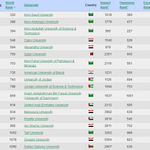
Asia is redefining the global standards of research excellence. Explore the top 10 institutions leading the region in the SCImago Institutions Rankings (SIR) 👇
Beyond sheer volume, these leaders excel in translating science into real-world impact. SIR evaluates this complex ecosystem through 20 open and auditable metrics across Research, Innovation, and Societal Impact.
Shift the conversation from monitoring to active strategy. Analyze the data behind Asia’s scientific powerhouse and elevate your institutional standing: 🔗👇
scimagoir.com/rankings.php?s…
#SIR #Universities #AsiaticRegion

Ranking Web of Universities: Webometrics retweeted
#ScimagoIRIS | Research integrity is not imposed: it is managed with data, governance, and strategic vision.
SCImago IRIS establishes itself as a benchmarking and early-warning tool for higher education institutions, designed to transform scientometrics into an asset of institutional trust.
How does the model work?
🔸Methodological framework: Z-score normalization (where 0 represents the global average), allowing complex dimensions to be compared on a standardized scale.
🔸Strategic interpretation: Positive values indicate a higher potential exposure to scientific risks, facilitating the preventive detection of unusual patterns and structural vulnerabilities.
🔸Adaptable model: It operates with a dynamic set of indicators that continuously evolves according to the transformations and ethical demands of the global scientific ecosystem.
🔸Non-punitive purpose: It does not rank or penalize; it provides actionable intelligence to support informed leadership decisions.
The credibility of open knowledge begins with the institutional capacity to anticipate its integrity risks.
Explore your institution's broader landscape on our interactive platform and request a detailed report: 👇scimagoiris.com/integrity-ri…
#SCImagoIRIS #ResearchIntegrity

Ranking Web of Universities: Webometrics retweeted
On World Breast Cancer Day, data enables us to measure scientific progress. 📊
Through the SCImago Journal & Country Rank (SJR), we highlight the role of oncology journals as key vehicles for driving transformation in both knowledge and clinical practice.
📈 The top-ranked journals originate primarily from the United States and the United Kingdom. Analyzing these indicators helps identify trends in scholarly communication across the field and map the priority research areas addressed by leading publications.
Excellence in research fosters a tangible impact on society when shared with rigor and transparency.
Explore the full ranking at 👉 scimagojr.com
#SCImagoSJR #JournalRank #PinkOctober #Oncology

ALT Global Landscape of Scientific Publishing in Oncology SCImago Journal Rank
Ranking Web of Universities: Webometrics retweeted
The SCImago Journal & Country Rank (SJR) is a fully open-access platform mapping the global influence and visibility of scholarly journals. 📊📖
Its indicator values prestige, not just citation counts:
📚 Scientific Influence: Citation quality based on its origin.
🌐 Global Visibility: Positioning within the scholarly network.
📈 Editorial Strategy: Professionalization of scientific publishing.
By weighting citations based on the citing journal's prestige, the SJR enables equitable comparisons across disciplines.
A strategic compass for editors and researchers. 🧭 👉scimagojr.com/journalrank.ph…
#SJR #SCImago
Ranking Web of Universities: Webometrics retweeted

I’ve missed this book and now I’ve added a sample to my Kindle to see if it’s worth reading in depth 📖

Ranking Web of Universities: Webometrics retweeted
#ChartOfTheWeek | Who commands the digital discourse across the global news ecosystem?
The SCImago Media Rankings (SMR) 2026 report—Web Reputation of International Television and Media Outlets—uncovers a pronounced structural asymmetry in global visibility and web positioning across the world's leading news organizations. 🧵👇

ALT Geographic and linguistic distribution of the Global Top 100 in the SMR
Ranking Web of Universities: Webometrics retweeted

Muy interesante el testimonio que se recoge en este paper donde se presenta un nuevo benchmark de preguntas teóricas de física.
Cada pregunta le llevaría a un experto mundial en la materia un máximo de 24h, y con ellas se ha buscado medir el nivel de los modelos actuales.
Inicialmente GPT-6 Astra consiguió una muy buena puntuación cercana al 90%, lo cuál ya es sorprendente. Aún así cuando investigaron dónde se encontraban los errores que la IA había cometido, Astra insistía en que su formulación era la correcta, y que debía de haber algún tipo de error en los cálculos de los expertos humanos que habían diseñado esas soluciones.
Efectivamente lo había, la puntuación de Astra final fue del 98%


Ranking Web of Universities: Webometrics retweeted
🇪🇺 ¡Mañana presentamos la @ESS_Survey!
Una jornada para conocer sus innovaciones y explorar cómo sus datos ayudan a comprender nuestras sociedades.
Desde las 16:00 horas en la sede central del @CSIC.
Inscripción gratuita:
saco.csic.es/apps/forms/s/Ao…

Ranking Web of Universities: Webometrics retweeted
SCImago Graphica evolves to version 2.0 and transforms into a web application! 🚀🌐
We are taking a step forward with a much more expressive and stable graphics engine, available directly from your browser with no installation or login required.
Key new features:
🎨 Redesigned interface: More intuitive.
🧭 Chart Advisor: Upload your dataset and it suggests the ideal visualizations for your data, ready for editing.
📊 Catalog of 42 renewed visualizations: Alluvial diagrams, temporal networks, cartograms, sunbursts, and more.
✨ Expanded graphic grammar: Waffle charts, new cartograms, data-anchored annotations, and accessible color palettes.
📘 20-chapter manual: Comprehensive guides from dataset preparation to maps, networks, and clustering.
💾 Were you using the desktop version? You can open your .gph projects in the new version without losing anything.
We invite you to try it at:
🔗 graphica.app
@ScimagoGraphica


SCImago Graphica 2.0 is here, now 100% in your browser 🎉
No install, no account, and your data never leaves your device.
New Chart Advisor, a catalogue of 40+ ready-to-use visualizations and a redesigned interface.
👉 graphica.app

Ranking Web of Universities: Webometrics retweeted
#SCImagoIRIS | The crisis of trust in science demands a paradigm shift: we must move from evaluating solely volume and impact to ensuring ethical robustness.
Universities have the power to mitigate these risks through their incentives. With SCImago IRIS, we provide the key indicators to map and manage scientific integrity risk before it compromises institutional reputation.
👉 Discover how to apply the SCImago IRIS approach at your institution: scimagoiris.com/integrity-ri…
#ResearchIntegrity #IRIS
Ranking Web of Universities: Webometrics retweeted

Españoles en Information & Library Sciences
9a edición del Ranking de Stanford (2% Top cited)
elsevier.digitalcommonsdata.…
Ortega, JL
de Moya, F
Delgado López-Cózar, E
Pinto, M
Bordons, M
Aguillo, IF
Torres Salinas, D
Borrego, Á
Orduña Malea, E
González Alcaide, G
Rafols, I
Costas, R
Ranking Web of Universities: Webometrics retweeted

21 de los 45 científicos peruanos del 2% más citado del mundo de la lista de Standford/Elsevier del 2026 son médicos del @CMP_PERU
7 de @CayetanoHeredia
5 de @cientifica_sur
4 de @usil_edu

Ranking Web of Universities: Webometrics retweeted
Want to maximize the impact of your research? 📈 Choosing the right scientific journal is step one.
Discover how to:
📊 Navigate SJR quartiles
🚫 Avoid predatory publishers
📋 Apply a 7-step methodology to select the perfect home for your manuscript.
👉 Read our full step-by-step guide on the blog and start planning your next submission today 👇scimagolab.com/how-to-select…

Ranking Web of Universities: Webometrics retweeted
⚠️ Higher exposure: Western Europe (0.11) and Northern America (0.09) are the only regions displaying positive values, evidencing a greater structural reliance on hyperauthorship dynamics.
📉 Lowest incidence: The Asiatic Region (-0.79), Middle East (-0.63), and Africa (-0.56) present the lowest global exposure to this specific scientometric risk.
🌎 Conservative profiles: Latin America (-0.25) and Eastern Europe (-0.41) maintain negative values, suggesting a lower incidence of these practices within their scientific output.
🔍 Explore our SCImago IRIS platform and discover the specific scientific risk indicators of your institution to strengthen your governance. 🔗👇
scimagoiris.com/integrity-ri…
Ranking Web of Universities: Webometrics retweeted
Monitoring these indicators is a strategic, non-punitive tool. It empowers policymakers and research managers to review co-authorship practices, ensuring that institutional positioning and publication volume are consistently backed by transparency, accountability, and meaningful scholarly contributions.
📥 Want to evaluate your organization's risk profile and publication structure? Request the detailed SCImago IRIS report for your institution. 🔗scimagoiris.com/contactus.ph…