

The Future of Real Estate Investment
Joined October 2024
- Tweets64
- Following58
- Followers114
- Likes35







An outlook and a protection design answer different questions. Read them side by side. Not investment advice. #WEBLOCK #RWA #RealEstateTokenization
Our thesis: tokenization has solved issuance but not default. The missing layers are Evidence, Remedy and action-specific gates.
For that claim, scale is not the test. The test is what a holder can rely on when something goes wrong.
Any outlook for managed assets implies more claims, held by more people, in more forms. A tokenized property claim is one of those forms.
Morgan Stanley Insights has published an article on the asset and wealth management growth outlook to 2030. We do not restate its figures here. We ask a narrower question.

In WeBlock's view, issuing a token is no longer the hard part of real-estate tokenization. Handling a default still is.

Two layers are missing. Evidence: proof of the real-world state. Remedy: what happens when a tenant or borrower fails. Action-specific gates are the third element.
A product that cannot describe its failure case is incomplete, however clean its issuance record. Not investment advice. #WEBLOCK #RWA #RealEstateTokenization
Avalanche C-Chain is WeBlock's chosen reference execution environment. That describes where the contracts run. It describes nothing else.
Choosing a chain is an engineering decision. It is not a statement about the rights behind a token. WeBlock's product, the RBT, is a tokenized claim on a specific property's rental income.

A token can be perfectly valid while the right it represents is broken.
That gap is what our new technical paper is about.
WeBlock has published "The Fourth Proof" — Edition 1.0, on rights continuity for real-world assets, with an Avalanche reference architecture. 🧵

Our position: RWA infrastructure should be judged by continuity of rights through failure, not by issuance alone. Korea is the proposed first proving ground.
Read Edition 1.0: weblock.land/tech-paper
And when failure does arrive, it runs a defined course — 11 states from OBSERVED to CLOSED.
A monitoring feed can open a case. It cannot declare default.
That separation keeps an oracle from exercising legal discretion.

Cross-chain messaging is asynchronous. We never equate message delivery with legal DvP.
Eight stages are explicit: Intent, Validate, Dispatch, Acknowledge or Reject, Finalize, Timeout, Abort or Compensate, Reconcile.
A message arriving is not a thing having happened.
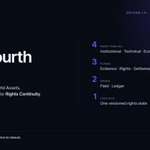
The architecture is 4-3-2-1.
4 proof families
3 planes — Evidence, Rights, Settlement
2 speeds — Field and Ledger
1 versioned rights lifecycle
The central object is not a token. It's a versioned rights state.
These are evaluated per action, not as one global gate.
A routine transfer doesn't need a fresh valuation. Collateralization does.
One uniform check makes a system simultaneously too strict to use and too loose to be safe.
