
Assistant Professor at UIUC MatSE, Postdoc at Harvard SEAS/Wyss Institute, Bioengineer, Materials scientist, Chemist
Urbana, IL
Joined November 2015
- Tweets542
- Following700
- Followers889
- Likes1K





Thank you for the support. Excited to join the Sontag community!

We are excited to announce that Hua Wang, Ph.D. from @UofIllinois is our third DSA recipient of 2024! His project is titled 'New-Generation Exosome Vaccines for Treating Glioblastoma.' bit.ly/3ZyrzEq
#TheSontagFoundation #DSA2024 #DSAGrantee @WangLabUIUC

Thanks for the highlight!

#ILLINOIS researchers earned a $946K American Cancer Society grant to develop a vaccine for solid tumors like triple-negative breast cancer and glioblastoma.
“It affirms our critical cancer research,” said Carle Cancer Institute's Hau Wang.
▶️bit.ly/4hc3RFY

ALT A group of eight laboratory researchers in white coats standing together in a lab setting.
Excited and humbled to receive the 2024 Sontag Distinguished Scientist Award. My group and I are grateful for the tremendous support from the Sontag Foundation and @IllinoisMatSE @CancerCenterIL ! We will continue our quest for therapeutic cancer vaccines and immunotherapies!

Congratulations to Assistant Professor Hua Wang, whose critical work to fight back against deadly brain cancer by developing vaccines has earned the Distinguished Scientist Award from The Sontag Foundation. His team earned $750K for research support.
matse.illinois.edu/news/7203…

Thanks for the shout-out! This grant will allow us to further develop our mRNA-based cancer vaccines for treating solid tumors including glioblastoma and breast cancer. Looking forward to continuing to collaborate with Shuming (BioE), Joseph (BioE), Xing (BioE), Wael (Carle)
Congratulations to Assistant Professor Hua Wang, who has earned $946,000 in funding as part of the American Cancer Society Research Scholar Award.
Wang's team is innovating in the medical space by developing mRNA-based cancer vaccines for treating solid tumors.
For Immunomaterials, Park et al. @fischbcl17 @ Paszek Lab report the ability of tumor cells to utilize the mineralization of collagen in the extracellular matrix to evade the attack of natural killer cells.
onlinelibrary.wiley.com/doi/…

Bo et al. discuss how immunomaterials have enabled one to skip the lengthy and costly process of identifying tumor-specific antigens, by making use of the in situ generated tumor antigens to provoke potent effector T cell response.
onlinelibrary.wiley.com/doi/…
Han et al. @JHElisseeff find that the signatures of inflammation and interleukin-17 signaling (sign of type-3 immune activation) increase with injury and treatment in aged animals, providing new insight on the immune-regeneration axis.
onlinelibrary.wiley.com/doi/…
Pirozzi et al. provide a nice review of another class of mechanically active materials - artificial muscles - with a specific use case of cardiac assistance.
onlinelibrary.wiley.com/doi/…

Mendez et al. @ellentroche describe a hybrid hydrogel actuator that can elicit tunable mechanoresponsive release of drug from a hydrogel layer through pneumatic actuation. onlinelibrary.wiley.com/doi/…
Mendez et al. @ellentroche describe a hybrid hydrogel actuator that can elicit tunable mechanoresponsive release of drug from a hydrogel layer through pneumatic actuation. onlinelibrary.wiley.com/doi/…
Roy et al. @ClaudiaLoebel describe a bilayer hydrogel folding system that can generate folding patterns, similar to the mucosal tissue in the epithelium of the upper respiratory airways.
onlinelibrary.wiley.com/doi/…
Roy et al. @ClaudiaLoebel describe a bilayer hydrogel folding system that can generate folding patterns, similar to the mucosal tissue in the epithelium of the upper respiratory airways.
onlinelibrary.wiley.com/doi/…
For mechanically active materials, Nie et al. from the Rogers Group provide a nice review on using such materials for bio-interfaced sensors for continuous monitoring. @ProfJohnARogers
onlinelibrary.wiley.com/doi/…

For mechanically active materials, Nie et al. from the Rogers Group provide a nice review on using such materials for bio-interfaced sensors for continuous monitoring. @ProfJohnARogers
onlinelibrary.wiley.com/doi/…
We are thrilled to share the Special Issue "Engineering Active Materials for Biomedical Applications" in Advanced Materials, guest edited by David Mooney, Patricia Dankers, Ellen Roche, and me @ellentroche @IllinoisMatSE @BIOENGatIL
onlinelibrary.wiley.com/doi/…

We are thrilled to share the Special Issue "Engineering Active Materials for Biomedical Applications" in Advanced Materials, guest edited by David Mooney, Patricia Dankers, Ellen Roche, and me @ellentroche @IllinoisMatSE @BIOENGatIL
onlinelibrary.wiley.com/doi/…
Our lab had the honor & pleasure to host breast cancer survivors & warriors today. I always appreciate the conversation with the patient community and share with them the efforts we are making to advance novel cancer vaccines and immunotherapies to potential clinical translation.
It will be a long journey, but I cherish the mutual encouragement between patients and researchers. Thank you all for visiting the lab and educating my students from the other side. #MBC @CancerCenterIL @IllinoisMatSE
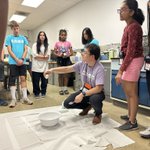
Yeah it is an ongoing fun week here at MatSE Illinois. Kids learnt how to make stuff smarter, cleaner, and stronger, and smashed some eggs on day 2!!! @StattAntonia @IllinoisMatSE @MRLatIllinois @uofigrainger


Having seen different kinds of comments from students over the years, this one really got me. Grateful for having such friendly and bright students.

Hua Wang retweeted

Submissions are open! I'm co-organizing the symposium "Democratizing AI in Materials Science — A Pathway to Broaden the Impact of Materials Research" at the Fall 2024 MRS Meeting: bit.ly/3UlnroT Deadline is June 24!
