

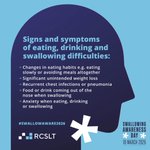


#SwallowAwarnessDay 2026! Speech and language therapists offer essential assessment for individuals with eating, drinking and swallowing difficulties.


WWL ACSLT retweeted

🤔 So what do we mean by CPD?
It's basically how you keep your skills sharp and your knowledge current: 'continuing professional development'. It's an essential part of safe and effective practice.
It could be training, discussing, reading, reflecting, having a learning under supervision - any activity that you learn and develop from.
It needs to be regular, outcome focused and self-directed.
It needs to benefit your service users and your practice.
Aside from that, it can be anything!
👉 Browse our support: hcpc-uk.org/cpd/cpd-resource…

ALT List of CPD activities including training, discussing, reading, reflecting, giving and receiving supervision on a blue background with HCPC logo and signpost icon.
Useful read ⬇️ Capacity, in this context, is the ability to pause instead of jumping to solutions, to keep conflict in the room and work through it rather than pushing it to the ‘meeting after the meeting’. We need to develop capacity as well as competence in our leaders.

To thrive and survive as a change or improvement leader in a big system, we need to be competent. We need to be able to redesign processes, apply improvement methods, analyse data, mobilise teams & achieve outcomes.
A February 2026 HBR article by Annie Peshkam (“To lead through uncertainty, unlearn your assumptions”) says that this isn’t enough. She distinguishes between “competence” (doing things well) and “capacity” (staying present when action will not resolve the tension). As change and improvement leaders, we have invested heavily in competence: QI methods, governance, pathways, PMO disciplines. We have invested far less in capacity: the inner steadiness, emotional regulation and shared sensemaking that allow us to hold complexity with our teams. Capacity is the ability to pause instead of jumping to solutions; say out loud what is difficult about a change; keep conflict in the room and work with it rather than pushing it into the “meeting after the meeting”.
The systems we work in are in sustained uncertainty: financial pressure, workforce depletion, reform agendas, unrelenting demand. Deloitte's Global Human Capital Trends survey of 14,000 leaders found that, in this context, we must look beyond efficiency and predictable results and instead elevate resilience, adaptability, and human connection. Yet our improvement/performance approaches still reward leaders who give quick answers, project confidence and absorb team anxiety. These assumptions shrink rather than expand our capacity to lead.
How can change and improvement leaders build capacity?
1) Embed personal practices of pause and reflection into our leadership routines, especially in "high‑stakes" meetings.
2) Start key conversations by naming the tension in the room and giving people time to speak to it before moving to plans.
3) Design our improvement structures (huddles, steering groups, programme boards etc) as “holding environments”, where disagreement and emotion are legitimate data, not distractions.
4) Stop carrying the burden alone: share sensemaking work with our teams, service users and communities, and make that sharing visible.
5) Invest in development focused on emotional steadiness, presence and curiosity, alongside the technical disciplines of QI and "change management".
We talk a lot about learning cultures. This article challenges us to cultivate unlearning cultures in addition. The shift from competence to capacity is not a “nice to do”; it is central to our ability to lead change and improvement in the face of relentless uncertainty.
hbr.org/2026/02/to-lead-thro…

WWL ACSLT retweeted
Have you heard about our CPD Week webinars? 👇👇
They're designed to give practical insights, refresh your knowledge and count as CPD (alongside appropriate reflection).
Learn more and register: hcpc-uk.org/cpd-week

ALT Schedule of CPD Week 2026 webinars by HCPC covering profiles, professionalism, communication, EDI, and advanced practice from March 2-6 at 1pm.
We did it! 2️⃣4️⃣ days of #evidencebasedcountdowntoChristmas Thank you to the adult community SLT team. We have covered a range of topics this year including patient feedback, interventions in profound disabilities, health literacy, apraxia, dysphagia, knowledge mobilisation …
And many many more! To give our self an extra task this year we have linked many to #fundamentalsofcare
Christmas Eve and it’s our final #evidencebasedcountdowntoChristmas and today we’re ending with the RCSLT Bulletin Our Digital World.
This addition has information on AI, its current use in #SLT and resources available to support our skills with health data and digital tools.
Day 2️⃣3️⃣ and we’re thinking about the different ways you can access the #evidencebase . Today we’re listening to a podcast about Dysphagia and Health Inequalities open.spotify.com/episode/2Tg…

By being aware of these factors we can help meet our fundamentals of care of #nutrition and #hydration #patientexperience #wellbeing #rightpersonrightplace
I think listening to a podcast is a good way to get information and I’ll keep doing it in 2026! #evidencebasedcountdowntoChristmas