

Classical education for the next generation.
Virginia
Joined June 2009
- Tweets5.6K
- Following257
- Followers2.8K
- Likes15.4K





Well-Trained Mind retweeted

Story of the World Volume 2, Revised and Expanded 25th Anniversary Edition, is now available as a digital download from Well-Trained Mind Press!
Over the last few years, I've been working on revising and expanding the Story of the World in celebration of 25 years in print. I've thoroughly enjoyed revisiting this project. It gave me the chance to streamline the chronology of the originals (I did more back-and-forthing than necessary, in 2001), to clarify a few things I wish I'd said more carefully, and to add some necessary content--more attention to Asian and African history to prepare readers for the third and fourth volumes, plus ten mini-biographies of fascinating and too-unfamiliar characters from the past.
Full curricula for Volume 2 available in February, but you can get a foretaste now.
youtube.com/watch?v=faZBbShM…
welltrainedmind.com/a/introd…
Well-Trained Mind retweeted

Just overheard a tiny little girl on the street saying the weather is getting “puddlier and puddlier” and that’s the new word for this year.
Well-Trained Mind retweeted
One of my oldest and dearest friends just sent me this picture...taken in Blackwells in Oxford, England. What fun to see this book, which remains one of my favorite projects, still on the shelves after nearly twenty years.
This is a good opportunity for me to do a writing update, if you'll indulge me! My most recent book, THE GREAT SHADOW, is still getting quite a lot of social media attention and media pieces, including (speaking of international readerships!) a lengthy feature from the Hindustan Times. I'm working on a book club supplement for the next edition, so if you enjoyed the book and would like to suggest a discussion question, please chime in! hindustantimes.com/lifestyle…
Our 25th Anniversary Edition of the Story of the World project continues, with Volume 2 (The Middle Ages!) coming out in February. I've already revised Volume 3 and am deep into Volume 4. I love the new editions--all the storytelling of the original, plus more depth and more fascinating characters.
google.com/books/edition/The…
And I've got some great new projects in the works. Stay tuned for updates.
Thanks for following.
susanwisebauer.com/books-by-…

Well-Trained Mind retweeted
I deeply appreciate this quote from a UK home educator:
**
People sometimes ask how I got the children to do their work. It wasn’t always easy, but the fact that they’d been home educated from the start was helpful. The younger ones looked up to the older ones and wanted to “do home ed”. In general, I tried to remember the home educator’s favourite truism that education is about lighting a fire rather than filling a bucket — and you can’t light a fire if one of you is crying, or cross, or tired. That meant, for example, that I did reading practice with one of my children while snuggled up in bed, taking it in turns to read a line each, because he found it especially hard. That same child used to hunker down under the table when tackling maths problems, so clearly unconventional learning spaces were his thing. (He now works sitting at a desk.)
I also see myself as more of a midwife than an obstetrician. Learning is the children’s job; my task is to facilitate that.
**
In my workshop "Homeschooling the Real (Distractible, Impatient, Argumentative, Unenthusiastic, Non-Book-Loving, Inattentive, Poky, Vague) Child," I always emphasize that there's nothing we can do to create a love of learning in our kids--all we can do is provide a space for that love to develop over time. (We also can't create gratitude, love, ambition, or any other of those innate desires. That's up to the child.)
You should be able to read the whole piece with the gift link below, but if not let me know and I'll try again.
thetimes.com/life-style/pare…
Well-Trained Mind retweeted

NEW Classical Liberal Arts at UVA headed by Jenn Frey & Angel Parham. Ideas founded in friendship; the tradition is being handed on!
as.virginia.edu/news/pilots-…


Well-Trained Mind retweeted
I love maps, which is why the September 4 UN resolution recommending (not mandating) use of the Equal Earth projection fascinates me.
Excuse me while I quote from The Well-Trained Mind:
"History and geography fall naturally together; every time you study an event or person, you'll want to look up the location on the globe, the wall map, and in the atlas (which will give you not only political borders but also a brief history of the region). NOTE: Don't neglect the use of a globe--all wall maps and atlases distort land masses by laying them out flat."
The Mercator projection that we all grew up with (and which was originally meant for seafaring navigators) does indeed distort northern land masses ENORMOUSLY. The attached graphic shows the difference between the Equal Earth projection (red, much closer to a global representation) and the traditional Mercator projection, which makes Greenland, Alaska, Canada, and Russia in particular seem much larger than they actually are.
We should all try to have an accurate understanding of the world, which is why I find it so mind-boggling that the United States was the single "nay" vote at the UN (there were 164 "ayes") endorsing the resolution. Apparently, as a country, we believe that a more realistic map is a "radical ideological project."
Well, some of us would just like a more realistic map.
Have a look at the United Nations report, and also at this excellent take on maps other than Equal Earth that try to correct the Mercator distortions.
futuremaps.com/blogs/news/to…
news.un.org/en/story/2026/09…

Well-Trained Mind retweeted
Y'all, another release date sneaked up on me!
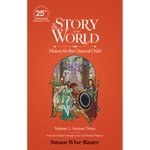
TODAY is the official publication day for the 25th Anniversary Edition of the Story of the World, Volume 1! And along with that, the 25th Anniversary Editions of the Activity Guide, Audiobook, and Tests.
The Story of the World was my first post-Well-Trained-Mind project, impelled largely by the fact that when my mother and I were putting together resources for recommendation, I couldn't find a world history program for younger students that I liked. So we suggested using history encyclopedias (which was fine as far as it went, just didn't give them the opportunity to read actual narrative history), and I started writing my own instead.
I was younger then. "Sure, I can write the history of the world!" I thought. But sometimes hubris yields something positive, and now I am constantly meeting adults who grew up reading the Story of the World and who still appreciate it.
This new edition gave me the chance to change up a few things I've long wished I'd done differently--like sticking to closer chronological order and paying a little more attention to Asian history. I think Rainbow Resource did a great job with their catalog copy summary, so I'm going to paste that below along with a few links. And if you have questions, post them here and I'll do my best to answer.
To head off the most obvious questions: we're revising the whole series, one set per year (so SOTW 2 in 2027, etc.); and yes, we're keeping the original series in print for the foreseeable future.
**
From Rainbow Resource Center:
Main Text:
The hub of the curriculum, Volume 1 25th Anniversary edition Student Reader keeps the previous edition’d content essentially the same. You’ll first notice the reordering or dividing of chapters (to better fit a chronological timeline). This, in itself, makes this edition not compatible with the previous edition. Ten new chapters are entitled History-Makers. These mini biography chapters include an Assyrian warrior queen, Draco and Solon, Zhang Qian (of the Silk Road), Judas Maccabee, and more. Chapters still explain the start of each major world religion (content is nearly identical to the previous edition). The previous material on Jesus and the start of Christian religion has been retained. This content is no longer a separate chapter, but is included in Chapter 36, Israel Under Roman Rule. The content summarized from Jesus’ Sermon on the Mount, now includes 6 rather than 8 key points. Additionally, 2 new chapters add Asian history: China (Han and other dynasties), one on Korea and Japan. Finally, one additional chapter discusses the Northern Barbarians. Not compatible with previous editions. 414 pages, sc. ~ Ruth
Instructor Guide
The Story of the World 25th Anniversary Expanded Edition Volume 1 Ancient Times Instructor Guide is packed full of the tools you’ll need to direct your student’s learning. Now the Instructor Guide and Student Activity books are separate volumes. This guide is extremely user friendly. This newest edition is a significant and outstanding update from the previous editions’ Activity Book. The larger, easy-to-read font and layout make the program more pick-up-and-go. Key tasks, the steps to take, and supporting activities and newly updated and expanded reading options are simple to choose from. The teacher oral script for student narrations, the review questions, and mapping exercises are bolded. Answers are written in simplified italics. Icons identify the plentiful Interactive Activities, and whether they are adaptable for a classroom; are low-prep, or those that require physical activity.
The Instructor Guide allows you to easily customize this course to your family or classroom needs. Yet, the key components are straightforward and easily implemented. Core Exercises will alternate between review questions and narration questions. Each chapter includes map work and student review cards (found in the Student Workbook). Activity options are labeled by type, and include math and science related, coloring pages, field trips, etc.
Sections are clearly identified: Read & Review; Narrations, Map Work, etc., with clear steps, supplies needed, etc. Additional History and Literature readings are updated and include brief descriptions. Newly updated, the annotated literature choices range from Christian to secular, so you can choose to meet your family’s needs. For activities, exercises, “Read and Review,” the parent’s script and answers are included. Typically, there are storytelling activities, games, memory work and more, providing additional ways to engage with history. Certain chapters provide a culminating activity (Celebrations).
If you are wanting to dive deeper and tailor the course specifically for you and your learners, detailed appendixes will resource you quickly—super user friendly. Briefly, these Appendixes include:
Appendix One: Creative writing prompt instructions
Appendix Two: Instructions for optional memory work activities
Appendix Three: Supplies needed (those frequently used and also products by chapter needed)
Appendix Four: Activities by Type (quick activities; art, chapter celebrations; classroom activities; cooking; craft; field trips; games; Low and No Prep; make a mode; math; memory work; movement’ picture study; and research skills.
Appendix Five: salt dough recipe
Appendix Six: suggested schedules (2-day; 4-day; co-op/classroom scheduling; and ends with a detailed 36-week schedule
I personally found this Instructor’s Guide very user friendly and simple to implement. Non-reproducible, 435 pages, sc. ~ Ruth
Student Workbook:
This consumable student workbook begins with a large-lined Narration page with space for illustrating. Students are regularly recommended to give oral or written narrations of chapter material. Maps, coloring pages, activity and game resources also fill this text. The material here will help your student process and engage with the content he or she is learning. Additional ideas for learning engagement are included in the Instructor Guide. While many of the activities are similar to the previous edition, the page order has been significantly changed. While reproducing is allowed for your family use, purchasing a book for each additional student may be well worth your time.
Reproducible for household use only. Classroom license available from Welltrainedmind.com. 146 perforated pages, sc. ~ Ruth
**
welltrainedmind.com/c/subjec…
rainbowresource.com/catalogs…
Well-Trained Mind retweeted
We practised our cursive handwriting every year up through high school, and although my dear late mother would shudder at what my handwriting now looks like (I've reverted to printing, as many people who write extensively by hand do), I've always appreciated the value of cursive practice.
(Here's hoping this is less contentious than Ilia Malinin's skating costume!)
**
If boomers and Gen X are puzzled that many youngsters are not required to endure the same painstaking labor of mastering cursive that they were, they might be even more surprised — perhaps, even delighted — to hear that some are learning the craft entirely for fun.
“I see why we’re not teaching cursive to a degree. All of our literature now is in print. The computers, typing, texting — it’s print, it’s not cursive,” Kenerson said. “So a lot of people probably felt like we don’t need that anymore. That’s outdated. But science wise and mentally, we do.”
In the early 2000s, as technology picked up, cursive was declared all but dead. By 2006, only 15 percent of SAT essays were written in cursive. The Common Core standards released in 2010 did not include cursive as a required curriculum, leading to states around the country to drop the requirement.
But in the years since, there has been a steady effort to preserve the art by historians and educators like Kenerson. Clubs, camps and optional classes like hers have popped up around the country. In recent years, states from California to Pennsylvania have passed legislation to mandate the teaching of cursive in school and further cement handwriting skills.
The resurgence comes as a rise in screens and artificial intelligence motivates conversations about the role of technology in education. Research suggests handwriting is a key tool for learning and memory. It activates brain activity like motor, sensory and cognitive processing better than typing does.
**
You should be able to read the whole delightful report at this gift link:
wapo.st/4auXefj

Well-Trained Mind retweeted
Sad to report that the West Virginia Connections event on Saturday has been rescheduled because of the weather, so I won't be keynoting this weekend after all. They're still finalizing the new date, but I'll let you know when there's an update. And although I am very sorry to miss the event, I am honestly relieved that I don't have to fight the ice--we were planning to drive there with Well-Trained Mind Press books and were a little worried about how that was going to go.
Well-Trained Mind retweeted
Happy Tuesday, all, and it is PUBLICATION DAY for THE GREAT SHADOW: A History of How Sickness Shapes What We Do, Think, Believe, and Buy!
Publication day is usually a bit of an anticlimax, since nothing particular happens except that online bookstores start shipping. It's supposed to be the first day in brick and mortar stores, but many of them put the book out early instead of holding it until the official pub date. That's probably why I've never actually had a publication party.
But for THIS book, which had a very long and difficult gestation period, I really wanted to have a party. FOR ONCE. So one of my good friends put together a party--my very first pub party!-- for this evening, which now is...not happening, because no one can get out of their driveway.
All that shiny stuff in the pics? That's the skating rink which covers most of my farm. But, hey, I've got my party clothes on (as you can see) and I'm ready to go break all the ice on the livestock troughs.
And I'm making something delicious for dinner tonight, although I don't quite know what yet since I haven't been to the grocery since Friday.
So raise a glass, join my virtual publication party and post cheers! You can also read the Barnes & Noble pub date blog post that B&N asked me to write, and if you're looking for something new to listen to while you shovel snow, try tuning into the delightful discussion Al Zambone and I had on the Historically Thinking podcast. (Well, it got a bit dark at the very end, but most of it is delightful.)
barnesandnoble.com/blog/susa…
podcast.show/historicallythi…


Well-Trained Mind retweeted
Two big events over the coming week--the pending icepocalypse (I'll let you know how that works out), and the publication date on Tuesday, January 27, of my new book THE GREAT SHADOW: A History of How Sickness Shapes What We Do, Think, Believe, and Buy. I am distracting myself from the upcoming loss of power with the two newest reviews. The New York Post writes:
"Our evolving theories about what makes us sick haven’t just changed medicine, Bauer argues in her sweeping history. They’ve shaped civilization itself, influencing our religions, political systems, consumer habits, prejudices, and even our understanding of the universe."
And the Wall Street Journal says:
"It is easy to forget that, even in today’s healthiest countries, we are only four or five generations removed from a world where most people, most of the time, died of infectious disease...Ms. Bauer reminds us of the human dimensions of living in such a world...'The Great Shadow' benefits from Ms. Bauer’s keen sense for the way the bodily experience of disease so readily takes on psychological and spiritual freight...Ms. Bauer winsomely threads scenes and vignettes from contemporary life throughout her book, especially from our polarized landscape, still haunted as it is by the Covid-19 pandemic. Often, the point is to contrast how fortunate we are to live in a time when not every sniffle is a herald of doom, nor every cut and scrape a portal for merciless bacteria to enter and feast on our flesh. The author appreciates what a terrific advance modern germ theory represents, but she also recognizes its tendency to generate absurd excesses. Her history of Kleenex tissues is a tour de force."
Why, thank you, I immensely enjoyed writing the history of Kleenex. It was, unexpectedly, a place where a number of different threads wove together into a pattern.
Enjoy the reviews, and, if you're feeling like it, order a copy.
wsj.com/arts-culture/books/t…
nypost.com/2026/01/17/world-…

Well-Trained Mind retweeted
Just a few updates, here in the middle of the week. I'll be keynoting in Charleston, WV at the end of the month, talking about education, parenting, and classical schooling generally. On February 20, I'll be presenting at my alma mater, the College of William and Mary: "How Sickness Shapes Us Book Talk with Susan Wise Bauer." That's 3:30-5 PM in the MacKenzie Theatre at Swem, so if you're nearby, come say hello.
And the audiobook version of THE GREAT SHADOW is now an Audible "Most Anticipated in 2026" selection, so please go check that out!
events.wm.edu/event/view/lib…
audible.com/pd/The-Great-Sha…
wvhsn.betterworld.org/events…

Well-Trained Mind retweeted
A lovely day today at the final sessions of the American Historical Association conference in Chicago (where all the natives were in an excellent mood, thanks to the Bears victory last night!). I chaired a panel about classical education (description below, in case you're interested), and also got to visit the Macmillan booth in the exhibit hall; Macmillan is the parent company of St. Martin's Press, and I was absolutely delighted to see that the booth featured THE GREAT SHADOW. I am so fortunate to be able to engage with history and story at multiple levels--narrative, popular, and academic. I can't wait for the next project! (More details coming soon...)
Also I'm going to go have dinner at the Girl & the Goat tonight as a Chicago treat.
us.macmillan.com/books/97812…
**
Session 275
Sunday, January 11, 2026: 11:00 AM-12:30 PM
Williford B (Hilton Chicago, Third Floor)
Chair: Susan Wise Bauer, Well-Trained Mind Learning Services
Papers: What Should Historians Know About the Classical Education Movement? Susan Wise Bauer, Well-Trained Mind Learning Services
The Remarkable Story of K–12 Classical Education: History, Influences, and Current Landscape Jessica Richardi, Coastal Carolina University
Classical Education and History at the University: A View from Utah Nathan Rives, Weber State University
Abstract: Classical education has inspired many recent reforms and innovations in K-12 education and beyond. What is it, and why should historians care? Presenters approaching the topic with different perspectives and expertise will offer information and insights on the past, present, and possible futures of the U.S. movement, and how it is already impacting the landscape of K-12 and higher education.

Well-Trained Mind retweeted
If you’re a follower of my work, please consider pre-ordering my upcoming book The Great Shadow.
This book really grew out of my narrative world history series for W. W. Norton (that would be The History of the Ancient World, The History of the Medieval World, The History of the Renaissance World). I was writing about the rise and fall of kingdoms, the quest of rulers for power, the growth of new nations—but I kept getting distracted by people dying.
Not just people dying, because we all will. But the ways in which they died. The historical characters I was writing about died of the most mundane afflictions. People died of splinters, sore throats, pimples, earaches. They died of abscesses in their tonsils, of eye infections, of sore knees and infected toenails. They died of stomach aches and coughs and fevers and (my personal obsession) anal fistulas. (That would be Henry II, father of Richard the Lionhearted.)
And these deaths are recorded with almost no comment. I was fascinated by this. Writing history requires you to try to see the world through the eyes of your subjects, not import modern sensibilities back into their time. When we wake up with a sore throat, or run a splinter into our finger, we sigh and take an antihistamine, or pull the splinter out and put some antibiotic cream on the wound. And then we carry on without thinking much more about it.
But before the late nineteenth century—which is to say, for the vast majority of human history—anything that went wrong with your body could change everything you hoped for, every action you took, your entire future.
I wanted to understand what that felt like. I wanted to know how it affected the way our ancestors thought about each other, the physical world around them, God and demons, dust and fresh air and food. So I started to dig into the experience of being sick, from ancient times all the way up to the present day.
That’s what The Great Shadow is about—not just what it was like to get sick, in 1500 or 500 BCE, in 75 or 300 or 1485 or 1790, but what that changed about what we believe, think, do, and even buy. You’d be amazed how many phenomenon are rooted in illness—everything from accepting that the earth isn’t at the center of the universe, all the way up to segregated bathrooms, Tupperware, and the Ikea aesthetic in room furnishing.
Now for the pre-order request: One of the very best ways to support a writer whose work you appreciate is to put in a pre-publication order for their next book. It doesn’t matter where you order the book from, or how much you pay. (Discounts are fine!) Pre-orders aren’t important because of money. They demonstrate to book buyers, chains, and distributors how much interest there is in the book. That affects orders placed, the prominence of the book in stores on online, and even what the first print run is. Pre-orders can have a cascading effect on a book’s future, both for the better and for the worse.
So if you find this idea interesting, and if you’d like to read some REALLY vivid accounts of coming down with the Black Death or consumption was actually like, please order now! I’m including some links for your convenience, but The Great Shadow is available anywhere books are sold—and your local indie bookstore will be more than happy to place the order for you.
us.macmillan.com/books/97812…
bookshop.org/p/books/the-gre…
barnesandnoble.com/w/the-gre…
indigo.ca/en-ca/the-great-sh…
amazon.com/Great-Shadow-Hist…

Well-Trained Mind retweeted

Rest in peace, Patricia Routledge 🙏🏻
In memory of her, I encourage everyone to read these words of hers from February last year.
Whether young or old, you're bound to get something out of it.
*****
"I’ll be turning 95 this coming Monday. In my younger years, I was often filled with worry — worry that I wasn’t quite good enough, that no one would cast me again, that I wouldn’t live up to my mother’s hopes. But these days begin in peace, and end in gratitude.
My life didn’t quite take shape until my forties. I had worked steadily — on provincial stages, in radio plays, in West End productions — but I often felt adrift, as though I was searching for a home within myself that I hadn’t quite found.
At 50, I accepted a television role that many would later associate me with — Hyacinth Bucket, of Keeping Up Appearances. I thought it would be a small part in a little series. I never imagined that it would take me into people’s living rooms and hearts around the world. And truthfully, that role taught me to accept my own quirks. It healed something in me.
At 60, I began learning Italian — not for work, but so I could sing opera in its native language. I also learned how to live alone without feeling lonely. I read poetry aloud each evening, not to perfect my diction, but to quiet my soul.
At 70, I returned to the Shakespearean stage — something I once believed I had aged out of. But this time, I had nothing to prove. I stood on those boards with stillness, and audiences felt that. I was no longer performing. I was simply being.
At 80, I took up watercolour painting. I painted flowers from my garden, old hats from my youth, and faces I remembered from the London Underground. Each painting was a quiet memory made visible.
Now, at 95, I write letters by hand. I’m learning to bake rye bread. I still breathe deeply every morning. I still adore laughter — though I no longer try to make anyone laugh. I love the quiet more than ever.
I’m writing this to tell you something simple:
Growing older is not the closing act. It can be the most exquisite chapter — if you let yourself bloom again.
Let these years ahead be your TREASURE YEARS.
You don’t need to be famous. You don’t need to be flawless.
You only need to show up — fully — for the life that is still yours.
With love and gentleness,
Patricia Routledge
*****
Once more, rest in peace. 🤍

Well-Trained Mind retweeted
I am so very fortunate to be able to spend my working hours on wonderful writing projects...and this is one that's been in the works for a few years now.
I have long wanted to revisit the Story of the World series. I'm proud of it, but it's 25 years old, we've gotten DECADES of feedback from parents, and improvements were needed!
Starting today, the PDF and MP3 of the brand new 25th Anniversary Expanded Edition are available exclusively from Well-Trained Mind Press. The print versions will be available everywhere books are sold in February 2026.
I LOVED going back through this text, preserving the storytelling voice, but cleaning up, re-organizing, and adding much-needed stories that give necessary background to the empires that students currently only meet in volumes 2 and 3. Plus, I decided to add ten new "free standing" (not tied to the chapters) biographies of what I'm calling "History Makers"--colorful characters from history who might not have graced the international stage, but who were immensely important to their own nations and times.
Here's the summary that my colleagues at Well-Trained Mind Press drew up:
**
New Features in The Story of the World: Volume 1 – 25th Anniversary Expanded Edition (Main Text):
The same engaging storytelling and readability that children love
Two new chapters on East Asian history
Additional material in the existing chapters on key historical events, including:
The rise of the Roman Republic
The beginning of the Han dynasty
The Silk Road
The rule of Herod the Great and the siege of Masada
Ten new biographies of fascinating historical figures (Spartacus, Zhang Heng, and more)
Twenty new illustrations and maps
Updated pronunciation guide
New chapter order for better chronological flow
Clearer formatting distinguishing ancient texts, myths, and stories from historical narrativea A newly-recorded audio version, thrillingly narrated by Katherine de Leiros
**
If you visit welltrainedmind.com/story-of…, you can see samples, excerpts, more explanations, and even enjoy (I hope) a podcast where I explain personally what changes we made, and why.
To answer two more important questions...
Yes, we're revising the whole series! The fourth volume needs the most extensive updating in my opinion, since it ends before 9/11, and boy has a lot of water gone under the bridge since then. But each volume will be expanded with new biographies, corrected according to the most recent scholarship, and made as readable and exciting as the first. Well-Trained Mind Press will be publishing one volume per year until the series is complete.
And the existing edition of The Story of the World will remain in print for the foreseeable future. We're proud of it, families love it, and we know that schools and co-ops already have lesson plans designed around it, so we're not going to take it away. But, personally, I really hope you'll check out the new edition. Because I have learned a LOT about writing history in the past twenty-five years, and I think that experience shows.


Well-Trained Mind retweeted

Be wary of posts that make you think: “man, people in the past were incredibly stupid compared to enlightened moderns”
Be wary of posts that make you think: “man, people today are really dumb compared to the illuminated Gigachad scholars of yesteryear.”
Both sell falsehoods

Well-Trained Mind retweeted

Classroom Commands in Latin! 🙂 I use these almost every day with my students!
What are some other commands you use in your class not listed here?
Get this design for a poster here: habesnelac.com/paid-download…

