

Our mission is to preserve and defend America’s free-enterprise system by litigating, educating, and advocating for free-market principles
Washington, DC
Joined April 2010
- Tweets4.2K
- Following917
- Followers1.1K
- Likes326


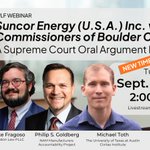
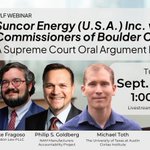
To learn why #Paramount should prevail, read @WLF's amicus brief. The statute doesn't permit Salazar's class action. And thank goodness - personalized advertising is what keeps the internet from going behind a paywall.

The court on Wednesday seemed likely to let a lawsuit alleging that a website owned by entertainment giant Paramount Global violated a 1988 video privacy law when it shared information with Facebook go forward, at least for now.
scotusblog.com/2026/10/court…


Wise counsel from someone who knows it and lived it. axios.com/2026/10/13/frackin… @APIenergy

Justice Kavanaugh put it precisely right, the question is whether the #SupremeCourt is a "textualist" one or a "literalist" one. Salazar needs the Court to read the Video Privacy Protection Act entirely shorn of context to prevail, but—as Justice Barrett has aptly noted—such a "vacuum is no home for a textualist."
#SalazarvParamount #oralarguments
Tomorrow, #SCOTUS will hear oral arguments for Salazar v. Paramount Global, a case examining who qualifies as a “consumer” under the Video Privacy Protection Act. @WLF filed an amicus brief in the case, and our Senior Litigation Counsel, Zac Morgan, will be participating in @WCL_PIJIP's “IP at the Supreme Court Series” post-argument panel at 5pm.
To hear his thoughts, check out the event here: american.edu/wcl/impact/init…
@AUWCL

1/4 - In a free market, businesses compete for customers, and price is one way they do it.
Technology increasingly allows businesses to offer personalized prices and discounts. That can mean better deals, more competition, and products reaching consumers who might otherwise be priced out.
3/4 - A new @WSJopinion article raises that very concern. The #FTC acknowledges that the effects of personalized pricing on consumers remain unclear. And research suggests the practice can actually save consumers money.
Shouldn't regulators better understand those effects before acting?
WSJ article: wsj.com/opinion/will-the-ftc…

4/4 - @WLF raised these concerns in September, urging the FTC to withdraw its proposal.
Our comments explain how the FTC's approach could discourage competition, create uncertainty for businesses, and raise constitutional concerns.
Read our filing: wlf.org/case/in-re-proposed-…

“Fraud on the Treasury is a public wrong. Its prosecution belongs to the one officer the people can hold to account.”
The False Claims Act qui tam provisions allow for a private individual to bring a lawsuit on behalf of the federal government, even if the government declines to participate in the case. But last year’s Trump v. Slaughter decision confirmed that everyone who wields executive power must answer to the president.
In a new @LawLiberty article, @WLF's General Counsel Cory Andrews examines how the Eleventh Circuit’s Zafirov decision explains how the #FederalClaimsAct is an odd exception to this ruling: lawliberty.org/private-prose…
#civiljustice

.@ClassLaw360 reported on plaintiff admitting in Roundup trial that she ignored label's safety instructions. How can this case be allowed to proceed? Story link⬇️ @AmTortReform @LegalReform


.@AdamThierer may be on to something here. FCC's relevance in today's communication world is quickly dimming.

What if lawsuits weren’t just legal disputes, but investment opportunities?
Third-party litigation funding allows outside investors to finance litigation in exchange for a share of the recovery. And the potential returns can be enormous. One of the world’s largest litigation funders reports an 82% cumulative return on invested capital, with dozens of matters generating returns above 200%.
The concern? When investors can make substantial returns by financing lawsuits, financial incentives can become part of decisions about whether litigation is brought, continued, or settled.
At its core, the question is pretty simple: Should lawsuits be an investment asset?
To learn more, read: wlf.org/2026/05/19/publishin…
@AmTortReform #LawsuitAbuseAwarenessWeek #ThirdPartyLitigationFunding #LitigationFunding #LegalReform

What does lawsuit abuse look like?
Sometimes, it’s allowing a class action to include people who were not harmed at all.
In Drake v. Bayer Healthcare LLC and In re Apple iPhone Antitrust Litigation, WLF has supported challenges to class actions that include consumers who cannot show they suffered the injury alleged in the lawsuit.
The concern? Class actions can exponentially increase the cost of litigation by including people who have no injury and therefore couldn’t sue on their own.
At its core, the question is pretty simple: If you weren’t harmed, should you be part of the lawsuit?
@AmTortReform #LawsuitAbuseAwarenessWeek #ClassActions #Litigation

What does lawsuit abuse look like?
Sometimes, it’s using an old legal theory to address a very modern policy debate.
States are pursuing claims against social-media platforms over allegations that their products harm young users—including through public nuisance, a centuries-old tort traditionally used to address interference with public rights, such as excessive noise, pollution, or blocking public roads.
The concern? Stretching a traditional legal theory beyond the kinds of harms it was created to address.
At its core, the question is pretty simple: How far should an old legal theory be stretched to address an entirely new kind of problem?
@AmTortReform #LawsuitAbuseAwarenessWeek #PublicNuisance #Litigation
For nearly fifty years, #SCOTUS has been developing #FirstAmendment and #FifthAmendment caselaw in one direction. More protection for freedom of association. Stricter enforcement of the Takings Clause. One case is the outlier, PruneYard v. Robins—the speech-compeller and property-snatcher's best friend. In Majestic Realty v. Salazar, the Court had a chance to slay PruneYard once and for all, but on Monday, the Court decided not to. To learn more why the Court ought to have taken the case, read WLF's amicus brief: wlf.org/case/majestic-realty…
Though @WLF has supported lawsuits against the City, this is one NYC action that we can fully get behind! wsj.com/opinion/zohran-mamda… via @WSJopinion #LawsuitAbuseAwarenessWeek

What does lawsuit abuse look like?
In Salazar v. Paramount Global, nearly 40 years after the Video Privacy Protection Act was passed, a man is arguing that subscribing to a free newsletter made him a “consumer” protected by the VPPA, even though he never subscribed to video content.
This distinction matters. The law was created to protect the privacy of consumers’ video-viewing information. The question now is how far that protection extends when someone subscribes to something entirely different—like a free email newsletter.
And the potential consequences are enormous: the VPPA provides for at least $2,500 in damages per violation. Multiply that across thousands or millions of users, and potential class-action exposure can quickly reach millions or even billions of dollars.
The concern? A nearly 40-year-old law aimed at a very specific privacy harm could expose companies across industries to massive liability for commonplace online activity.
@AmTortReform #LawsuitAbuseAwarenessWeek #ClassActions #CivilJustice