

Helping Curious People to Explore Eye Health, History, Innovations & any Eye related topics. Curated by Board Certified Ophthalmologist. #SeeBeyondTheObvious
Visual Cortex
Joined August 2026
- Tweets85
- Following79
- Followers14
- Likes115


Visus Curious retweeted

Welcome to Soft Matte Atelier!
Let us help you to curate your own fine art gallery on your TV.
Visit us for ambient silent long format video loops with our art on YouTube @FrameArtAtelier
And for high quality 3840x2160 digital downloads on Etsy
softmatteatelier.etsy.com
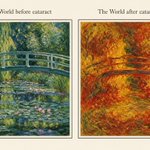
Want to know how the world looks through cataracts?
Monet already painted it.
In his late years the Water Lilies and Japanese Bridge grow warmer, muddier, and more abstract because that’s closer to what he actually saw.
Blues and violets faded. Reds turned dull. He started arranging paint tubes by memory when he could no longer trust the color on the canvas.
After surgery on one eye in 1923 everything looked too blue. He had the new lens tinted amber.
Those famous late works aren’t just Impressionism.
They’re an artistic preview of a yellowing lens.
🤖 Made with AI

Our eyes change after 40 — but that doesn’t mean your best years of sight are behind you.
Everyone develops presbyopia after 50. Dry eyes become more common. Cataracts, glaucoma, and macular degeneration rise with age.
The good news? We have now better tools than ever: reading glasses and contact lenses, drops that help with presbyopia, cataract surgery is a routine operation that restores clarity of vision in most people and there are treatments that can significantly slow down glaucoma and retinal diseases.
A simple dilated eye exam finds these changes early, when they’re easiest to manage. Millions of people in their 60s, 70s, and 80s still enjoy sharp, independent vision because they stayed ahead of it.
Your eyes can keep serving you well all your life. Schedule that exam and keep seeing the world clearly! . 👁️✨
🤖 Made with AI

👁️ Cosmic twin of the human eye!
The Helix Nebula (NGC 7293), just 650 light-years away in Aquarius, is nicknamed the “Eye of God” for a reason.
Its glowing ring of gas and dust, laced with thousands of radial filaments, surrounds a blazing white-dwarf “pupil” — creating an uncanny visual twin of a human iris.
A dying Sun-like star’s final breath, sculpted by stellar winds… staring back at us across the light-years.
Nature rhymes on every scale.
#HelixNebula #EyeOfGod #Astronomy #Eye
🤖 Made with AI
Then came the real breakthrough.
Around 1508–1509 he filled an entire notebook (Manuscript D, the “Codex of the Eye”) with experiments no one else was attempting.
He studied how the pupil expands and contracts with light.
He discovered that images enter the eye upside-down.
He compared the eye to a camera obscura.

These weren’t beautiful sketches for art’s sake.
They were rigorous science: dissection, observation, and hands-on models — all aimed at understanding how light becomes sight.
Leonardo never published a finished book on the eye.
But the surviving pages show he was centuries ahead of his time.
While other artists simply drew what they saw, Leonardo was cutting into skulls.
In the late 1480s he mapped the eye sockets, optic nerves, and the exact path of vision to the senso comune — the center of all the senses.
He even measured the precise distance between the pupils and the proportions of the eyelids.

Leonardo da Vinci didn’t just paint masterpieces.
He dissected the organ that makes vision possible - the eye.
For over 20 years he was obsessed with the human eye — calling it the “window of the soul.”

April 3, 1887. Vienna.
Polish-born ophthalmologist Vincenz (Wincenty) Fukala, trained under Carl Ferdinand von Arlt, performs a clear-lens discission on a young patient with extreme myopia (−13 D or worse).
No cloudy cataract. The lens is taken out so the eye can see.
That is the first well-documented refractive eye surgery. Historians still call it Fukala’s operation.
By 1894 he has treated 44 patients. Many can work again. Colleagues including Ernst Fuchs warn it is dangerous. He keeps going anyway.
The catch, understood only later: retinal detachment. The method was abandoned for decades, then returns in modern form as refractive clear lens exchange.
Corneal chapter, same era:
• 1885, Norway: Hjalmar Schiøtz cuts the limbus and knocks 12 D off a 19.5 D astigmatism.
• 1898, the Netherlands: L.J. Lans maps how corneal incisions change refraction.
• 1939, Tokyo: Tsutomu Sato at Juntendo operates on military pilots with radial cuts—early RK, later with improved technique to reduce endothelial damage in 1980-90s.
LASIK is the happy grandchild.
Fukala was the start.
#RefractiveSurgery #EyeProblems #Cataract


Share which procedure or experience in eye doctor office was most intimidating or scary for you? And why?
Mindfulness meditation just leveled up eye health! 👁️✨
RCTs show it can slash intraocular pressure in glaucoma patients by more than 10-20% in only 3 weeks — often dropping IOP by 1.5–6 mmHg.
It also lowers stress markers like cortisol, boosts optic nerve perfusion, and improves quality of life (as an add-on to regular treatment).
Zen meditators even showed sharper visual acuity and contrast sensitivity in one study.
Our body is amazing 🔥
Key studies:
pubmed.ncbi.nlm.nih.gov/3025…
aao.org/education/editors-ch…
link.springer.com/article/10…
#Meditation #EyeHealth #Glaucoma #Mindfulness #VisionScience #HealthyEyes
🤖 Made with AI


Those mysterious shadows drifting across your vision aren’t ghosts or a glitch in the matrix — they’re eye floaters, tiny bits of collagen dancing inside the gel of your eyeball every time you look around!
They’re completely normal for most people, yet they feel like little cosmic debris orbiting your retina. Next time one floats by, just smile… you’re watching a private light show only you can see.
⚠️ important: Most floaters are harmless, but seek urgent medical help (eye doctor or ER, ideally within 24 hours) if suddenly amount or intensity of floaters increases, when it looks like a shower of many new floaters, flashes of light, a dark curtain/shadow over your vision, or sudden vision loss — these can signal a retinal tear or detachment and need immediate attention to protect your sight.
#EyeFloaters #VisionFacts #EyeHealth #MindBlown #ScienceIsWild

