

@VerbumCatholic
Account based inUnited States!
About this account
- Account based in
- United States
- Connected via
- United States Android App
X says this location may be affected by a proxy or VPN.
Account-level information from X, not a live location or the device used for a specific post.
Dad | Convert | Canon nerd Superfan of Verbum Catholic software *Find the official Verbum feed @Verbum*
Skibidi, OH
Joined February 2014
- Tweets8.8K
- Following248
- Followers629
- Likes38.9K





James retweeted

Today is, among other things, the feast of St. Denis of Paris
He is a Cephalophore
That means he is in a particular category of saint that is often depicted carrying his or her own head away from their execution
Cephalophore essentially means "head carrier"

It's not easy to use Jerome to make a clear point for Protestants or Catholics (but he's more problematic for Protestants)
youtube.com/live/bJ_nLF9ViPc…

James retweeted

Protestants can’t do things that get the entire world’s attention except divide
There’s plenty outside the Church that have nothing nice to say about Bl Fulton Sheen’s beatification, but the fact that they’re even talking about it at all tells you the magnitude of the event. I’m trying to think of the last time Protestants did something that caught the public’s attention this much and absolutely nothing comes to mind.
This is our advantage. Our ancient rites and traditions fascinate the world. We had every major media outlet in the world staring at a chimney last year and now relics are a point of discussion. It’s not that we’re the best at this, it’s that we’re the only game in town.


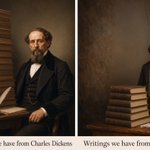
Contemporary to Smith, Charles Dickens wrote nearly 5 million *published and cherished* words the world over, plus another 1-2m in surviving letters.
He also grew up poor and poorly educated, having to get a real job at the age of 12. Though he was never accused of any crimes.


To purchase the Joseph Smith papers 27 volume set, it will cost you roughly $1,500- $2,000.
Add to that the 360k words of the Book of Mormon, Pearl of Great Price, and Doctrine and Covenants.
That doesn’t include his translation of the Bible. Nor does it include the Lectures on Faith.
Paul has 8 epistles. (43k words +/-)
I don’t say this to diminish Paul in any way.
I say this because most people write off Joseph Smith as a fraud, without realizing they’ve only touched the surface of investigating what he actually produced in his lifetime as a Prophet of God.

Human beings never want to be told what to do about everything.
But we definitely want to be told what to do about some things, especially if that absolves us of responsibility.
"Faith whose sole purpose is securing your exit from Hell...leaves little room for the teaching of Christ.
The Gospel is an invitation to the life and work of God *starting now*"


Watch how @needGod_net answers when asked how many Church Fathers believed in baptismal regeneration. Instead of answering plainly, he points to a handful of early Christians, mentioned by Tertullian, who denied the necessity of baptism.
He is right that Tertullian refers to them. What he leaves out is why. Tertullian records the argument in On Baptism 13 to rebut it, and introduces the men who made it as “those most wicked ones.”
Their argument, as Tertullian records it, is this: “Baptism is not necessary for them to whom faith is sufficient; for withal, Abraham pleased God by a sacrament of no water, but of faith.” Tertullian answers that things changed with Christ. Baptism was imposed at Matthew 28:19; John 3:5 makes rebirth by water the condition of the kingdom. Together, he concludes, they have “tied faith to the necessity of baptism.”
Tertullian is not evidence that early Christians thought baptism optional. He is rather evidence of how repulsed the Church was by those who made such a claim.
Ryan’s obfuscation bypasses the question he was actually asked, which has an answer. Everett Ferguson wrote the standard monograph on baptism—nine hundred pages, published by Eerdmans—concluding that the early Christian literature is “virtually unanimous in ascribing a saving significance to baptism.”
Ferguson is Church of Christ, and thus friendly to that conclusion. Those who are not, however, have still had to reckon with the record. William Cunningham of the Free Church of Scotland called baptismal regeneration an error indicating “an entire ignorance of the fundamental principles of the gospel,” yet he granted that “there are few subjects in regard to which the Papists can produce from the fathers a more plausible array of testimonies to countenance their tenets than in regard to this sacrament.”
That is the record. Every named orthodox or proto-orthodox writer of the first four centuries who discusses baptism at length treats it as effecting regeneration and the forgiveness of sins. Justin Martyr calls it regeneration and the remission of sins by about AD 155. Irenaeus, Tertullian, Cyprian, Cyril of Jerusalem, and Augustine all follow. In 381, the Nicene Creed in its final form affirmed “one baptism for the forgiveness of sins.”
The Fathers allowed exceptions, as the Church does now: baptism of blood for the martyr, baptism of desire for the one who dies before reaching the font. The Church has always taught that God binds salvation to the sacraments without binding Himself to them. No Father, however, teaches that baptism is a mere symbol. Period.
Ryan makes more trouble for himself when he grants that Catholics may genuinely be saved but “not if they believe in the doctrines of their church,” going on to say, “If someone believes in the doctrines of the Catholic Church, they’re not a Christian.”
Consider the implications of this claim. By Ryan’s own hypothesis, a man who trusts Christ for his salvation can still be disqualified—not for a failure of trust, but for holding the wrong proposition about how that trust saves him. Not even martyrs would be exempt from Ryan’s exacting standard.
So faith alone is not sufficient after all. You must have faith, and you must also hold the correct theory of faith. The theory has quietly become a second work, and it is the one work that damns.
While he concedes Christians should still be baptized and do good works, he has made assent to one theory of justification into a test a believing, obedient Christian can fail—at the cost of his soul.
He also points to those who tell him they expect heaven because they are good people.
So, what?
He argues against Catholicism by pointing to a position the Church does not hold. The doctrine underneath “I’m a good person”—that a man can keep God’s commandments unaided—is what the Church anathematized at Carthage in 418 and again at Orange in 529. He samples what churchgoers say in personal conversations and deploys it against what an institution teaches. This is the weak man fallacy, which lets him bypass the Church’s actual teachings in favor of the words of its most ignorant members.
Furthermore, to justify his “faith alone” as bare internal assent, he ignores Scripture and the early Church alike, and lands somewhere Luther himself never stood.
Luther taught that baptism “works forgiveness of sins, rescues from death and the devil, and gives eternal salvation to all who believe this.” Zwingli is the one magisterial Reformer who comes close to Ryan, and even Zwingli admitted that “all the doctors have been in error from the time of the apostles.” His honesty notwithstanding, no Reformed confession followed him there. Ryan’s is not the Reformation’s position but a minority report that became the common evangelical assumption centuries later.
His accusation of works-based salvation is likewise without merit. We do not obey Christ because we are trusting our own works. We obey Him because we love Him, and He told us what love looks like. “If you love me, you will keep my commandments.” Is it so controversial to believe that loving Christ is essential to salvation?
Apply Ryan’s rule to Jesus’s parable of the sheep and the goats, and it reads very differently. “I was hungry and you gave me food, I was in prison and you visited me. But you were relying on yourself. Depart from me.” And to the others: “I was hungry and you gave me nothing. But you trusted that I would save you. So, come, inherit the kingdom.”
What kind of faith is this?
A faith whose entire purpose is securing your own exit from hell is a self-help program with pious vocabulary. The Gospel is an invitation into the life and work of God, starting now. Reduce Christianity to where you go when you die—and then reduce even that to holding the right opinion about faith—and there is very little room left for the teachings of Christ.
This is what the Romans said about the early Church.
catholic.com/magazine/print-…


James retweeted
There's been some discourse out there about the intercession of the saints, whether people in heaven can hear us, whether we should ask for their prayers, etc
I don't intend to wade too far into it, but I think at least 3 key questions have to be part of the discussion:
1/5
This will probably go away if we just ignore it.

Debt models start crashing when federal debt reaches around 154% of the size of the economy. At current interest rates, we’re headed above 160% in the next decade.
The models put us in the danger zone around 2035. A recession, war or one bad shock can push our borrowing costs higher when we have less room to absorb it and are already borrowing just to pay the interest.
We can change the math now, or eventually the bond market will do it for us.
James retweeted

Debt models start crashing when federal debt reaches around 154% of the size of the economy. At current interest rates, we’re headed above 160% in the next decade.
The models put us in the danger zone around 2035. A recession, war or one bad shock can push our borrowing costs higher when we have less room to absorb it and are already borrowing just to pay the interest.
We can change the math now, or eventually the bond market will do it for us.

James retweeted
I can understand how some people who went to Catholic schools no longer believe in the Church
I myself went to public school and no longer believe in the state


James retweeted

The Atheist cannot comprehend the mindset of a religious believer. You see, God is not just the conclusion of a syllogism. He is a person that you choose to have a relationship with. That requires heart, not just mind. So of course Joe is going to enter into this with both.

Dude says conversion is a matter of mind and heart.
This for me affirms my Atheism. Because you don’t think with your Heart you think with your mind.
If Theism is a heart matter to any degree no thanks. That’s for the weak.
youtu.be/-C-FiSqfKi8?is=c_PE… via @YouTube

James retweeted

I just converted to Catholicism! Here’s my story:
youtu.be/-C-FiSqfKi8
James retweeted

Music fosters communion. It helps unite our hearts to overcome differences between people and bring everyone together in praise of God through a symphony of voices. #GeneralAudience
James retweeted

Gavin Ortlund just dropped a spicy short claiming the Bible has nothing like Catholic relics—and Jimmy Akin is having none of it. In this episode, Jimmy dismantles the short point by point, exposes a major Trent misquote, reveals the rich biblical evidence for honoring the dead and seeking help through relics, and shows why cultural differences don’t equal error. Fast, sharp, and packed with Scripture and history you won’t hear elsewhere.
youtube.com/watch?v=dcCZnnBo…
