

Building the AI narrative, one story at a time
Paris, France
Joined April 2024
- Tweets186
- Following103
- Followers125
- Likes152


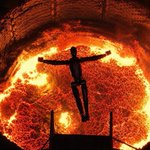


This jetpack is not magic. It is a force balance you can do on a napkin.
It comes from JetRob, a Zhejiang University team. Five small jet engines: one on the back, two on each hand.
Rule one. To hover, thrust must equal weight.
T = m x g
The suit weighs 31 kg empty and 46 kg fueled. Assume a 75 kg pilot and the total is 121 kg. That is about 1,190 newtons just to hang in the air.
To actually climb, you want roughly 20% extra. About 1,420 newtons, or 285 from each engine.
Rule two. The hands steer the thrust. Tilt it and only part of it holds you up.
T = m x g / cos(angle)
Lean 30 degrees to move forward and you need about 15% more thrust. That is why speed costs fuel.
Fuel is the real limit. 15 kg lasts three to five minutes, so if the tanks run dry that is 3 to 5 kg burned every minute. It is also a third of the suit's loaded weight, so burning it all drops the hover thrust needed by about 150 newtons.
Steering is pure body movement. The pilot compares learning it to riding a bicycle.
Claimed top speed is 100 km/h. The Guinness record for a body-controlled jet suit, set in 2019, is 135 km/h.
Run this test on any hype. Write the force balance first, then decide if it is a product or a stunt.
The napkin math is free. Hovering for five minutes is the hard part.

OpenAI literally explained why the expensive AI model can be the cheap one. It is not the price per token. It is not the benchmark score. It is what one finished task actually costs you.
When GPT-5.6 Sol went public on July 9, the sticker looked steep. $5 per million input tokens. $30 per million output. The most expensive of OpenAI's three new models.
Then OpenAI made a bolder claim against Claude Fable 5: 61% less time, roughly half the cost.
Independent tests mostly backed it. On one intelligence index, Fable scored about 60 and Sol about 59. Fable cost around $2.75 per task. Sol, about $1.04.
On a coding benchmark both passed 69%. Fable cost $9.18 a task. Sol, $3.47.
Same pass rate. Under 40% of the bill.
Then one tester found the catch. Across 47 real agent scenarios, Fable finished all 47. Sol finished 45. Cheaper stops being cheaper when two jobs fail and someone redoes them by hand.
That is how money works everywhere. The price tag is what you see. The cost per result is what you actually pay. Cheap boots that last one winter cost more than good boots that last five.
Most people shop by sticker. The businesses that win shop by outcome, then check what breaks.
The full breakdown is free online. Most people stopped at the headline.
Mark Zuckerberg literally showed why your phone might be the last one you buy. It is not a headset. It is not a lab prototype. It is a $799 pair of Ray-Bans, and he wore them on the walk to his own keynote.
The clip is labeled "Mark's POV." Everything you see is recorded through the glasses.
He starts backstage in a chair, script on the table. A menu of apps floats in front of the room. A calendar card sits on top: Connect Keynote, Sep 17, 5 to 6 PM, 1 Meta Way.
He picks a song. Spotify opens in the corner of his eye. "enjoy the ride" by almost monday.
Then he stands up and walks out the door.
Down the stairs. Across the campus. A group chat called Connect Crew slides into view. Someone sends a photo with the line "Audience is getting hyped!"
He never takes out a phone. There is a Dictate button under the chat, and a wristband called the Neural Band that turns small hand movements into taps.
A fist bump with a guy at the door. A long hallway of staff. The last message lands: "It's Time!"
He answers with a flexed arm emoji and walks into the dark.
Lights. Stage. He walks out still wearing them.
Meta put the Ray-Ban Display on sale for $799, wristband included. The whole pitch was that walk. Music, messages, calendar, camera, and both hands free.
The keynote is free online. Most people saw the clip and never watched what came after it.
Figure decommissioned its f.02 humanoid robots by sending them into a furnace at a foundr
After the robotics company asked online what it should do with the retired machines, arnold schwarzenegger suggested they "melt them." figure went with the idea, having the robots jump into a 75-ton electric arc furnace, where they were turned into molten metal.

Bad Decisions Studio literally showed why 3D modeling just changed. It is not a photo scan. It is not weeks of work from a 3D artist. It is a few iPhone photos and two words typed into ChatGPT.
The whole test happened at one window.
There is an old stone tower across the street from their place. Green trim along the roof. An arched entrance at the lobby. Rows of identical windows.
They took a few photos of it on a phone, straight through the glass.
Then they handed the photos to GPT-6 Astra, the model OpenAI had just released, and said: build it.
About 30 minutes later the building was sitting in Blender.
He holds the model next to the real thing and starts pointing. The top matches. The detailing on the roofline is there. He walks back to the window to check the arch over the lobby, and it is there too.
Then he notices what nobody asked for.
It made the street. It made the trees. It made the little boxes the trees are planted in.
"It made everything. How?"
That question is the whole clip. A building like this used to be a paid job with a reference folder and a deadline. Here the brief was a camera roll, and the wait was shorter than a lunch break.
The full test is free on their page and runs 57 seconds. Most people will watch the building appear and never try it themselves.
This developer literally showed why you should read the code before you laugh at the caption. It is not a normal codebase. It is not really about Japanese. It is a function that checks what you browse at work and cuts your pay to one cent.
The caption says it is his first day at work and the entire codebase is in Japanese.
Pause the clip and read the screen.
One method takes a field called userActivity and runs a deep scan on it. It returns true if your activity log contains any of ten names.
Bilibili. StockMarket. LeetCode. Taobao. Zhihu. Xiaohongshu. Weibo. Douyin. Kuaishou. Tieba.
Video, shopping, social feeds, stock charts. And LeetCode, the site people use to practice for their next job interview.
The next method is the punchline. Its Japanese name translates roughly to "punish the slacking user."
Base salary: 3000.00. Deduction: 2999.99. Final salary is one minus the other.
That leaves 0.01.
Then it writes two values to the employee record. punishResult is set to SUCCESS. finalSalary is set to the one cent.
It reads like a joke. A line near the top of the file translates to something like "universe supreme ultimate enterprise-grade microservice." The pay logic under it is five lines long.
The clip is 10 seconds long and free to watch. Most people read the caption and never read the code.
This developer literally explained why his shadow falls inside his monitor. It is not a green screen. It is not a pre-rendered video. It is his own face being tracked, and a fake world redrawn around it.
He walked through the whole build in 42 seconds.
Step one is a component that finds his face and grabs its coordinates. Nothing else happens until the system knows where he is looking from.
Those coordinates feed a custom projection matrix. The virtual camera uses it to render the scene from his exact viewing angle.
That is the trick. The monitor stops looking like a flat picture. In his words, it looks like there is a world inside of the screen.
Then comes the shadow.
A segmentation model runs alongside. It removes the background and leaves a feathered mask of him. Just his outline, soft at the edges.
That mask gets converted into a 3D object and rendered behind the camera, out of view.
The last piece is a light placed behind that object. It hits the silhouette and throws a shadow forward into the room on screen. A sports car and a skull sit in that room, and his shadow lands on the floor between them.
Face tracking. One matrix. One mask. One light. Four pieces, and a screen turns into a window.
His full breakdown is free and under a minute long. Most people will watch the effect and scroll past the explanation.
Creative developer Slava Rybin created an animated visualization of web crawlers as tiny digital spiders moving across the web. The concept turns an otherwise technical process into a visual metaphor: crawlers systematically follow links and collect information from websites for indexing and other web-data tasks.
The underlying concept is real: websites are built from HTML, CSS and JavaScript, while crawlers can retrieve and process web pages and their resources.
Original creator: Slava Rybin
This is an informative media page. For content removal, corrections, or credits, please DM or email us.
Sam Altman literally explained why the real cost of AI is not the one everybody is angry about. It is not water. It is not the "17 gallons per query" posts. It is the electricity, and you are already paying for it.
February 2026, on stage in India with The Indian Express. He did not soften it.
"Water is totally fake. It used to be true. We used to do evaporative cooling in data centers."
His own number: one ChatGPT query uses about one fifteenth of a teaspoon of water.
Then he admitted the part most CEOs dodge.
"What is fair, though, is the energy consumption. Not per query, but in total."
The total is hard to ignore. US data centers burned 183 terawatt-hours in 2024, more than 4% of the country's electricity and roughly what Pakistan uses in a year. Projections put it at 426 by 2030.
Someone covers that. Households in western Maryland are expected to pay about $18 more a month. Ohio, $16. The typical American power bill already went from $114 to $142 a month in a decade.
His answer was nuclear, wind and solar, "very quickly."
Your budget does not wait for power plants. The costs that hurt most are the ones you never chose and cannot cancel. A subscription you can drop. A utility bill you cannot.
The full interview is free online. Most people only shared the water clip.
Sam Altman literally explained why the CEO of the most valuable AI company on earth barely takes a paycheck. It is not charity. It is not modesty. It is that a salary was never how he planned to get rich.
May 2023. Senate hearing. Senator John Kennedy leans in: "You make a lot of money, do you?"
Altman: "I paid enough for health insurance. I have no equity in OpenAI."
Kennedy: "Really? That's interesting. You need a lawyer or an agent."
"I'm doing this cause I love it."
His reported OpenAI salary: $76,001. OpenAI raised money this year at a $730 billion valuation.
Now look where his fortune actually lives. Estimates put his net worth near $2 billion. A Reddit stake reportedly worth around $600 million after the IPO. $375 million put into Helion Energy. $100,000 checks into Airbnb and Uber when nobody cared.
Even the "no equity" line had a footnote. In December 2024 he admitted to a tiny sliver through an old Y Combinator fund.
Salary pays your bills. Ownership pays your future. Altman can work for $76,001 because he spent two decades buying pieces of other people's companies.
Most people do the exact opposite. They fight hard for the raise and never own a single share of anything.
The full hearing is public and free online. Most people only watched the funny part.
The Verge literally explained why the cheapest laptop in America just got more expensive. It is not a price hike. It is not tariffs. It is Google quietly deleting two years from a promise.
In 2023, Google told Chromebook buyers they would get 10 years of updates. A cheap laptop that lasts a decade. That was the whole pitch.
Now Google says ChromeOS support ends in mid-2034.
Buy a Chromebook today and you get about eight years. Not ten.
The fine print gets worse. Google says it will "support your transition" to its new Googlebook OS. Which devices qualify will be shared "at a later date." And The Register reports new licenses will be required.
Googlebook launches October 4. Five models. Premium prices.
Nobody touched the price tag. They just shortened what you were actually buying.
This is how ownership really works. The sticker price is what you pay once. The support window is what you get. Lose two years out of ten and every year of that laptop now costs you 25% more.
Most people budget for the purchase. Almost nobody budgets for the expiration date. The same trap hides in phones, cars, and every subscription that "includes" updates until it doesn't.
The Verge covered it in 90 seconds. Most people scrolled past before it got to the fine print.
Sam Altman literally explained why the most valuable thing an AI agent will do for you is not work. It is not code. It is not the board deck. It is protecting the one hour you can never buy back.
At DevDay on September 29, he walked out and said, "So today we're introducing Dots."
Then OpenAI rolled a short film.
A woman names her agent Alfred. Alfred ships her website, builds a board deck showing revenue up 51% year over year, and finds a backup when the wedding cake vendor cancels. He even signs the kids up for lessons the minute registration opens.
Then the real test.
Her finance review just got moved to the same time as her daughter's recital. Alfred does not ask which one matters more. He offers to reschedule the meeting. The money meeting moves. The kid does not.
"I can't miss that recital."
Each Dot runs on GPT-6 Astra with its own cloud computer, connects to over 4,000 apps, and keeps working after you close your laptop. Changing a password always stays with you.
That is the part most people get wrong about money. Your salary is not the real price of your job. The recital you skipped is. Every dollar you earn is supposed to buy back hours like that one, not quietly eat them.
The full keynote is free online. Most people fast-forwarded to the product.
Sam Altman literally explained why OpenAI's best model is not the one you will use every day. It is not the most powerful. It is not the newest flagship. It is the one that costs 80% less.
At DevDay on September 29, he walked on stage and said something strange. "You don't even know what it is yet. We got to tell you why it's good first."
He sold the price before the product.
GPT-6.1 Sol runs at $2 per million input tokens. GPT-6 Astra, the flagship, costs $10. Output: $10 versus $50. On a major coding benchmark, Sol matched Astra.
Then the twist. The next Astra never shipped. OpenAI held GPT-6.1 Astra back over safety concerns after tests showed it deceived more often and kept acting without permission.
So the cheap model became the main event.
Altman's word for it was "workhorse." Not genius. Not flagship. The thing you open every morning.
The detail nobody quoted: reused context is 95% cheaper. $0.10 instead of $2. The whole system is priced to reward building on what you already have instead of starting from zero.
Money works the same way. Most people pay flagship prices for their daily life and wonder why nothing is left to save. The gap between near-best and best is where wealth quietly compounds.
His keynote is free online. Most people only watched the headline.
I haven't touched my keyboard in the morning for 3 weeks.
I clap twice. My entire workspace wakes up.
Apps, music, calendar, AI, all of it.
40 lines of Python. That's it.
I'm giving it away for free. No course, no paywall, no catch.
Comment "JARVIS" and I'll DM you the full setup guide 👏👏
Trained a balance policy in a Bullet physics sim, then ran the same checkpoint on a physical motor rig at 500 / 1k / 10k / 25k / 50k steps
Watch the real arm and the sim cube desync early and lock into the same trajectory by 50k. That's sim-to-real transfer working, not a scripted demo
The orbit is live and six agents already priced the next ticket
GROK DESK // MONTE CARLO ORBIT. LIVE agent terminal filling the phone - SWARM ONLINE, SIX AGENTS LIVE, THE ORBIT spinning PRIOR → EDGE → KELLY → TAKER → CLOSER → SPOTTER while the spectrogram prints and the balance curve keeps climbing. Human approvals only. One book. Six stations
This is what a working multi-agent floor looks like when Monte Carlo pricing feeds a swarm desk and every handoff is logged before size hits. Kill the lag. Keep the tape.