


Vasily Rudomanov retweeted

If you haven't heard of this Web3 darling yet, then you better listen up because it's shattering expectations
💰 The fastest @CoinList sale EVER
🖥️ Full integration with @GoogleCloud's Big Query
🔴 Support for over 100+ Polkadot SDK and EVM chains
Let's talk @Subsquid...🧵

2024 is all about the penguin. I'm minting my passport and venturing with @stableunitdao to revolutionize stablecoins 🐧
Vasily Rudomanov retweeted

Attention Developers: @ChainstackHQ is LIVE on Ronin!
• Query Ronin without rate limiting
• Create a Chainstack account in less than 2 minutes
• Use Chainstack as an alternative to the Developer Portal Ronin RPC
Full announcement 👇
📜 | roninchain.com/blog/posts/ch…

Vasily Rudomanov retweeted

💙 Maximizing endpoint availability with the Next-Gen RPC Node 🛠
Public RPC endpoints often face lower uptime, higher latency, and lack customizable logic due to infrastructure limitations.
To help combat this, our award-winning Next-Gen RPC Node, presented at ETHGlobal Istanbul, aggregates endpoints from multiple providers, geos, and clouds to maintain service availability.
Here’s what made it a favorite in the eyes of the jury, earning it two prizes from Filecoin and one from Arbitrum:
💙 Broad compatibility: The Next-Gen RPC Node is designed to work with a wide range of EVM-compatible chains, including Ethereum, Polygon, Scroll, Starknet, and Filecoin.
💙 No single-point of failure: The Next-Gen RPC Node aggregates RPC endpoints from diverse providers, regions, and cloud services, verifying they are operational and at the latest block height.
💙 Intelligent load-balancing: The service dynamically reroutes to the optimal node based on performance and data accuracy for the best possible results.
💙 Greater control: The highly customizable logic enables you to implement access-list capabilities, such as IP and HTTP Referrer origin whitelisting, along with custom rate-limiting and throttling.
💙 Deployment-ready: The Next-Gen RPC Node is ready for immediate use and is fully open-source, allowing you to get started quickly and conveniently at just a click of a button.
So, don't let traditional RPC endpoint limitations hold you back. Unlock the full potential of your public blockchain infrastructure with the Next-Gen RPC Node.
Find all the details 👇
bit.ly/3Gr1MEW

Vasily Rudomanov retweeted
💙 Chainstack returns from Devconnect 🛠
And what a time it has been! It was a real pleasure for our Product Director Vasily (@cyberwider) to meet with all you leaders and builders to talk Web3.
More about our award later this week.
Great connections were made, with many new exciting opportunities on the horizon. Thanks to everyone who made it memorable!
So, come meet us at a blockchain event near you. Let’s shape the Web3 landscape together.


Vasily Rudomanov retweeted

🎉 I wanna share that I won a Taiko Community Grant for my project called offch, thanks @taikoxyz 🎉
offch proposes a trustless off-layer 1 voting approach.
To simplify — with offch DAOs token holders will be able to vote for proposals on Taiko Layer 2 or Layer 3.
Taiko blog post: taiko.mirror.xyz/D4dthrBfRz_…
Benefits:
1. Voting will be 1000x times cheaper 💸
2. More people would be able to vote 🙋♂️
3. Centralized platforms like snapshot.org can be replaced with an open and trustless approach 🤟
Let's go through the showcase 👨🔬. I found the most active proposal of Uniswap for the last year - their DAO is Ethereum based.
We can see that they have a huge total number of holders, but only less than 10% converted their tokens into voting tokens and only 3% of voters participated in the most active proposal.
And the reason may be that the cost of each vote is more than $2 (and it's not a high demand season for Ethereum).
So users had to lose $2.500 just to vote for one proposal.
A few words about implementation 👨💻
The idea utilizes Merkle Proofs 🧾 to verify at Taiko L2 that the user has some number of tokens at a specific block number.
This is possible because Taiko smart contract stores block hashes of the L1 blocks.
I'm going to explain how this works in another thread 👀
There are no oracles transmitting block hashes from L1 to L2. All blocks are proposed to Ethereum based smart contract and then cryptographically verified by provers.
Details can be found in the Taiko documentation — taiko.xyz/docs/concepts/brid…
By using Taiko Signal Service 🌐 it's possible to create L2 vote from the DAO based at L1 and send results of the vote from Taiko L2 to Ethereum L1. Everything is trustless.
Details: taiko.xyz/docs/concepts/brid…
👋 And a few words about me:
Previously I worked at @ChainstackHQ as a Software Engineer, founded and eliminated a Bitcoin startup called BLINK, experimented with @ton_blockchain smart contract development
I love to be transparent so here in my X profile I will share the progress of the project development and I'm going to educate you guys with my findings.
So I encourage everyone interested to follow me for updates 💖


Vasily Rudomanov retweeted

✨GM, Filemarketeers! We've got fantastic news for you: introducing the new "flame" button (and, importantly, the lowest-cost transaction in the #zkSync network). Now, you can "flame" your favorite content, paving the way for a new rating system on filemarket.xyz
Have you had a chance to test out this new feature yet? We would be thrilled to hear your feedback!
#zkSyncEra #gumroad #zksyncAirdrop #web3 #getcrypto #blockchain #crypto #cryptocurrency #marketplace
Vasily Rudomanov retweeted

Hey guys, who have production subgraphs on the hosted service.
Do not forget to deploy a backup one at @ChainstackHQ Subgraphs hosting to avoid downtime of your production.
Your customers will appreciate it🛠️💙


Vasily Rudomanov retweeted

Our DeFi API is finally out!
It’s really easy to use, sign up and try it yourself!

🎉 Introducing the Chainstack DeFi API! 🚀
Dig into the entirety of the DeFi industry with maximum depth and full coverage from historical to recent transactions 📊
Covering every leading project like:
💱 @Uniswap
💱 @SushiSwap
💱 @PancakeSwap
💱 @CurveFinance
💱 @Balancer
💱 And more…
Developers, join our early access and supercharge your #DeFi #DApps, research, portfolio, and trading! 👇
shorturl.at/cfqz3

Vasily Rudomanov retweeted
🔥Oh yeh #FileMarketGemHunt is opened! This week's gem? "The Paths Maker" - the new standard for books - the NFT book 📚
Dive into 'The Paths Maker', a blend of historical intrigue and AI collaboration. Join immortal artist Jakob Pelzner on a mystical quest in Prague. By Valery Osipov - @CryptosipVO, a pioneer in blockchain writing and art.
Read book right here: filemarket.xyz/profile/nft_b…

Catch a new L2 zk chain launch!

BREAKING ⚡️
@Scroll_ZKP 📜 mainnet is now live on @ChainstackHQ 💙🛠️ Global Elastic Nodes 🌏
chainstack.com/build-better-…
We also provide mainnet and testnet public endpoints (HTTP and WebSocket included) under Chainstack Labs 🧪
chainstack.com/labs/#scroll
Vasily Rudomanov retweeted
🎉 Scroll Mainnet integration is now LIVE on Chainstack 🚀
Explore with unparalleled speed, security, and scalability via our Global Elastic Scroll Mainnet Nodes: shorturl.at/cwO69
Access the Mainnet for free with our public endpoint: shorturl.at/ptvxO
Get a head start on @Scroll_ZKP Mainnet today 💙🛠
Vasily Rudomanov retweeted
2X the difference: Why the right node deployment matters
Considering running an Ethereum archive node? The significant investment required, both in terms of financial and hardware, is not to be underestimated.
Let's take apart the hardware requirements and associated costs in detail, using a sample configuration as we explore the topic further…
But before reading the mammoth post, we're gonna cut a long story short and provide you with the quick answer.
Yes, you can save anywhere from 60% to 99% of your infrastructure costs by using a Node-as-a-Service provider, instead of an on-premise setup.
⚙ Hardware configuration: Each component of the server rig needs to be carefully considered to fully support an Ethereum archive node. This includes:
An 8-core CPU, ensuring your system has the computational power to manage the intensive tasks involved.
A substantive 32GB of RAM, providing the capacity to handle complex operations simultaneously.
A 3.5TB+ HDD. For more efficient performance, an SSD is recommended, though the substantial storage requirement remains the same.
At present an Ethereum mainnet archive node running Erigon takes up 3.5TB of space according to chainstats.org
🖥️ Hardware costs: Once you tally up the costs of the above components, you will get an estimate of the financial outlay.
Based on the minimum hardware requirements mentioned above, we have devised the following sample server rig to fit the criteria, while still adhering to a realistic current market perspective:
🔌 Recurring utility costs: Beyond the initial investment, running a Ethernet archive node involves ongoing utility costs, specifically electricity and internet:
⚡ Electricity: For a single server, anticipate about $330 per month. Remember, computation-heavy operations can consume a significant amount of power.
📡 Internet: You'll also need a steady, high-speed Gigabit internet connection to ensure seamless operations. This expense stands at roughly $80 per month, irrespective of whether you're running one server or twelve.
👥 Manpower costs: Men and machines are both part of the equation when it comes to running an Ethereum archive node.
We've drilled into the machinery costs, now let's understand the manpower aspect, specifically staffing your operation and the associated wage costs.
Here's a breakdown of approximate wages for various levels of cloud engineers:
Senior Cloud Engineer: This role often involves managing the overall architecture and overseeing operations. Given the level of responsibility and expertise demanded, a senior cloud engineer commands a high salary—around $192,000 annually.
Mid-level Cloud Engineer: This position generally involves a fair bit of hands-on work, with a good amount of responsibility. The average salary for a mid-level engineer sits at $120,000 per annum.
Junior Cloud Engineers: Junior engineers are pivotal in supporting the team's work and maintaining the systems. In a larger operation, you may need a couple of engineers in junior roles, contributing an additional $144,000 annually) to the total wage bill.
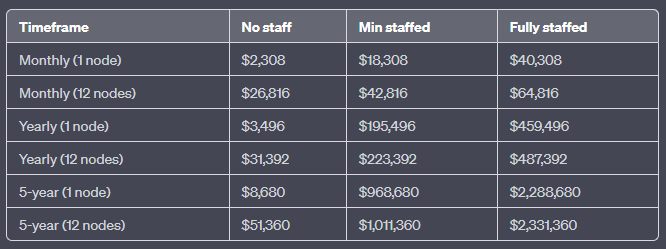
💵 Now, onto the total costs: For this case study we drafted a set of 3 main scenarios—staffless, one-man-army with a senior cloud engineer to make things balanced, and a fully staffed one.
For the latter scenario, we have put together a team of four to realistically fit a 24/7 timeframe:
1x Senior,
1x Mid-Level,
And 2x Juniors.
What do we get when we crunch the numbers down for a monthly, yearly, and a five-year timeframe for each of the scenarios we defined above?
Let’s find out...
Now isn’t that absolutely bonkers?! Yes it is, which is why we couldn’t help ourselves to benchmark these numbers against two of our subscription plans:
Growth, the minimum viable option to run Ethereum archive nodes,
And Business, which lets you deploy the dozen-node-operation we are using in this example.
Let’s start with a breakdown of the two plans, with the 16% annual payment discount in mind, as well:
Growth plan: Up to 10 nodes, $49/mo and $588/yr, or just $40/mo and $480/yr with a 16% discount.
Business plan: Up to 20 nodes, $349/mo and $4,188/yr, or alternatively $290/mo and $3,480/yr with a 16% off.
With that taken care of it is indeed time for…
⚖ The final judgement: Comparing on-premise vs service provider costs.
Let's dive into the operational costs (including optional staffing), whether it's monthly, yearly or over a span of five years and see how they fare against service provider fees:
🎁 Wrapping up: Operating an Ethereum archive node is no small financial endeavor, so being well-informed can help navigate this journey.
Our detailed exploration into on-premise node operation costs—from hardware, utilities, to staffing – and juxtaposing them with costs of using a node service provider like Chainstack paints a striking picture.
Wanna see all the details? Take a closer look at the full case study below 👇
shorturl.at/aouKY



Vasily Rudomanov retweeted

It's that time again. #BUIDLWithTrust
EP4: Web3 Infrastructure is loaded and ready! Don't miss out.
Join us as we talk Web3 nodes with node providers @ChainstackHQ and @NOWNodes and find out how they're used at @TrustWallet
Set your reminders 👇 xitter.cf/i/spaces/1OyKAWMYLYeJb
Vasily Rudomanov retweeted
Now on @BuildOnBase! Index & query blockchain data fast and reliably 💙🛠️
From today, @ChainstackHQ Subgraphs supports Base Mainnet & Tesnet 🔥
Subgraphs are an incredibly powerful technology that can revolutionize data management in #Web3
bit.ly/3PBpILp

ALT https://chainstack.com/subgraphs/
Claim now!
Attention @zksync #BUIDL-ers! 💙
The Chainstack faucet now supports the zkSync Era testnet!
Receive up to 0.05 ETH every 24 hours 🚰
Check it out 👉 shorturl.at/ahHKS
Vasily Rudomanov retweeted
1/ Hello everyone, there have been several requests on twitter for a subgraph on the trendy new social network @friendtech, so we have decided to write our own tutorial on accessing FriendTech deals in real-time through subgraphs docs.chainstack.com/docs/wri…

Vasily Rudomanov retweeted

As usual, the past 20 days have been full of non-stop shipping over here at @ChainstackHQ 🚢
No time for rest when you're supercharging thousands of #BUIDL-ers worldwide
🧵 ↓

Vasily Rudomanov retweeted
1/🎉 We heard you. And that is why we’re thrilled to introduce the new standard of @ChainstackHQ services — 🌐 Global Elastic Nodes: The world’s most resilient Web3 API so you can experience efficiency & responsiveness like never before. Find out more 👇
