

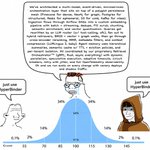





Sometimes I think I lost all my math intuition until I figure this kind of stuff out instantly. I’ll get it all back.


I’m not even exaggerating @SemanticReach


I keep going down rabbit holes of higher level math but I need to push myself to reinforce the fundamentals
Everyone in AI/ML needs to go follow this man

I've been thinking about AI in the context of Byung-Chul Han’s philosophy lately, specifically how notions like "tokenmaxxing" and datacenter buildout fits the "logic of obesity" he writes about, coextensive with Bataille's "accursed share." The technology which is intended to relieve humanity of toil becomes a vast labor to keep up with; new productivity metrics in terms of token usage are placed on workers, production (specifically knowledge work) is encouraged to be divorced from the very negativity, repose, and contemplation which makes it possible. Governments are thrown into confusion, education is destabilized, and so on.
Han would note that a single, meticulously crafted human paragraph carries more negative weight (the silences, the deletions, the revisions, the unsaid) than a billion algorithmically produced tokens. The actual goods are the intangibles, institutional knowledge, social knowledge, value creation.
Similarly data center buildout is done for the sake of building out, production for the sake of production. The process no longer enriches human life, it enriches the process's own metabolic expansion. It behaves *tumorously*
(I'm not anti-AI btw...just trying to understand it from all angles.)
We’ve been beating the big labs and their spin outs by a long shot for months now and a huge leap is coming very soon…

Superintelligence is not the greatest threat to society. It’s >90% accuracy lie detectors on every cell phone.

We Need an International Treaty to Ban Superintelligence open.substack.com/pub/persua…

Promising cures is marketing. Products like Hyperbinder will tighten the R&D loop with better tools and reasoning for agent-human collaboration.

Jennifer Doudna won the Nobel Prize for gene editing and went on Bloomberg to say the chatbots everyone is betting on cannot innovate at all. Every promise Silicon Valley is making about AI curing disease just hit the one person qualified to check it.
She has spent her whole career inside the actual frontier of curing disease.
So when she talks about what AI can and cannot do in biology, she is not guessing. She is reporting from inside the lab.
Her words were blunt. She is not seeing chatbots innovate. They summarize data. They write reports. They do not come up with a brand new idea nobody has ever had.
Then the interviewer pushed. So you're saying AI can't innovate?
Doudna did not flinch. She does not know if it can't. She just does not see it doing it right now.
This lands harder when you remember who is making the opposite case. Sam Altman says AI will eliminate disease within five years. Larry Ellison says AI will cure cancer in a 48 hour window.
An OpenAI executive even floated that the company should get a cut of sales on any drug discovered through ChatGPT. Doudna answered that in two words. Good luck.
Even the cancer specialists Altman is selling to keep warning that cancer is not one disease but hundreds, each needing its own cure, and that compute does not skip the years of lab work.
Her reason is simpler. Biology is hard. You cannot simulate your way to an understanding of the human body.
The people promising cures are the ones selling the tool.
The person who actually won a Nobel building them is telling you it has not happened yet.
Source: Bloomberg Originals
Watch the full video on their official channel.
Looking for quant finance builders testing next-gen AI knowledge substrate.
HyperBinder is a vector-symbolic / hypervector cognitive database that gives AI agents persistent, compositional long-term memory + relational reasoning — far beyond vanilla RAG or vector stores.
Perfect for:
• Multi-timeframe market memory & pattern recall
• Dynamic risk factor graphs
• Live strategy backtesting agents that actually remember past regimes
• Unified semantic + symbolic financial knowledge bases
Early test users / collaborators wanted (academic & industry quants especially welcome). DM or comment if you're building agentic quant systems.
Mike from Semantic Reach
semantic-reach.io
Fragmented data should necessitate a fragmented stack.
Existing companies won’t be at a disadvantage since we can ingest all of their messy knowledge and represent it in one unified structured semantic space. We make it easier and cheaper to have richer context.

Increasingly, I believe companies may need to be rebuilt from the ground up, where you have a single timeline of all observability + product metrics + file changes laid out in a retrievable system, like Datadog + Posthog + Google Drive + Slack (really unified filesystem of Claude Code chats + Codex chats). This might be the new data foundation for any and all companies to maximize AI. Needs to be rebuilt because keeping track of diffs on existing system basically impossible to produce longitudinal information on decisions and rollbacks, something coding agent storage companies are actively trying to figure out, but this should extend to businesses as a whole.
Highly skeptical existing businesses will adopt this though because it means overhauling everything about their instrumentation and business data, but I think businesses built on this foundation probably can execute 100x better and faster
Michael Myles retweeted

We're building the semantic foundations and agentic infrastructure that will power AI systems as they become more autonomous and self-directed.
Follow our CEO @NathanAnecone for more insights!
@AnthropicAI 's recent article on self-improving AI caused a bit of a stir, but I've seen surprisingly little work on the necessary and sufficient conditions for RSI.
I argue that pure RSI might be far more difficult than many in the field might believe, for borderline metaphysical reasons.
tl;dr: Certain liar paradox-like constraints on self-referentiality and the work of mathematician David Wolpert on the physical limits of inference engines conspire to make total closed-loop RSI not just difficult but potentially logically incoherent. Link in the replies.
Michael Myles retweeted

@AnthropicAI 's recent article on self-improving AI caused a bit of a stir, but I've seen surprisingly little work on the necessary and sufficient conditions for RSI.
I argue that pure RSI might be far more difficult than many in the field might believe, for borderline metaphysical reasons.
tl;dr: Certain liar paradox-like constraints on self-referentiality and the work of mathematician David Wolpert on the physical limits of inference engines conspire to make total closed-loop RSI not just difficult but potentially logically incoherent. Link in the replies.


There’s a better way to do this

JP Morgan's investment research team just shared exactly how they built their multi-agent system "Ask David", and it's the same architecture pattern showing up everywhere:
- supervisor agent orchestrates
- specialized subagents handle retrieval, structured data, analytics
- LLM-as-judge reflection node before the answer ships
- human-in-the-loop for the last accuracy gap
worth watching for anyone building:
A recent #IBM video lays out the choice between RAG and long context windows and asks: Is #RAG still needed? As frontier models context windows grow, it becomes tempting to "context dump" and hope the model is smart enough to sort through it. For certain tasks this is feasible, but it also just pushes the problem back.
We argue that the choices presented are a false dichotomy, and the real solution is a new type of context engine that does a lot more work behind the curtain.
👉semantic-reach.io/blog/long_…