

Highly decentralized messenger. Fully private. Uncensorable. Gossip is the home of free speech. Try the alpha : https://xitter.cf/t.co/B5SmtUqhfZ
World
Joined October 2025
- Tweets94
- Following1
- Followers392
- Likes48








Pinned Tweet
Introduction to the technical paper 📄
We just released the full technical paper explaining how Gossip works under the hood 🔍
It covers our post quantum cryptography stack, the pseudonymous identity system, metadata protection, the Agraphon messaging algorithm, and the design choices that keep Gossip censorship resistant 🔐
This is the blueprint for the future of private communication 🚀
Read it here: usegossip.massa.network/goss…

What happens if an attacker gets access to your keys?
Encryption isn't only about keeping messages secret while everything goes right. A strong messaging protocol also needs to limit the damage if secrets are eventually exposed.
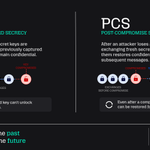
That's where Perfect Forward Secrecy (PFS) and Post-Compromise Security (PCS) come in.
With PFS, compromising long-term secret keys later shouldn't allow an attacker to go back and decrypt communications they previously captured. The protection of past messages doesn't depend on keeping today's secrets safe forever.
PCS addresses the other side of the problem. If an attacker temporarily gains access to a device or session, security shouldn't remain compromised forever. Once that access is lost, Gossip can use fresh secrets that the attacker doesn't know to restore confidentiality for subsequent exchanges.
This means a key leaked online doesn't have to expose an entire communication history or permanently compromise everything that follows.
PFS limits the damage to the past. PCS enables recovery for the future.
That's an important part of how Gossip is designed to handle compromise over time.

We’ve made a few updates to the Gossip website to make it easier to follow the project and see where we’re at.
The roadmap and changelog are now separated, making it clearer what’s coming next and what has already been shipped.
We’ve also given the website a small visual refresh and added our paper on PQ Rerand, recently published in the Journal of Cryptographic Engineering.
Go have a look and let us know what you think 👇
usegossip.com/

Gossip retweeted

We're excited to announce that Massa will be attending Global Gathering 2026 in Estoril, Portugal, from September 4–6.
Members of both Massa Labs and the Massa Foundation will be there to present Gossip, our decentralized messenger built for privacy, freedom of speech, and resilient communication.
Global Gathering brings together communities working at the intersection of technology, human rights, and social justice. We're looking forward to joining the conversation, sharing what we've been building, and meeting the people shaping a more open and resilient digital future.
We'll have more to share about our participation over the coming weeks, so stay tuned.
If you'll be in Estoril, come say hi!

Over the past few weeks, we've been working alongside @CDTChinese as part of Gossip's first real-world testing phase.
China Digital Times is an independent organization focused on internet censorship, digital rights, and online freedom. Their work and community made them a valuable partner to evaluate Gossip in environments where privacy and secure communication matter most.
Throughout this testing phase, participants helped us validate the application under real-world conditions and provided valuable feedback to improve the user experience.
We'd like to thank China Digital Times and everyone who took part in this first testing phase for their trust, their time, and their invaluable feedback.
This milestone brings us one step closer to building a communication platform that combines strong privacy guarantees with practical usability.
More updates will follow as Gossip continues to evolve.

Chat Control is back. Again.
For the third time, the EU has brought mass chat scanning back to the table. And once again, private communication is at the center of the debate.
This time, a motion to reject the proposal failed in the European Parliament. Despite more MEPs voting against than in favor, the required absolute majority wasn't reached, allowing the proposal to move forward in the legislative process.
Whatever your position on Chat Control, one thing should be clear:
When the future of private communication depends on political decisions or centralized platforms, it can change far more easily than most people realize.
Privacy shouldn't be something that survives from one vote to the next.
That's why we're building Gossip.
Our vision is a messaging protocol designed to protect not only message content, but also metadata, remove unnecessary identifiers like phone numbers, and move toward a decentralized network with no single point of control.
Because the future of private communication shouldn't depend on trust.
It should be built into the architecture.

Gossip is currently in an early stage of deployment.
All core security features are already implemented in the current version, including encryption, metadata protection mechanisms, and privacy properties such as plausible deniability.
The main limitation today is not the security model, but parts of the backend infrastructure, which remain centralized or hybrid to ensure stability during early testing.
This allows us to validate the protocol and user experience in real-world conditions before scaling the system further.
The next step in the roadmap is to progressively decentralize the backend layer, by moving toward a distributed infrastructure based on Massa’s node network.
This integration is planned as the next phase of the project, not part of the current version.
Development is iterative and driven by real usage and feedback from early deployments.

We are continuing the first real-world testing phase of Gossip.
This phase is not about releasing new features, but about understanding how the system behaves under real conditions.
Early testing helps us evaluate:
- how users interact with privacy-first communication tools
- how the system performs in constrained environments
- what assumptions need to be adjusted based on real usage
At this stage, Gossip is still evolving, and the architecture is being refined based on feedback from early deployments.
The goal is to close the gap between design assumptions and real-world behavior.
We will continue sharing learnings as the testing phase progresses.

Most messaging systems depend on centralized infrastructure.
This creates a single point of control and a single point of failure.
Gossip is designed to reduce this dependency as much as possible over time.
In its current version, the system is still evolving, but it already includes multiple access paths to the application.
One of them is a Progressive Web App (PWA), which can be accessed even if traditional distribution channels become unavailable.
The goal is resilience through multiple layers of access, not a single controlled entry point.

Privacy should not depend on trusting a platform with your personal data.
Gossip is built on a privacy by design approach.
No phone number. No email. No government ID.
No personal information required.
Instead, users generate a cryptographic identity derived from a passphrase, and can start communicating immediately.
By removing identity requirements at the entry point, Gossip reduces the amount of data that can be collected, leaked, correlated, or exploited.

Most messaging apps are designed to prove authorship.
Gossip works differently.
Gossip provides plausible deniability.
Both participants share the secret material needed to generate valid messages, which means nobody can cryptographically prove a message truly comes from you.
Either side could have forged it.
In environments where conversations may be exposed, this changes the threat model entirely.
Privacy is not only about hiding what is said, but also about removing certainty around who said it.

Gossip is a privacy-first messaging app built for people who need more than just encrypted messages.
Most messaging platforms focus on protecting message content. Gossip goes further by also reducing metadata exposure, making it harder to map who is communicating with whom.
Users create a cryptographic identity from a passphrase. No phone number, email address, or personal information is required.
Gossip is designed for journalists, activists, researchers, and anyone operating in environments where privacy and censorship resistance matter.
Over the coming weeks, we'll dive deeper into the technologies and ideas that power Gossip.

Today, Gossip enters its first real-world testing phase.
In collaboration with @CDTChinese and activists across the world, we are starting to put Gossip in the hands of users who face real privacy and censorship challenges.
Gossip is a privacy-first messaging app built to protect not only message content, but also communication patterns and metadata. No phone number. No email. No personal identity required.
This marks an important milestone for the project and the beginning of a new phase focused on real-world feedback and continuous improvement.
We'll be sharing updates, insights, and progress throughout the testing period. Stay tuned.

Gossip retweeted

加密通讯应用 Gossip 现已开放内测。
这是一款去中心化的即时通讯工具——注册不需要手机号,不需要邮箱,一个助记词就可以开始使用。
你的通讯内容和使用数据都被加密,没有中心服务器存放你的对话记录。
中文用户的反馈,是这个应用目前最需要的。因此,中国数字时代与 Gossip 团队携手推出了这次体验,邀请你试用 @UseGossip,并把使用体验反馈给开发团队。
👉 详细了解: chinadigitaltimes.net/chines…

We fixed an issue affecting iPhone users when accessing the Gossip PWA. The problem was related to node rate limiting, which could prevent the app from loading correctly on iOS.
To address this, we improved request handling by adding caching, reducing unnecessary load on the nodes and making the experience more stable.
Since the Gossip PWA is hosted on DeWeb, this should also improve overall reliability and responsiveness for all users.
We are temporarily pausing the Gossip News Flash sessions for a period of time as we run a larger scale live test with activists and active participants.
This setup will allow us to focus on gathering clearer signals and more structured feedback in a controlled environment.
The goal is to better observe what works, refine the format, and improve the overall delivery based on real usage.
We’ll share updates as we move into the next phase.
🎙️ Gossip News Flash #26
@damipator is back live to cover the latest ecosystem news, recent progress, and what’s currently shaping the next steps.
📅 Tuesday, 19 May 2026
⏰ 5:30 PM CET
📺 Live on X and YouTube, links shared on the day
Starting in less than 30min.
