Growing with every sunrise 🌅 🤗
London
Joined November 2021
- Tweets3.6K
- Following143
- Followers9
- Likes7.6K
Aisha AlMuwaiji retweeted

▲ Mistral just released Timestral, its first time series foundation models, and the headline is size: 209M parameters, #1 zero-shot on 3 benchmarks, and no GPU needed.
The key innovation is Decoupled Horizon Forecasting (DHF). Instead of masking the values to forecast, learned forecast tokens read the full history. Every observed value works as both target and context.
Covariate-aware attention gives each series a role: target, past-only or known-future covariate. Information flows only from covariates to targets, so a weather forecast or holiday calendar can help without leaking a target's own future.
Timestral-209M scores 0.658 MASE on GIFT-Eval, 0.626 on TIME and 50.39 SQL skill on fev-bench. The 28M model beats Chronos-2, about 4x larger, on GIFT-Eval and TIME. It is a trade-off though: the lead is thin (0.658 vs 0.661 over t0-gamma), and results stay self-reported until the technical report lands.
4 sizes (5M to 209M), 32,768-step context, 21 quantiles, 10 ms to 140 ms on an 8-thread CPU. Weights ship under a Modified MIT license, while TimesFM-3 weights are non-commercial......
Full analysis: marktechpost.com/2026/10/18/…
Repo: github.com/mistralai/timestr…
Models: huggingface.co/collections/m…
@MistralAI

Aisha AlMuwaiji retweeted

If you build with LLMs, save this article
@perplexity_ai breaks down the OWASP Top 10 for LLM Applications 2026
with real world incidents and practical ways to mitigate each vulnerability
Keep it in your project's security notes
Pass the article to Claude Code and ask it to review your project, identify potential vulnerabilities, and implement as many mitigations as possible
perplexity.ai/hub/blog/llm-s…

Aisha AlMuwaiji retweeted

∇ Stanford CS336 (Spring 2026) — Lecture 6: Kernels and Triton
A shorter tensor expression does not necessarily mean fewer trips through GPU memory.
For a constructed 1024 × 1024 float32 softmax, five separate passes move about 32.016 MiB in a logical read/write model. An ideal fused row kernel moves 8 MiB: read the input, keep the intermediate values on chip, write the result.
That is roughly a fourfold traffic ratio, not a measured fourfold speedup. Caches, reduction costs, register pressure, and spills still matter.
Triton makes this mapping explicit: a program owns a block of values, masks its tail, and performs the local computation. BLOCK_SIZE is a count of logical elements—not a count of CUDA threads.
The same reuse principle leads from fused activations to row reductions and tiled matrix multiplication. Measure the baseline, check numerical edge cases, then compare the actual kernels.
My notes:
ickma2311.github.io/ML/CS336…

ALT Softmax traffic comparison for a constructed 1024 by 1024 float32 matrix. Five separate passes total 32.016 MiB of logical reads and writes. An ideal fused row kernel reads the input and writes the output for 8 MiB. The approximately fourfold traffic ratio is not a measured speedup.
Aisha AlMuwaiji retweeted

Knowing how to train ML models doesn't make you an AI Engineer. Another $2,000 certification probably won't either.
The real skill gap?
Knowing how to turn models into production AI systems.
Harvard just made it easier to close that gap. For FREE.
Professor Vijay Janapa Reddi's Machine Learning Systems curriculum teaches the engineering behind modern AI.
Here's what's inside:
1️⃣ ML Systems Fundamentals
→ Training, optimization, benchmarking
→ Model deployment and serving
→ Hardware acceleration
→ Production ML operations
2️⃣ Advanced AI Engineering
→ GPU and compute infrastructure
→ Distributed training
→ Large-scale inference
→ Reliability and fault tolerance
→ Infrastructure and fleet operations
And this isn't another collection of lectures you passively watch.
You actually BUILD things.
✅ 34 interactive browser-based labs
✅ TinyTorch: Build ML machinery from scratch
✅ Hardware kits for hands-on deployment
✅ MLSys·im: Simulate AI infrastructure
✅ StaffML: Practice ML systems design
The GitHub project already has ~28K stars.
Here's what I want data scientists to understand:
You already know Python, statistics, and machine learning.
That's your foundation.
But knowing how to train a model is VERY different from knowing how to deploy, scale, monitor, and optimize one.
That's the engineering gap you need to close.
❌Stop collecting ML certifications.
✅Start learning how AI systems actually WORK.
Harvard Machine Learning Systems. FREE.
(Link in comments)
♻️ Repost for a data scientist making the leap to AI Engineering.
🚨 Want to learn how to build + ship AI and Data Science projects (that businesses actually want in 2026)?
On October 21st, I am hosting a free workshop to help you get started with AI + DS projects in Python (free).
Register here (500 seats): learn.business-science.io/ai…

Aisha AlMuwaiji retweeted

Security is much cheaper to build into a system than to add in after something goes wrong.
In this article, @devseyi explains how to make security part of your architecture from the start.
You’ll learn about threat modeling, domain-level security rules, database security, secure logging, CI/CD gates, and more.
freecodecamp.org/news/secure…

Aisha AlMuwaiji retweeted

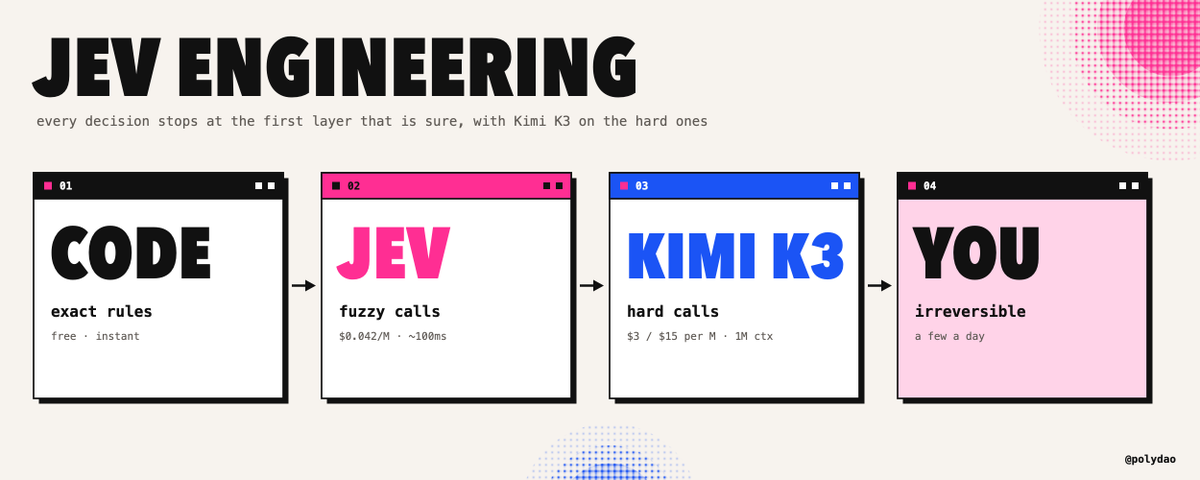
this is pure f*cking gold for anyone running coding agents
Jev founder Diogo Amogo wrote a PDF on building a Jev harness
the promise:
> 200x faster
> 400x cheaper
the model hasn't been the slow part for a while
the speed and the cost sit in the harness wrapped around it
• how to use it
> drop this PDF and the article below into Claude Code or Codex
> let it rebuild its own setup
one evening of setup
and your agent starts next week on a harness most teams still don't have

Aisha AlMuwaiji retweeted

FINALLY. 😭🏆
After what feels like a decade, it’s time to add another tally to the hackathon wins.
Winner -Legal & Government Services Category at @IntronHealth , Intron’s Sahara CodeSwitch Africa Challenge. 🇳🇬🔥
WE ARE SO BACK. 🚀
Aisha AlMuwaiji retweeted

🎀 KASOA WALKED FOR PINK! 🎀
Step by step, Kasoa showed up for breast cancer awareness at the Kasoa Pink Run! Families, friends and neighbours came together at Odupongkpehe Park, Kasoa Old Market Area, to walk for a cause that matters.
🎥 Here are some highlights from the walk.
Aisha AlMuwaiji retweeted

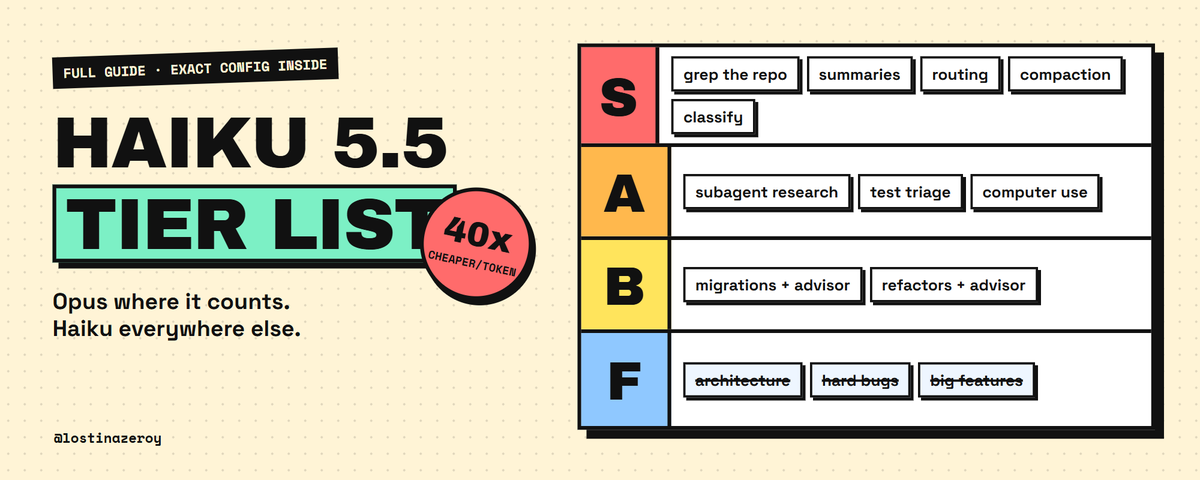
this is f*cking wild, two files turn claude code into a router that sends every job to the cheapest model that can do it
if opus is your main model, the built-in explore subagent runs on opus too. every file search and grep gets billed at opus prices
give each layer a specific job:
→ haiku 5.5 scouts: file search, grep, log summaries, compaction, classification
→ sonnet 5.5 builds: normal code work, tests written to an existing pattern
→ opus 5.5 decides: architecture, hard debugging, plans where a wrong call costs a day
→ you approve anything irreversible
a cheap model can quietly cost 5x
haiku 5.5 is priced by prompt length. above 100K tokens, input and output cost 5x more. a subagent that gets the whole transcript pasted in crosses that line on every call
every route has to show:
> which model answers
> what it's allowed to touch
> how big the prompt gets
> who checks the output
one example night from the guide, 400 agent decisions: everything on opus $39.50. routed $3.03
open claude code in your repo, then ask:
"set up this repo to use claude haiku 5.5 where it is strong. show every change as a diff and wait for my approval
1. tell me which model the main session, each subagent and the built-in Explore subagent use today
2. add .claude/agents/Explore.md with model: haiku, effort: low and tools: Read, Grep, Glob
3. add "CLAUDE_CODE_SUBAGENT_MODEL": "haiku" under env in .claude/settings.json. keep every subagent that sets its own model
4. flag every place where a haiku subagent could get a prompt over 100K tokens"
start with the scouts. it's the safest change and the first one that pays back
full setup guide below ↓

Aisha AlMuwaiji retweeted
Giving an AI agent direct access to an internal API can cause security and auditability problems.
In this article, Harish shows you how to wrap an internal API with MCP, expose only approved tools, and enforce server-side rules.
You’ll also add a gateway, validate tool calls, attach user or service identities, and block unsafe queries.
freecodecamp.org/news/how-to…

Aisha AlMuwaiji retweeted

Must-read paper integrating decision models like Jev into harnesses.
They distilled an open 4B decision model, mostly from Jev's answers on the agent's own states, that beats Jev inside that agent and is much cheaper to run.
Their harness, JevAgentHarness, sends each routine choice to the decision model and uses its answer only when the confidence clears a threshold fitted on the agent's own trajectories. Below the threshold, the LLM decides as usual. With the fitted threshold, tool and argument cascades cut cost by 14.2% without changing the outcome of any of 500 tasks. A fixed threshold of 0.5 lost 21.5 points.
They also train AgentDecision-4B on states the agent reaches after its own mistakes, with Jev's answers as labels. On tasks unlike its training data, the agent solved 91.5% with it and 82.0% with Jev. On familiar tasks, 4B models trained this way made agents 81.1 to 89.0% cheaper and up to 2.5 times faster while staying within 3 points of success.
Paper: academy.dair.ai/papers/jevag…

Aisha AlMuwaiji retweeted

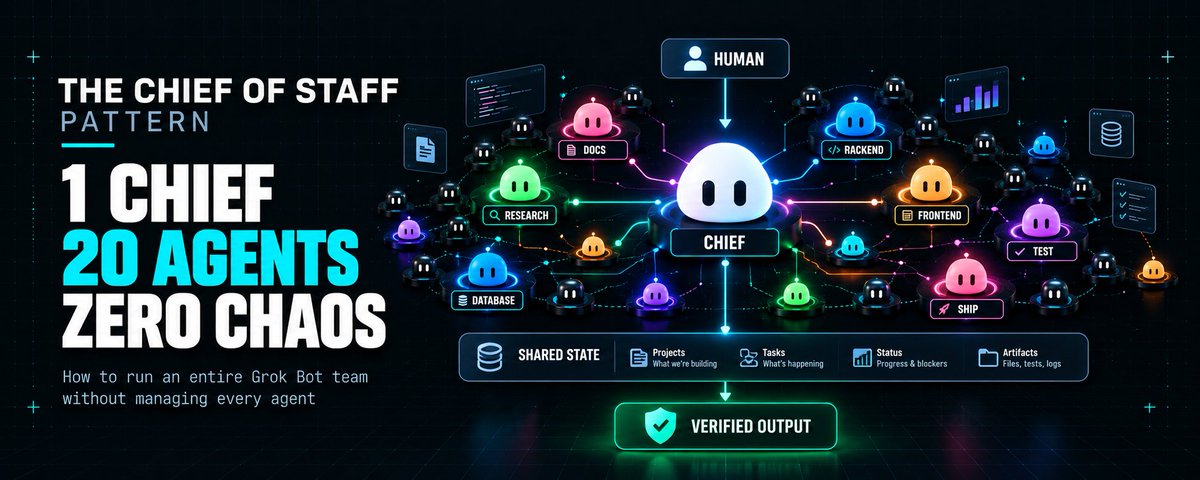
SpaceXAI engineer Lauren Tan made all 54 of her pstack skills public, and you can use them to build a smarter Grok Bot team.
this is f*cking brilliant...
the stack includes:
→ 3 setup skills: /poteto-mode orchestrates the workflow
→ 8 build skills: /architect, /arena, /swarm to plan, compare approaches and parallelize work
→ 6 review skills: /correct, /interrogate, /create-verification-skill to catch mistakes before they ship
→ 8 context + learning skills: /recall, /catchup, /teach to recover context and turn experience into reusable knowledge
→ 5 writing skills: /unslop, /technical-writing and more
→ 24 engineering principles covering how agents reason, test, handle dependencies and structure code
but here's the part that matters most:
the skills are only half the system.
Lauren's approach is to make the codebase agent-friendly, enforce what you can through tests and CI, and use skills for the things that still require judgment.
install pstack → analyze past mistakes → improve the codebase → verify automatically → scale your agents
most people keep writing longer prompts.
this is how you build a system that gets better with every run.
save the skill list, install pstack, and bring the full workflow to your Grok Bot ↓


Aisha AlMuwaiji retweeted

This is free f*cking gold.
Five repos that replace an AI influencer agency, run from one Claude Code session.
I can't understand why anyone is still paying four figures a month for this:
1. OpenMontage -> github.com/calesthio/OpenMon…
Claude Code as a video studio. 12 pipelines, 100+ tools, 700+ skill files, 60+ providers, avatar and clip factory included. 68k stars.
2. Higgsfield Skills -> github.com/higgsfield-ai/ski…
Soul ID locks a face from 5 to 20 photos. Marketing Studio runs 9 ad modes. Virality Predictor scores the video before you post it.
3. Higgsfield CLI -> github.com/higgsfield-ai/cli
30+ image and video models from the terminal, plugs into Claude Code, Cursor and any MCP agent.
4. Higgsfield Claude Skills -> github.com/AKCodez/higgsfiel…
19 community skills. Character image -> 9:16 UGC video in one command, 15 prompt styles.
5. Phantom by ByteDance -> github.com/Phantom-video/Pha…
Same character across every shot, up to 4 reference images, 720p, built on Wan2.1.
The loop: identity -> character bible -> production -> virality test -> ads.
Low score goes back to regenerate on its own, you sign the sponsor deals and approve the spend.
The tools were always supposed to be free. The stack map is below ↓


Aisha AlMuwaiji retweeted

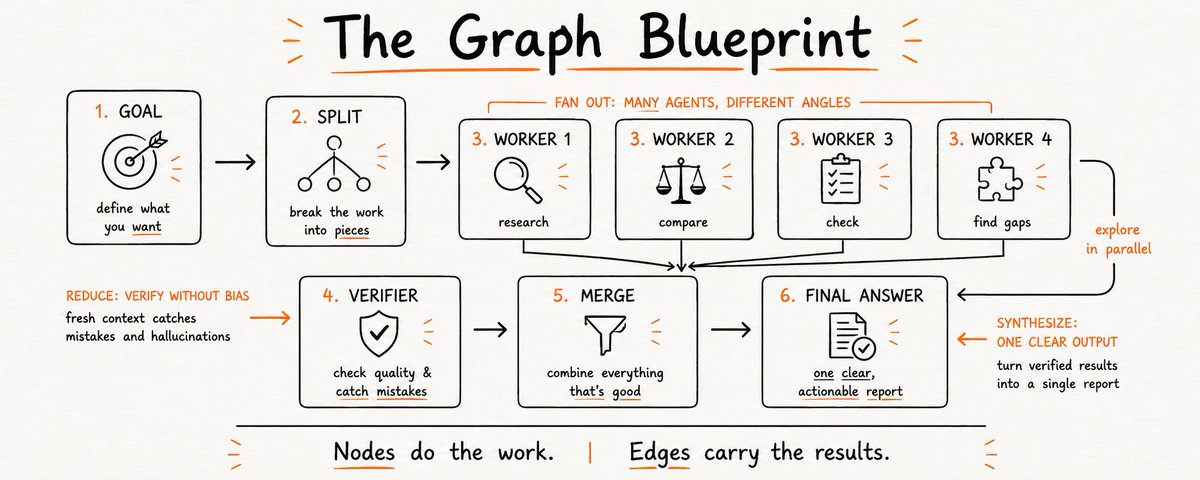
Head of Claude Code:
"I'm not prompting my agents anymore, I'm building graphs and loops so they can build the agents for me."
In 10 minutes he shows exactly where agentic engineering is going and how not to get left behind.
Definitely something you cannot afford to skip.
Watch it, then read the step-by-step guide below on how to build a system that improves itself.

Aisha AlMuwaiji retweeted

🚨 The entire RAG industry is about to get cooked.
Researchers just dropped a new approach that:
→ skips the vector database entirely
→ never embeds your data
→ doesn’t chunk documents at all
→ runs zero similarity search
It’s called PageIndex. Instead of slicing your docs and dumping them into Pinecone, it builds a clean tree index and lets the LLM reason through it the same way a sharp human would read a book.
It hit 98.7% on FinanceBench and beat every vector RAG system on the leaderboard.
No embeddings. No chunking. No vector DB.
100% open source.

Aisha AlMuwaiji retweeted

JevBench v1.7.46 (API offerings only) is live!
Notable changes:
- 🥇 Brand new d1-ultra is leading the pack at Composite Score.
- Lots of strong new model versions in the Top 10.
- Very cheap with good capability: Instinct Dual 4B
- Very fast with good capability: attest-31B-v1.0


Aisha AlMuwaiji retweeted

🧵 Behind the scenes of AI Search in LangSmith:
TL;DR
1️⃣ SmithDB turns traces into readable trajectories. Structured filters narrow the candidates when you search
2️⃣ A model checks each remaining trajectory against your description and streams back matches
Aisha AlMuwaiji retweeted

Excited to see LLM-as-a-Verifier being adopted in @NVIDIA latest model release 🚀
Scaling self-verification with Nemotron 3.5 Super significantly improves accuracy across agentic benchmarks:
Terminal-Bench 2.1: 63% → 72% (+9%)
DeepSWE: 25% → 35% (+10%)
Check out the Nemotron 3.5 model card for more details:
research.nvidia.com/labs/nem…
Huge thanks to @NVIDIAAI for providing the resources and collaborating with us on this work!


Aisha AlMuwaiji retweeted

Fitch revises outlooks on 11 Nigerian financial institutions as stronger reserves, naira appreciation and easing inflation improve economic conditions.
arise.tv/fitch-links-nigeria…

Aisha AlMuwaiji retweeted

the @typesafeai team just dropped a massive banger.
Jev now supports images.
you can compose text, images, and structured data fluidly, then answer questions across these modalities rapidly and in parallel.
this is a big step for Jev.
until now, we've mostly talked about Jev as the fast decision-making brain for AI agents.
classifying emails. scoring leads. routing tasks. making yes/no decisions in milliseconds.
but image support opens up a whole new set of possibilities.
think about agents that can: → analyze screenshots and UI elements → classify images without waking up an expensive frontier model → combine visual inputs with text and structured data → process multiple questions in parallel instead of handling them one by one
the bigger idea is still the same.
not every task needs a massive LLM doing slow, expensive reasoning.
some tasks need fast decisions. now, those decisions can involve more than text.
I'm excited to see what people build with this.