




Route San Juan, August/September(?), 2004
-
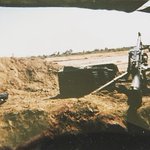
Picture doesn’t look like much but I can remember it. To the west of our FOB at the Iskan power plant, across the Euphrates ran Route San Juan. This was another company’s AO, but for whatever reason we were sent over to set up blocking positions for some op this Private First Class Machine Gunner wasn’t made aware of.
-
We ended up being out there for several days, digging in and maybe swapping out with another platoon part way through then coming back. Can’t remember. I remember it was hot. I remember we got mortared more than once. I remember the BC coming out to see us and bringing Gatorades then we started getting mortared and him and his PSD (CAAT) took off leaving us in the dust. I remember going back to the FOB. We had tracks, but moved on foot because the IED threat was so high. We had to halt pretty often and Marines were going down as heat casualties. We had more guys than we should have in the tracks and most of them had IVs in. Then we started getting mortared again and everyone piled into the tracks on top of each other. The mortars were close. Like really close. After this I think we ended up loading up in the tracks and just hauling ass back to the FOB.
-
Good times. I’ve determined I should share some of my own photos and stories, what I have and what I can remember. I’d love for you guys to do the same.


The Field of the Dead
-
I didn’t get a chance to post earlier in the day, but I wanted to make sure I put this back up. This post talks about the banzai charge on Saipan on the evening of 6-7 July.
-
“At daybreak we passed through the Army lines and entered a cane field of American and Japanese corpses. Bodies were everywhere, sometimes lying over one another. They were in ditches, ravines and in the flat cane fields. There were hundreds upon hundreds lying in different positions intermixed with American Army and Marine bodies.
-
There were truck loads of souvenirs lying about such as samurai swords, rifles, pistols and flags, however, at this moment we had no desire to take anymore than what had been requested of us.
-
We watched as troops moved in the area to identify the American dead and remove their previous buddies to a proper burial ground.” - Cpl Bernard Riggs
-
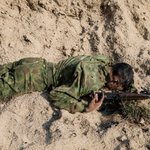
You guys know I’m not big on posting American dead, but this was reality. I did use AI to colorize these. I think it did a pretty good job and I find it brings out details that I personally miss in the originals. In the last photo note the homemade spear used by the Japanese soldier.
-
I’ll probably post more about Saipan tomorrow/Thursday and I’ve said this before, but why talk so much about Saipan? In my opinion Saipan has been overshadowed by the Normandy landings and has been marred by inter-service rivalry at the upper echelons, but nevertheless was an extremely important campaign involving the 2nd and 4th Marine Divisions along with the Army’s 27th Infantry Division.
🤖 Made with AI


“Like ripe apples in a storm.”
-
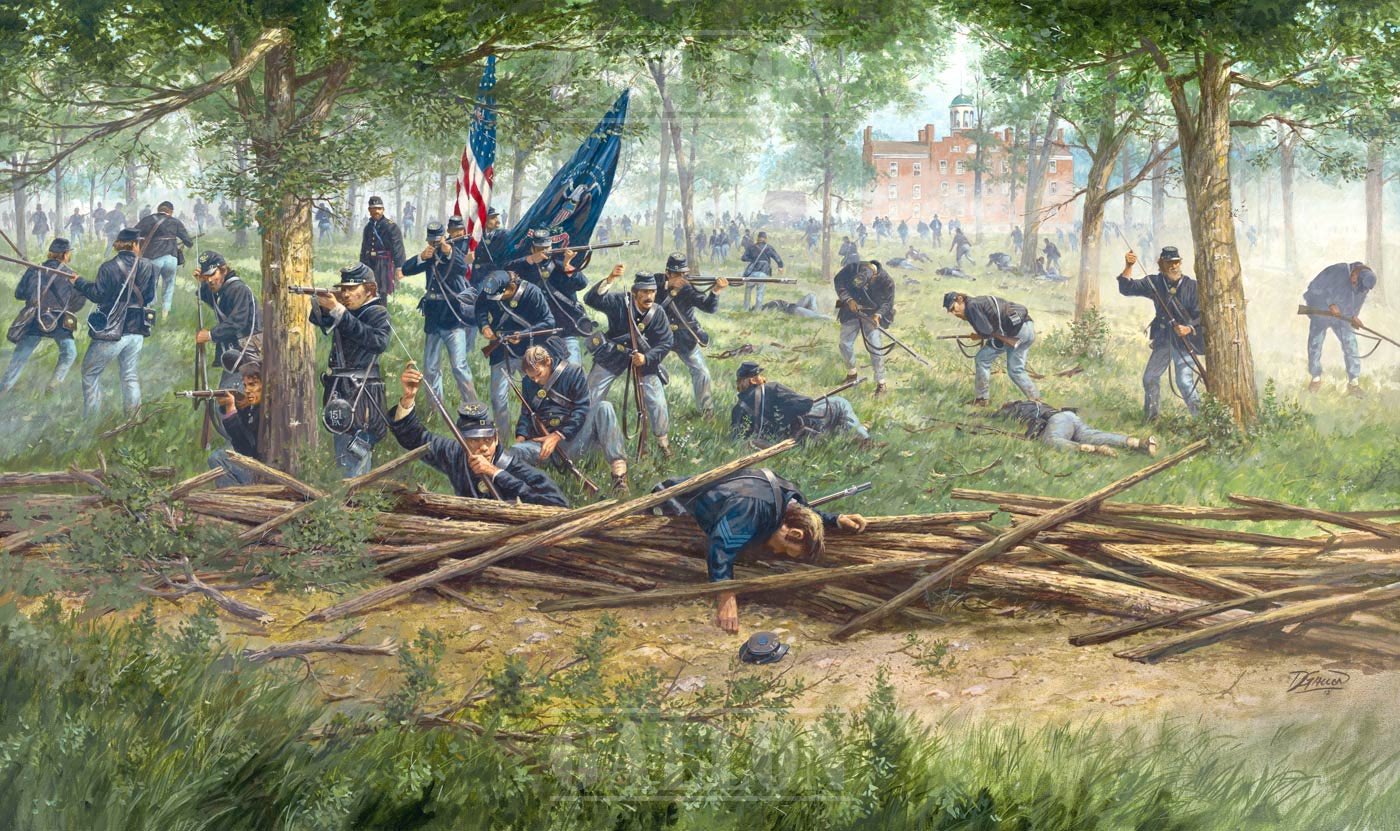
While you’ve probably heard of the exploits of the 20th Maine or the Iron Brigade at Gettysburg, you probably haven’t heard of the 151st Pennsylvania until today.
-
Most of these men had just enlisted in late 1862. Many of them came from the farmland of the Pennsylvania Dutch country of Berks County and the coal region of Schuylkill County (not all of them were school teachers) and found themselves, for the first time, in the maelstrom of battle.
-
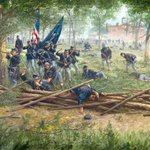
They found themselves thrust in to plug a gap as the rest of their brigade crumbled to their left and the Iron Brigade withdrew to their right. They held as the 26th North Carolina closed the distance and exchanged volleys at 20 yards or less, buying precious time for their comrades to reach the Seminary.
-
They held as long as they could before the 11th Carolina threatened their flank, and they fell back to rejoin the rest of the 1st Corps at the Seminary. More than half of the regiment had fallen by this point. They rallied behind a split rail fence defensive position constructed earlier that day.
-
A fresh wave of South Carolinians moved through their beleaguered comrades from North Carolina picking up the assault. The 1st Corps held as long as possible at the Seminary before streaming back through the town to Cemetery Hill, the 151st one of the last to go, the Confederates in pursuit. The 151st’s Commanding Officer LtCol McFarland was wounded here and captured and remained at the Seminary until September of 1863 recuperating after the loss of his left leg, along with many others.
-
That evening 92 men of the 467 that went in to battle were accounted for on Cemetery Hill. Through the night the count rose to 113. 72% casualties, the second highest loss of any Union regiment at Gettysburg. But they weren’t don’t yet. Held just behind the center of the Union line on July 3, the regiment helped repulse Longstreet’s Assault.
-
There are so many incredible acts of valor that have gone untold for so long. While Gettysburg is a great movie, it is based on a novel that only covers certain characters and portions of the storyline.
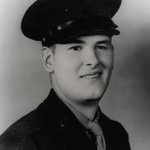
“The President of the United States of America, in the name of Congress, takes pride in presenting the Medal of Honor (Posthumously) to Private First Class Harold Glenn Epperson, United States Marine Corps Reserve, for conspicuous gallantry and intrepidity at the risk of his life above and beyond the call of duty while serving with the First Battalion, Sixth Marines, Second Marine Division, in action against enemy Japanese forces on the Island of Saipan in the Marianas, on 25 June 1944.
-
With his machinegun emplacement bearing the full brunt of a fanatic assault initiated by the Japanese under cover of predawn darkness, Private First Class Epperson manned his weapon with determined aggressiveness, fighting furiously in the defense of his battalion’s position and maintaining a steady stream of devastating fire against rapidly infiltrating hostile troops to aid materially in annihilating several of the enemy and in breaking the abortive attack.
-
Suddenly a Japanese soldier, assumed to be dead, sprang up and hurled a powerful hand grenade into the emplacement. Determined to save his comrades, Private First Class Epperson unhesitatingly chose to sacrifice himself and, diving upon the deadly missile, absorbed the shattering violence of the exploding charge in his own body.
-
Stouthearted and indomitable in the face of certain death, Private First Class Epperson fearlessly yielded his own life that his able comrades might carry on the relentless battle against a ruthless enemy.
-
His superb valor and unfaltering devotion to duty throughout reflect the highest credit upon himself and upon the U.S. Naval Service. He gallantly gave his life for his country.”

GTFGU - Saipan, 1944
-
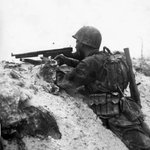
1919 team in action on Saipan, probably Garapan.
-
If you’re interested in learning more about the battle of Saipan, feel free to scroll back through my 18,000 posts and find posts from years past where I did some serious deep dives into the oft overlooked battle.
🤖 Made with AI


“Our amtracs were in line abreast and were taking artillery fire, the heaviest we had ever encountered. You could see the shells hitting the water, exploding and making the water splash way up.
-
Just off to my right a shell scored a direct hit on one of my boats and POW! It just went into pieces.
-
There was a flash and big explosion and I could see pieces of men flying out of it. I thought ‘oh shit’ but also thought ‘thank God it wasn’t my boat.’ Mostly I was thinking ‘who was it who got hit and hie many guys an I gonna be without?’” - John Murdock B/1/8, Saipan (pulled from Dean Ladd’s book Faithful Warriors)
🤖 Made with AI


Saipan. 15 June, 1944
-
RCT-6 and RCT-8 (2nd Marine Division) hit the northern Red and Green Beaches, while RCT-23 and RCT-25 (4th Marine Division) landed on the Blue and Yellow Beaches to the south.
-
The tractors were supposed to carry the Marines inland as far as possible, and some did manage to drive over the beach and a few hundred yards into the trees. However, when Japanese gunners found the range and began hammering the beach itself, most men preferred to hop out of the conspicuous, slow ‘tracs and take their chances on foot.
-
“They sure came to life to meet the fourth and fifth waves,” quipped Lieutenant William Masterson of the 25th Marines.
-
Less than 20 minutes after the first tractor made landfall, an astonishing 8,000 Americans were ashore and fighting for their lives.
-
Men watched helplessly as friends and comrades were pierced by flying shell splinters or disappeared in explosions. Officers and squad leaders made conspicuous targets; unit command structures began to fall apart.
-
A strong northerly current carried LVTs into the wrong landing zones. Tractors and tanks went up in flames, and the line bulged in areas and constricted in others as Marines worked their way towards their first objective line 500 yards inland.
-
In a scene with ugly overtones of Tarawa, BLT 1-25 was fought to a standstill only 12 yards from the water.
-
The 23rd Marines, landing on Yellow Beaches 1 and 2, fared somewhat better and moved through their objective of Charan Kanoa virtually unopposed. At the outskirts of town they came under severe artillery fire and were brought up short.
-
For hours, the battle ebbed and flowed around the living, the bleeding, the dying, and the dead. - From 1-24thmarines.com
-
While the 6th, 8th, 23rd and 25th Marines were making the initial landing, the 2nd, 24th and a battalion from the 29th Marines were conducting a feint to the north, around Tanapag. They would come ashore on the southern beaches around midday.


Major Edward B. Cole, 6th Machine Gun Bn
-
“The battle for Belleau Wood continued for four days more and then, on 10 June, the various companies laid down a barrage of machine gun fire. It was as the 1st Battalion, 6th Marines were crossing open ground toward the underbelly of the bloody Belleau Wood when Cole, always in front, suffered a severe wound.
-
He had relinquished command to his adjutant Thomas Curtis while he went forward. In vain Curtis had tried to dissuade him that his place was back with the guns. “Ned” as he was called, insisted he was going forward with 1/6 and did so. Along the way he came across nearly 100 Marines who had lost their way. Picking them up, he directed them to follow him and then led them in a flank attack.
-
They had nearly reached the German guns when the enemy saw them. The Germans were unable to turn the guns around, so they began hurling grenades. Two of them wounded him in his arms and legs before he grabbed the third to throw it back. It exploded in his raised hand, shattering it, and the fragments went into his face and all through his body. His men continued the attack and wiped out the guns and gunners, thirty-five of the former and an unknown number of the latter.
-
Ned tried to crawl back to his lines but the loss of blood slowed him down consderably. He was eventually picked up by Marines and carried to the rear.
-
Back at a line hospital the doctors tried to stem the bleeding and to operate, but he had lost so much blood they were forced to discontinue. By now he was in a state of shock and extremely weak. Though the doctors gave him up as a lost cause, his will carried him through the night.
-
In a day or so, he asked his brother, BGen Charles H. Cole, to bring fruit to the other wounded when he visited— still thinking of the ‘other guy’ when he himself was in such a bad way. His duty was still on his mind when, shortly before he died, he sent Gen Harbord, commanding the 4th Brigade, a message that he would very soon be back and fighting again. He died on 18 June 1918, fighting to the last.” - Legendary Marines of the Old Corps
-
He would be awarded the Distinguished Service Cross and Navy Cross.

Remembering Captain Patrick Rapicault, 2/5 Weapons, Killed In Action on 15 November, 2004 IVO Ramadi, Iraq.
-
“The President of the United States of America takes pride in presenting the Silver Star (Posthumously) to Captain Patrick Marc Rapicault, United States Marine Corps, for conspicuous gallantry and intrepidity in action against the enemy while serving as Company Commander, Weapons Company, Second Battalion, Fifth Marine Regiment, FIRST Marine Division, I Marine Expeditionary Force, U.S. Marine Corps Forces, Central Command, in support of Operation IRAQI FREEDOM, from 24 September to 15 November 2004.
-
Captain Rapicault courageously led his Marines on the streets of Ar Ramadi, Iraq through 50 firefights and 27 improvised explosive device ambushes. Always leading from the front, he directed the fire and maneuver of his company with complete disregard for his own personal safety.
-
Despite being the first Marine in the Battalion wounded and his company suffering the heaviest casualties during daily street fighting, Captain Rapicault always displayed an infectious enthusiasm that motivated every Marine to fight hard and recover quickly from battle.
-
On every mission, Captain Rapicault’s intuitive and calm combat leadership ensured success on the battlefield, with limited damage to vehicles and friendly casualties. He gallantly gave his life in the cause of freedom.
-
Captain Rapicault’s bold leadership, courageous actions, and complete dedication to duty reflected great credit upon him and were in keeping with the highest traditions of the Marine Corps and the United States Naval Service.”
-
Rest Easy Marine


“Those poor souls. They didn’t have their fathers here”
-
Marine Colonel Francis Fenton kneels beside his son, Private First Class Mike Fenton, near Shuri, Okinawa, May 1945.
-
They had met once during the fighting when their paths crossed at a partially destroyed Okinawan farmhouse. After exchanging news the two family members returned to their work. They would never talk again. On May 7, 1945, while beating back a Japanese counterattack the younger Fenton, 19, was killed.
-
When his father received the bitter news, he traveled to the site of his son’s death and knelt down to pray over the flag-draped body.
-
Upon arising, Colonel Fenton stared at the bodies of other Marine dead and said: ‘Those poor souls. They didn’t have their fathers here’
-
If you’ll remember in the past, I posted a photo of Captain Ike Fenton of 1/5 in Korea, 1950. Ike Fenton was another son of Col Fenton.
-
This Memorial Day, and every day, remember those who paid the ultimate sacrifice and spend the day how you feel best honors their memory.


