

Performance Intelligence for men 35+. 75 peptide vendors screened, 4,606 COAs read, FDA letters checked. What's real, what works, who to trust.
Joined May 2026
- Tweets1.1K
- Following284
- Followers167
- Likes248




Pinned Tweet
2 years of injury hell… 2 surgeries on my L5/S1 vertebrae. The first surgery was a total failure. I rehabbed for 1 year, was selected to play in the 2024 World Cup but I knew my back still wasn’t right. I had to withdraw from the squad… Heartbroken.
On the day my team took to the field to play the world’s best teams in England, I was checking in to the St Vincent’s Hospital, Sydney to get my second surgery.
I diligently followed my rehab protocol but again my recovery plateaued at around the 6 month mark, which is when I had been expected to have been fully recovered.
I was frustrated and still physically nowhere near where I needed to be to return to the field.
I started to look into research peptides after I started seeing them pop up in my social media feed. BPC-157 seemed too good to be true but I was so desperate I jumped in and did very little research. I found a supplier in UK, bought a batch of vials and got started.
No, this isn’t a post about what a miracle outcome I got… quite the opposite! You see, I had no idea what I was doing, I had no plan, not protocol, no structure, hell I hadn’t even heard of a COA 🤦♂️. I got started, injected as often as I remembered to, guessed my doses and hoped for the best. WASTED a chunk of change, go no results to speak of.
I wasn’t educated about peptides and how I should approach them. I wasn’t educated still struggling with my recovery, so I went away to do proper research learn how to plan and execute a protocol under the guidance of a sports clinician who helped me out a proper plan in place. That’s when the game changed for me. BPC-157 daily and TB-500 twice weekly. Incremental dose increases every few weeks under guidance!
I started the new protocol in January 2025, by end February, I saw noticeable improvements in pain reduction, mobility and my scar tissue seemed to be improving.
By the end of March I was on the grass / Astro again, training and playing games again. I wasn’t in my main position in the middle but I was on the field which after 18 months out felt like a miracle.
Whilst I still had a long road ahead within 6 months I was trialing for the national team again and while not playing in my preferred position, I was selected for a 3 test series vs Hong Kong.
We won the series 3-0, I was the top scorer for our team with 6 tries and the recovery was complete. I achieved what I set out to do, which was to regain selection and play for the national team again. That was my final representative appearance before I retired.
I set up @UndergroundBio to help guys like me, who had heard about peptides but had no idea how to get started, didn’t understand how they work or couldn’t find reliable information I could trust.
That’s what I am here for, to learn from my own experiences, work with the top industry professionals and pass on all my knowledge to those that need it.
I’m building an app next and I’d love you to join my journey as I build what I hope will be the best education, tracking and monitoring app in the market. I want people to really understand what works for them and not just follow the masses of misinformation flooding the internet.
I would love to hear your thought, opinions and suggestions too.

ALT Jersey presentation between Singapore Head Coach to player.
BPC-157 is the most talked-about recovery peptide, and most of its evidence comes from rats: faster tendon and ligament healing. WADA prohibits it.
What would earn your trust: one strong human trial, or years of results from people you know?

🧐 1 compound → the team behind its early research:
• BPC-157 → Sikirić's team at the University of Zagreb medical faculty. Their 1993 papers describe it as a newly synthesised 15 amino acid piece of a protein found in gastric juice.
• CJC-1295 → ConjuChem, a drug company in Montreal. Its researchers picked it as the best of three versions they tested in rats, in 2005.
• AOD-9604 → Monash University in Melbourne. Frank Ng's team there published the earliest study of it we could find, in obese rats, in 2000.
• Semax → the Institute of Molecular Genetics in Moscow, part of the Russian Academy of Sciences. Its scientists synthesised it, guided by two of the academy's senior members.
• Epitalon → Khavinson's group at the St. Petersburg Institute of Bioregulation and Gerontology. The earliest papers on it we found, from 2000, are theirs.
Before you lean on a compound's research, check how much of it comes from the team that started it.
🧪 Ullah 2018, the one study we found that compared age groups, gave kisspeptin-10 to young, middle aged and older men. LH rose in every group, but testosterone rose significantly only in the youngest.
The study was from Pakistan, and each man got one shot.
LH is the signal that makes your testes produce testosterone, and kisspeptin-10 tells your brain to release it.
Two Edinburgh studies used long drips. In four healthy men, testosterone rose by about 45% over 22.5 hours (George 2011). In four men with type 2 diabetes and low testosterone, it rose by about a third over 11 hours (George 2013).
All three used kisspeptin-10, not the longer kisspeptin-54. Each measured hormone levels over a day or less.
If you're past 35, would a rise in LH alone tell you enough?
🧐 Are you getting what you pay for with the smaller vial? Per milligram, TB-500's 10mg vial came out about 29% cheaper than its 5mg in our 15 October price check.
We priced 54 sellers that day. Ten compounds were listed in two sizes by at least 10 sellers each. In all ten, the bigger vial had the lower median price per milligram. The median is the middle price.
TB-500: the 5mg vial's median was $38.00, or $7.60 a milligram. The 10mg vial's median was $53.88, or $5.39 a milligram.
BPC-157: the 5mg vial's median was $30.00, or $6.00 a milligram. The 10mg vial's median was $50.00, or $5.00 a milligram.
These are list prices from one morning, and our check can miss sellers who only sell packs.
When you compare sellers, do you look at the vial price or the price per milligram?
🧪 In people with diabetes and overweight or obesity, starting tirzepatide came with about a 30% lower risk of advanced diabetic eye disease within a year. They were compared with matched people on lifestyle changes alone, in a records study, not a randomised trial.
The disease damages the tiny vessels at the back of the eye. In the advanced stage, fragile new vessels grow.
Needing anti-VEGF drugs, which stop those new vessels growing, was about half as likely. That's from Shah 2026 in Ophthalmology, which followed 173,846 US patients for 12 months.
The authors say tirzepatide "was associated with" fewer eye problems.
Would a records study of this kind change how you weigh tirzepatide, or would you wait for a trial?
🚨 Eli Lilly has dropped its lawsuit against Lone Star Peptide Co., one of the sellers it sued in August over products sold as retatrutide.
Lilly filed the notice on 16 Oct, with prejudice. That means it can't bring the same claim against Lone Star again. The notice gives no reason.
Lone Star never answered the lawsuit. In September, Lilly told the court it planned to ask for a default judgment. That's the ruling a court can give when the other side doesn't respond.
Its case against Legendary Peptides carries on. Legendary asked the court on 2 Oct to throw it out, and that motion is still waiting on a ruling.
On 19 Oct the judge in Beaumont, Texas, set a case management hearing for 30 Nov. The lawyers must meet by 12 Nov, and the order lists 6 Dec 2027 for jury selection and trial.
What to watch: Lilly's answer to Legendary's motion, and the judge's ruling on it.
🧪 Epitalon lengthens telomeres in cells in a dish. A review published on 8 October calls it "biologically active but clinically unproven" in people.
Telomeres are the caps on the ends of your chromosomes. They get shorter as cells age.
In a 2025 study from Brunel University London, epitalon lengthened telomeres in normal human cells by turning up telomerase, the enzyme that rebuilds them. It lengthened them in breast cancer cells too, through a different route.
The review looked at the human side and found small biomarker studies and one older trial in an inherited eye disease.
ClinicalTrials.gov has no record for epitalon under either spelling.
What would you want tested in people before you'd lean on the telomere claim?
🧐 1 compound → has any trial posted results on ClinicalTrials.gov, the US trials registry:
• BPC-157 → no. Its gummy study in 40 adults finished in November 2025 and hasn't posted any.
• CJC-1295 → no. Its one record, a 2005 trial in people with HIV and belly fat, is marked as stopped early.
• KPV → no. There's no record for it on the registry.
• Kisspeptin-10 → yes. An 18 person trial in adults whose brains don't send the signal to make sex hormones posted in 2026.
• Thymosin alpha-1 → yes. A 189 person trial in kidney dialysis patients posted in 2026.
• Tesamorelin → yes. A 263 person trial in people with HIV and belly fat posted in 2014.
• Cerebrolysin → yes. A 242 person trial in vascular dementia, a dementia caused by poor blood flow to the brain, posted in 2009.
When a page says a compound has been through human trials, check whether any of those trials posted results.
I played competitive rugby for years before I moved across to Touch Rugby.
Touch is rugby without the heavy contact. A defender stops you by touching you, and play carries on.
It is a different code of the game, focusing more on finding space and gaps instead of big physical collisions.
It's fast and lung-busting, but it still has a lot of physicality and strength needed to win the ruck, as players still physically try to block you as you run in with the ball. Winning the dip is like beating your opponent in the snap in the NFL.
It's interesting as many contact players look at Touch as if it is an inferior version of the game, yet some of the world's best rugby players started their rugby journeys playing Touch.
Touch is where I earned selection for Singapore at Masters level, the age grade for older players. I played in the 2019 World Cup in Malaysia and was selected for the 2024 edition before injury curtailed my chances to represent in 2 categories.
Did you stick with the sport you started in, or move to another one as the years went on?
🚨 In New South Wales, Australia, emergency department visits linked to peptides rose from five in July 2025 to more than 217 in September 2026.
NSW Health released the figures on 19 Oct. Across those 15 months it counted 1,180 visits, and 833 of them mentioned retatrutide and no other peptide.
Each visit was counted because peptide use came up at triage, the first check when you arrive. So the data shows an association. It can't show the peptide caused the visit.
In the US, if a peptide gives you a bad reaction, you can report it to the FDA through its MedWatch system.
🧪 AOD-9604 has been tested in people. The paper that writes up those trials reports safety and gives no weight results.
893 adults took part in six Australian trials between 2001 and 2006. All but one of the trials were in obese adults.
The two biggest were set up to test weight loss. One ran 12 weeks in 300 adults aged 30 to 65, and the other ran 24 weeks in 502.
The paper is Stier 2013. The authors say AOD-9604 was tolerated as well as placebo. IGF-1, the marker growth hormone drives, didn't move.
In the 12 week trial, five people on AOD-9604 had a serious event, four of them cancers. The investigator judged none of them related to the drug.
So if you're looking at it for fat loss, this paper can't tell you whether it works.
🧐 17 of the 85 sellers on our vendor register hold an A or a B. That's one in five.
4 hold an A and 13 hold a B.
How many sellers did you look at before your last order?
🚨 Two women were intubated last summer after peptide and vitamin shots at a Las Vegas antiaging conference, KFF Health News reported on 13 Oct.
Nevada's pharmacy board looked into it. Medical Daily says investigators could not find out why the two women became ill. "We were not able to obtain the product," the board's executive secretary said. Both women have recovered, Medical Daily says.
KFF's wider story is about people who report harm from peptides such as BPC-157. One man said he felt horrible after three days of BPC-157 up his nose. He told KFF the fatigue and anxiety lasted months, and his eyes and muscles twitched. Another man said a severe migraine hit within days of taking BPC-157 with TB-4.
KFF also found entries in the FDA's adverse event database. A 36 year old woman was hospitalised in December after taking BPC-157, and a 48 year old man with a "life-threatening" condition after taking it.
What a report can show: the FDA's own dashboard says a report "does not establish causation". The reports are not verified, and they can't tell you how often a harm happens. KFF says they still flag issues worth a closer look.
What the studies can show: when a 2025 sports medicine review gathered BPC-157 research on muscle, tendon and bone, just one of its 36 studies was done in people. The rest were lab and animal work, and the review says no clinical safety data were found.
The one human BPC-157 trial on the US registry that we rely on is a 2015 Phase 1. It has never posted results. KFF says FDA scientists flagged a 2020 study with signs of liver toxicity, harm to the liver, in rats and dogs given BPC-157.
If you're weighing BPC-157:
• Nobody can yet tell you how safe it is in people, so that risk is yours to weigh.
• With a vial sold for research only, purity, dose and sterility can't be checked, Medical Daily notes.
• Medical Daily lists the signs that need 911: trouble breathing, a swollen face or throat, chest pain or confusion. Yellow skin or eyes, or dark urine, need a prompt check.
• Tell a qualified medical practitioner about every peptide you take.
• If something goes wrong, report it to the FDA through MedWatch. Those reports are how a problem gets noticed.
People were hurt here. We'll keep watching for what the FDA does with these reports.
🧐 1 compound → the code name it was tested under:
• Tirzepatide → LY3298176. Eli Lilly's trial records still carry it, SURPASS-1 among them.
• Semaglutide → NN9535. Novo Nordisk's 2009 trials in healthy men used the code in their titles.
• BPC-157 → PCO-02, the tablet in its 2015 trial in healthy volunteers in Tijuana. Papers from the Zagreb group behind it use PL 14736 for its gut trials.
• Cerebrolysin → FPF 1070. Japanese lab and animal papers used that code in the 1990s. Cerebrolysin is an extract from pig brain.
• Tesamorelin → TH9507. Theratechnologies ran a 2008 trial in HIV patients under that name.
Search the code as well as the name. Some trials only turn up under the code.
Vittone 1997 gave sermorelin to 11 healthy men aged 64 to 76, all with low IGF-1 (the growth hormone marker). They took it every night for 6 weeks. Their night-time growth hormone went up, but IGF-1 didn't move.
In those 11 men, two of six strength tests went up, the upright row and the shoulder press, and so did crunch endurance. But muscle and fat on a DEXA body scan didn't budge, and nor did weight.
Every man got the drug, and each was only compared with his own numbers from six weeks earlier.
Would you still run it for muscle?
tl;dr
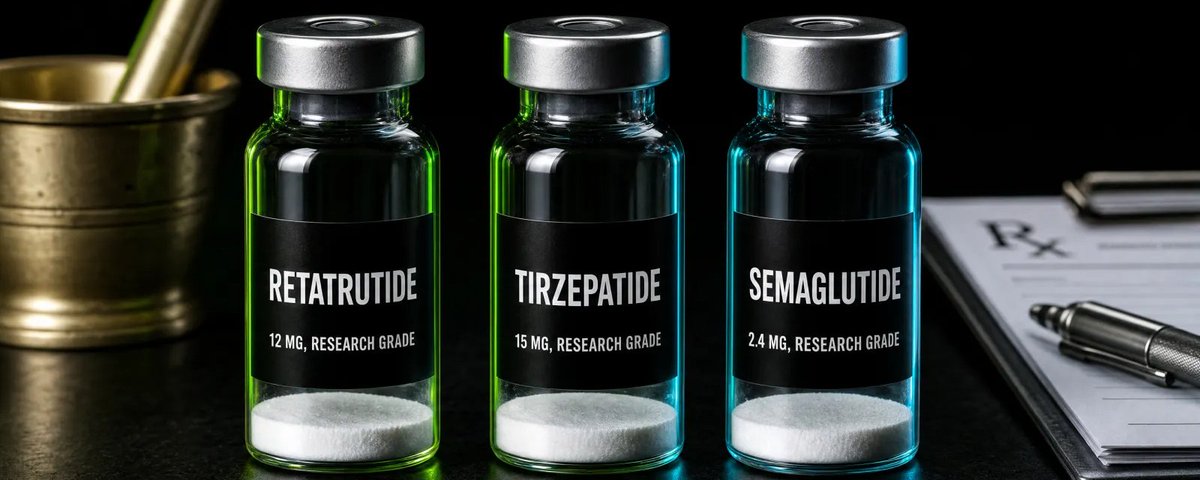
💉Retatrutide switches on GIP, GLP-1 and glucagon receptors, while tirzepatide hits GIP and GLP-1 and semaglutide only GLP-1.
💉In separate trials, retatrutide's 12 mg dose cut mean weight by 24.2% over 48 weeks, more than tirzepatide's 20.9% or semaglutide's 14.9%.
💉These are not head-to-head comparisons, and retatrutide also reduced liver fat by up to 82.4% and improved body composition.
💉Side effects are mainly mild to moderate gut issues that ease over time, similar across the drugs.
💉Retatrutide remains investigational and unapproved by the FDA, unlike approved tirzepatide (Zepbound) and semaglutide (Wegovy/Ozempic)

🧐 More than half the seller certificates we read in September named one of three labs.
We read 2,559 certificates published by 25 sellers. Three labs between them are named on 1,389, or 54%. One lab alone is named on 832, about a third, and those come from 8 of the 25 sellers.
In our view, that makes the lab name a weak way to choose between sellers, since many of them share it. What sets one apart is what the lab tested on that batch.
When you pick a seller, how much weight do you give the lab name?
🧪 Teichman 2006, the main human CJC-1295 paper, reports two trials. In them, one shot raised growth hormone for 6 days or more.
The trials gave healthy adults aged 21 to 61 CJC-1295 or a placebo, a dummy shot. One trial used a single shot. The other used two or three, a week or two apart. They ran 28 and 49 days. I could only read the abstract, and it doesn't say how many people took part.
In Teichman 2006, one shot raised growth hormone levels 2 to 10 times. IGF-1, the marker growth hormone drives, rose 1.5 to 3 times for 9 to 11 days. No serious side effects were reported. After repeat shots, IGF-1 stayed above its starting level for up to 28 days.
The results are hormone levels. The abstract reports no muscle, fat, sleep or recovery results, so it can't tell you if anything you'd see in the mirror changes.
If a marker goes up, is that enough for you?
I've put together a direct comparison of retatrutide, tirzepatide & semaglutide; the evidence between them is genuinely different, not just marketing layers on the same molecule.
I've sourced every figure & laid out the FDA approval picture as it stands.
🧐 Before you read the purity figure on a certificate, find the lot number.
A certificate covers one batch, and the lot number names that batch. It only helps you if the same number is printed on your vial.
In September we read 2,559 certificates published by 25 sellers. 144 had no lot number, or the lot field said N/A or Unknown. That's about 1 in 18.
So find the lot first. Then hold the certificate up next to the label on your vial.
Does the number on your last vial match its certificate?