

Paleoclimate scientist | Clumped isotope research group leader @UniUtrecht
Utrecht, The Netherlands
Joined January 2015
- Tweets180
- Following296
- Followers452
- Likes465






Pinned Tweet
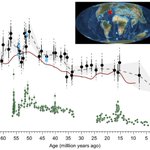
This study is a big step towards a new benchmark deep sea temperature record. More to come….science.org/doi/10.1126/scie… – at Bunnik, Nederland


Btw..this is not the #NewNormal. Since we are still on a warming trend due to continuing greenhouse gas emissions, future #heatwaves will be most likely hotter than this. This is just a heatwave in the transition to a real hothouse state… – at Wallingford, CT

Deep sea temperatures over the past 65 million years were much warmer than previously thought! This is important - with potential implications for our understanding of Earth System Sensitivity. Led by Nele Meckler @BjerknesBCCR, happy to be part of the team! – at Bunnik, Nederland


Getting close to the @UUEarthSciences fieldwork finish line…and Almost #FossilFriday..trace fossil beauties on Zumaia Beach. Each layer a snapshot in time, capturing a moment on the seafloor in the Eocene hothouse… #geology or a piece of #art ? – at Zumaia, España

Come work with us on Paleoclimate @UUEarthSciences ! Assistant Professor in Earth System and Climate Sciences (0.8 - 1.0 FTE) uu.nl/en/organisation/workin… – at Zumaia, España
2nd week fieldwork. Zumaia, Geo Walhalla , working on a.o. the K-Pg boundary, transition from red marl to carbonate banks. The one big mass extinction that wiped the #dinosaurs off the planet.

Day 5: Lizarraga, on top of a ridge that was a coral reef 60 million years ago, looking out into what was the deeper part of the ocean. Thinking of the nice blue water back then does unfortunately not cool us down ..#Heatwave ..As bonus some spectacular Karst features..


17
Day 4: Moved westward, to Ainsa, famous for Eocene turbidite deposits. Land surface temps climbed up to above 50 degrees. Don’t burn your fingers on the rocks. #Heatwave continues. Is this what an average summer day looked like during the Eocene?

#ImageOfTheDay
The second (early) #heatwave of the year is ongoing in western Europe 🥵
➡️Many records 🌡️ have been broken in #France 🇫🇷 and in #Spain 🇪🇸
⬇️As measured by #Sentinel3 🇪🇺🛰️, on 14 June the Land Surface Temperature exceeded 53°C in parts of Spain ♨️

1
8


Day 3: Paleogene carbonates of the Campo section. A carbonate ramp. What was this place like when it formed? Think of Persian Gulf Region and add twenty degrees to it…

1
17
And what happens if you add a lot more CO2 to a #greenhouse world that is already very hot? It’s getting even hotter. Happened during the #PETM. The red and white VW T7 Bus is right in front of the layer that was deposited as a consequence of an intensified hydrological cycle.

1
2
Day 2: Getting into the stuff we are here for, Paleocene-Eocene, hottest period in the last 60 Myr years. Logging these sediments in the sun, in a #Heatwave (34 C), is tough. Some students went up to their boundaries…

When these red floodplain deposits formed, in a high greenhouse gas world, summer heatwaves had day temps more like 54C..guess that would have killed us. Students did a great job, also thanks to the training by @sedimentologist, @Emiliagnathus, and others in the past two weeks!

9
Day1: Mind-blowing glimpse on the timescales of geologic change in Val de Boi. 500 million year old sediments that were heavily deformed during an orogeny that produced mountains which no longer exist


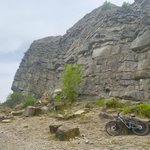
For the coming two weeks in field with @UUEarthSciences students, tomorrow day 1 in beautiful #ValDeBoi, #pyrenees . Fast forward from the Cambrian to the Triassic. Happens to be a great MTB area as well…

For the coming two weeks in field with @UUEarthSciences students, tomorrow day 1 in beautiful #ValDeBoi, #pyrenees . Fast forward from the Cambrian to the Triassic. Happens to be a great MTB area as well…
Lots of fun during the recording of a podcast on #paleoclimate with the great duo from @geoofeverything. @UUGeo really has some great students. Go check them out on spotify!

Members of our UU clumped isotope group, @ClumpyTobias, @elenadom96, @Japhir, went to the streets yesterday for more action to reduce carbon emissions. The science is overwhelmingly clear: politics needs to do more! @MinPres

Klimaatwetenschappers demonstreren in Den Haag: 'Ongemakkelijk, maar het moet' nos.nl/l/2424137

1
5