Fish and wildlife research on 43 university campuses in 41 states. Tweets do not equal endorsement. Follow us @usgscoopunits on Facebook and Instagram.
United States
Joined November 2014
- Tweets2.2K
- Following3.4K
- Followers2.9K
- Likes1.7K
Fish on! Understanding Recreational Fishers, brings together experts to show how people and the environment interact in recreational fishingโuseful for the public, students, researchers, and educators designing courses on human dimensions of fisheries.
link.springer.com/book/10.10โฆ
Congrats Daniel Isermann, Wisconsin Fishery, inducted into the Fresh Water Fishing Hall of Fame Class for his contributions to the sport of freshwater fishing. Industry leaders meet annually to select nominees into this elite group of professionals!
tinyurl.com/24kkdy4b
Congrats to James Cain, New Mexico CRU, who has been recently named a fellow of The Wildlife Society. James has made research contributions to species such as desert bighorn sheep, mule deer, Mexican wolf, and other ungulates. Congrats James! ๐
tinyurl.com/5n8j2s8x
Dr. Lowell E. Baier, 85, passed away peacefully on November 21, 2025. Lowell was a warrior & friend of the CRU Program. Lowell was an award-winning author, a champion of wildlife conservation, and natural resources management. Our deepest condolences. ๐
tinyurl.com/7mcyr2u6
The NY CRU and the NY Department of Environmental Conservation (DEC) are testing all-day spring turkey hunting in 31 Wildlife Management Units in NY. The study will measure hunter satisfaction, survival, and harvest to guide future DEC decisions. USGS pic
tinyurl.com/5n7tntrx
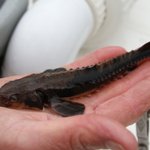
The South Dakota Unit is partnering with South Dakota Game, Fish and Parks and the Minnesota Department of Natural Resources to research lake sturgeon age, growth, maturity, and movement within Big Stone Lake in SD & MN. #LakeSturgeon
tinyurl.com/46w593ch
The Idaho CRU is using trail cameras to evaluate relationships among black bear, bobcat, coyote, mountain lion, and gray wolf โ and itโs not all about avoiding rivals! Some predators share space, likely due to shared food sources.
tinyurl.com/56btx5kf
Due to the federal government shutdown, this account is not being actively updated. For more information, please visit: doi.gov/shutdown
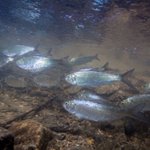
USGS researchers at the Massachusetts CRU are leading research on river herring. Their role in the food web isnโt well understood. Our goal is to see how young river herring affect predators like white perch and yellow perch. #Estuaries
tinyurl.com/bdy24ycd

ALT Alewife, are several other fishes that as a group are commonly referred to as river herring; alewife, blueback herring, American shad, hickory shad and other migratory shad on the east coast. Alewives spawn in freshwater but spend most of their life at sea. They donโt jump like salmon, but they can swim very fast in short bursts to pass through rapids. In spring, they migrate from the ocean back to their home rivers to spawn. Text and image source: Ryan Hagerty, U.S. Fish and Wildlife Service
The Idaho CRU is working with Idaho Department of Fish and Game to better understand steelhead. Given its iconic status, it is no surprise that anglers get excited about these fish! Steelhead bring in hundreds of millions of dollars to Idaho communities.
tinyurl.com/ywkr5f9u
The Louisiana CRU is working with the Louisiana Department of Wildlife and Fisheries to deliver information to decision-makers about gear selection and data interpretation for targeted studies and monitoring programs of Louisianaโs oysters.
tinyurl.com/2456p999
The Oregon CRU is leading efforts to understand critical ecosystems like the Nisqually River Delta in Washington. We used 6 years of data to model how weather and sea-level rise affect water temperaturesโkey info. for salmon that rely on cool water.
tinyurl.com/2cnwsvdb
The Arizona CRU is using GPS transmitters to track bald eagle migrations & highlight the importance of tracking all age groups for effective avian conservation efforts within the Pacific Flyway. Images: Koerner and Pearsall, U.S. Fish and Wildlife Service
tinyurl.com/mr9hvcb6
Job alert! The New Mexico Unit invites applications for a postdoc position to join a multi-agency partnership focused on recovery of the Rio Grande silvery minnow. Interviews begin in late September.
tinyurl.com/yt2bfdsu
Image: Rio Grande silvery minnow, Joel Lusk, USFWS
The Vermont CRU released AMMonitor 2, a fully open-source wildlife monitoring R package useful for students and users with some coding experience who desire a standardized yet flexible data management framework. Images: USGS
tinyurl.com/29wru66b
The Michigan CRU found that the nine-banded armadillo has expanded its range to all of Missouri, southern Iowa, parts of Kansas & Illinois, northern & eastern Indiana, eastern Kentucky & Tennessee, South Carolina & Georgia, & western North Carolina.
tinyurl.com/2ywcxr3c
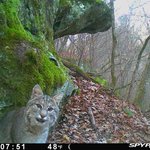
The New York CRU is using trail cameras to track bobcats, black bears & coyotes. Theyโre creating a database where users report wildlife sightings. This citizen science project helps gather important information about these species.
tinyurl.com/3ntk7kdk
The Mississippi CRU is working with volunteer anglers to build a one-of-a-kind fisheries database. With more fishing apps available for smart phones and other devices, managers can involve many anglers in data collection.
tinyurl.com/5z2jwu3m
Our camera traps recently โsniffedโ out a white-backed hog-nosed skunk โ the second-known sighting in Oklahoma since 1930! This finding is the first evidence of the skunk and is within the range of a poorly documented subspecies in decline.
tinyurl.com/mrykfwzm
Our Montana Fishery CRU is working with Yellowstone National Park to examine the impacts of invasive lake trout on the native Yellowstone cutthroat trout. People enjoy fishing for the species & the trout serve as a food source for grizzly bears & eagles.
tinyurl.com/554uf2ar