

The NLP Group at the University of British Columbia
Vancouver, BC, Canada
Joined February 2022
- Tweets131
- Following57
- Followers639
- Likes61



We are excited to host Vagrant Gautam from Heidelberg Institute for Theoretical Studies for a talk on "Reference in Modern NLP". We look forward to seeing you there!
📅 Tue, Aug 18
🕙 11:00 AM
📍ICICS X836
@UBC_CS @CAIDA_UBC @UBCLangScis

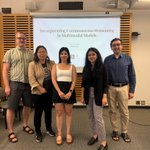
Congratulations to 🎓 Dr. Sahithya Ravi (@Sahithya_Ravi) for successfully defending her thesis, "Improving Commonsense Reasoning in Multimodal Models".👏 Wishing you continued success as you embark on the next chapter of your journey. Well deserved! 🎉


Congratulations to 🎓 Dr. Soheil Alavi for successfully defending his thesis, "Language Models as Interactive Systems: From Game-Based Interaction to Persuasive Experiences".👏 Wishing you continued success in your future endeavors. Well deserved! 🎉


We’re excited to have a guest speaker: Dayeon (Zoey) Ki from University of Maryland to give us a talk about auditing multilingual bias across the model pipeline. It will be in ICCS X836 on Friday, August 14 at 2 PM. – at Vancouver, British Columbia

That's a wrap! It was a pleasure sharing our work and connecting with colleagues at #ACL2026NLP.


We are excited to host Ido Dagan from Bar-Ilan University @biunlp for a talk on “Trusting what we read, and what we write”.
We look forward to seeing you there!
📅 Mon, Jul 13
🕦 11:30 AM
📍ICICS X836
@UBC_CS @CAIDA_UBC @UBCLangScis

UBC NLP Group retweeted

🎲 Can LLMs stand in for real, unpredictable systems?
We're increasingly dropping LLMs into simulations: humans in economic models 📈, agents in multi-agent settings 🤖, processes in epidemiology 🦠. But if a model always returns the single "most plausible" answer, it can't capture how messy and unpredictable the real world is.
Please check out our recent work from @UBC_NLP and @UBC_CS, where we introduce the first benchmark for evaluating randomness in LLMs.
🧪 Introducing UnpredictaBench: 448 problems spanning shuffling 🔀, real-world randomness 🌍, and random number sampling across 40 distributions 📊, testing whether models can truly sample from a target distribution, not just vary their outputs.
🔬 We also put creativity under a numerical microscope for the first time, measuring it as distributional behavior instead of vibes.
🚨 The result: no model clears 40% at KS@100. Most collapse to one answer. Reasoning helps a little, but there's no quick fix.
📄 huggingface.co/papers/2606.0…
Thanks for my awesome collaborators and supervisors: @DabiriAghdam, Liang Luo, Ellie Dingqiao Wen, Lele Wang, @careninigiusepp, and @PeterWestTM.

We are excited to host Kathleen Fraser from the University of Ottawa for a talk on “Bias and safety in large vision-language models”.
We look forward to seeing you there!
📅 Fri, May 29
🕙 10:00 AM
📍ICICS 246
@UBC_CS @CAIDA_UBC @UBCLangScis

UBC NLP Group retweeted

🌟 Intent, a cognitive state related to goals and plans in the human mind, is ubiquitous in human interactions across various domains. Accurately understanding the intent behind speech, conversation, and writing is crucial to the development of helpful Large Language Model (LLM) assistants, and misunderstanding the user intent could cause unexpected or even harmful consequences.
🤔 Intent understanding matters, but can LLMs grasp the intent as accurately as we expect?
To assess their intentional ability, we introduce IntentGrasp, a comprehensive benchmark for evaluating LLMs' intent-understanding capability. IntentGrasp contains a large-scale training set of 262,759 instances and two evaluation sets: an All Set of 12,909 test cases and a more balanced and challenging Gem Set of 470 cases.

Congrats to Annie Wang for presenting her MSc thesis titled "Promoting Epistemic Equity by Surfacing Knowledge Gaps between English Wikipedia and other Language Editions"! 🥳 You can read the preprint here: arxiv.org/pdf/2505.24195

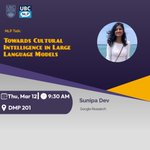
We are excited to host Sunipa Dev from Google Research for a talk on “Towards Cultural Intelligence in Large Language Models”.
📅 Thu, Mar 12
🕘 9:30 AM
📍 DMP 201
We look forward to seeing you there!

We are delighted to welcome Stella Li, a PhD candidate at the Allen School of Computer Science at the University of Washington, for a special talk titled “Proactive Question Asking for Reliable and Personalized LLMs.”
Join us:
📅 Mon, Mar 9th
🕒 10:30 AM
📍 ICCS X836

We are excited to host Tomasz Limisiewicz from Meta & University of Washington for a talk on “Pursuit of Fair and Effective Tokenization for Language Models”.
📅 Mon, Mar 2nd
🕒 10:30 AM
📍 ICCS X836
We look forward to seeing you there!

UBC NLP Group retweeted

I am excited to introduce our work SPIKE-RL, which models surprise in Video-LLMs 🤯
📎arxiv.org/pdf/2509.23433
✨ To appear at #ICLR2026
w/@VeredShwartz @adityachinchure @LeonidSigal
1/7 🧵
UBC NLP Group retweeted

Check out our #CVPR2026 workshop on Cognitive Foundations for Multimodal Models! We have an exciting line of speakers, a challenging shared task, and more!

📢 Excited to announce CogVL: Cognitive Foundations for Multimodal Models Workshop at #CVPR2026 🏔️ ✨
🔗cogvl.github.io
1/5


UBC NLP Group retweeted

🚨How do LLMs acquire human values?🤔
We often point to preference optimization. However, in our new work, we trace how and when model values shift during post-training and uncover surprising dynamics.
We ask: How do data, algorithms, and their interaction shape model values?🧵
It’s the spooky time of year again 👻🎃 and we kept up the UBC NLP Lab’s annual pumpkin carving tradition!
This year’s creations were very impressive, so much talent and creativity from everyone. 🍂✨
If you’re on campus, come check out our pumpkins displayed outside ICICS! 🏫


UBC NLP Group retweeted

Theory of Mind is key to human social intelligence, but does giving LLMs ToM make them better social reasoners?🤔
We find that ToM makes LLMs better at dialogue: more strategic, goal-oriented, enabling long-horizon adaptation! We introduce ToMA, a ToM-focused dialogue agent🧵👇

ALT https://arxiv.org/pdf/2509.22887