

The University of Alaska includes UA Fairbanks, UA Anchorage, and UA Southeast, with 15 campuses across the state of Alaska.
- Tweets3.8K
- Following394
- Followers8.6K
- Likes1.9K





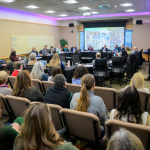


ALT From left, moderator Robert Hannon, UAF Chancellor Russ Vander Lugt and President Matt Cooper sit in leather armchairs around a low table with yellow flowers on the stage at UAF’s Fall Convocation. A large screen above them reads “Convocation 2026” over a blue mountain graphic and the University of Alaska Fairbanks logo, with warm orange and purple stage lighting behind.

ALT President Matt Cooper, in a navy blazer and glasses, smiles at Chancellor Russ Vander Lugt, who wears a gray suit and striped tie. Moderator Robert Hannon, seen from behind, holds a pink folder of notes.

ALT Moderator Robert Hannon, holding a clipboard, listens as President Matt Cooper gestures while speaking. Chancellor Russ Vander Lugt, in a gray suit and striped tie, sits between them. A table with yellow and white flowers and a stack of books is in the foreground.

ALT A young Indigenous child stands on a ramp in the foreground, wearing a black dress, furry moccasins, a woven headband, and a red and black button blanket cape adorned with mother-of-pearl buttons. Behind the child stands an adult wearing a similar large black and red button blanket cape over a black tunic with a red formline design. The adult holds a carved green, blue, and brown wooden mask over their face. In the background, people in graduation regalia and woven hats sit in stands.

ALT An elderly Indigenous man in a wheelchair smiles as he is guided down an aisle of clapping faculty and graduates at a commencement ceremony. He wears a light-blue shirt, dark pants, furry moccasins, a purple academic hood, and a tan fur-lined hide robe, holding a traditional woven spruce root hat. A woman in a black academic gown and blue stole smiles as she pushes his wheelchair. In the background, a large screen reads "Commencement 2026."

ALT Indigenous dancers and drummers perform at a graduation ceremony. In the foreground, a young man wears a patterned blue parka, beaded necklace, dark pants, and fur-lined boots with blue tassels. He holds a traditional round drum and drumstick. Beside him, another performer in a similar style with a fur headdress also plays a drum. In the background, academic graduates in black caps and gowns stand on a stage before a large blue backdrop featuring a yellow and blue "UAF" university logo, with the United States flag on the left.

ALT An image of a woman with glasses and dark hair tied back, looking slightly upward. A screen behind her projects blue and purple graphs of complex brainwave signals, which are also projected onto her face and neck, including a line reading "Run Time = 340" on her collarbone. A light blue speech bubble in the top right reads "DID YOU KNOW?". Large white text at the bottom reads: "UAA engineers and computer scientists are using AI to decode brain signals".

ALT An close-up, slightly high-angle shot shows a man adjusting a black, claw-like DSI-24 EEG headset onto a person with blonde hair. Only the top of the blonde person's head is visible, with the headset's round, black nodes positioned over their hair. The man, out of focus in the background, carefully places his hand on the top knob of the headset to adjust it. Text in the upper left corner reads, "The device is a Wearable Sensing DSI-24 electroencephalogram, or EEG, system."

ALT A two-part image showing researchers analyzing data from a brain-computer interface. In the top panel, a researcher wearing a black vest and a specialized black headpiece with sensors looks intently forward. Behind him, another researcher in a black polo shirt points at a laptop screen. In the bottom panel, a researcher viewed from behind points with his index finger at a large projection screen displaying complex blue EEG waveforms, a colorful diagram of a head with circular green nodes, and data tables.

ALT An image featuring a photograph above and text on a dark blue background below. In the photograph, Masoumeh Heidari, a woman with dark hair tied back and wearing glasses and a light blue button-down shirt, stands in a lab setting. She looks forward while holding a black wearable EEG headset. In the foreground on the left, another person’s hands hold a similar black headset, partially obscuring the view. Below the photo, white text reads: “These technologies are advancing very quickly, and I want our students to have opportunities to work with emerging tools and contribute to research at the forefront of AI, brain-computer interfaces and neurotechnology.” Masoumeh Heidari Assistant professor, UAA College of Engineering

ALT An informational graphic featuring a medical professional in sterile blue scrubs, a surgical cap, clear safety glasses with a pink frame, and a purple mask. They are wearing beige gloves and tying the waist strings of their blue surgical gown. At the top right, a blue speech bubble reads, "DID YOU KNOW?". An overlaying dark blue text box in the center reads, "How do you give rural Alaska students a new perspective on rural healthcare when they already live it every day?". In the bottom right corner is the logo for the University of Alaska.

ALT An eye-level portrait of Gloria Burnett, a smiling woman with long brown hair, wearing a black blazer over a shimmering golden-brown shirt. She is positioned in the center, set against a softly blurred, bright corridor with windows on either side. A light gray, semi-transparent text box overlay is positioned on her lower-left side with dark blue text reading: "Gloria Burnett, Director of the Alaska Center for Rural Health and Health Workforce needed a new way to engage rural students." At the bottom right, a small white square logo for the "University of Alaska" is visible.

ALT A close-up portrait of UAA nursing faculty member Keri Baker, a smiling woman with blonde hair, blue eyes, and silver hoop earrings, wearing a yellow shirt against a blurred green background. Superimposed on the bottom-left is a blue text box reading: "UAA nursing faculty member Keri Baker had a long-standing rural health partnership in Peru." The University of Alaska logo is in the bottom-right corner.

ALT An outdoor group photo of ten women standing side by side against a mountain backdrop in Peru. Near the center, a woman in traditional Andean dress—featuring a red and blue montera hat, a blue cardigan, a colorful shawl, and a bright red, patterned pollera skirt—smiles. The other nine women wear outdoor clothing, jackets, and sunglasses, smiling with arms around one another. In the background, a winding mountain road and rugged Andean peaks stretch beneath a bright blue sky filled with white clouds. Below the photo, white text on a dark blue background reads: “Together, they created a new opportunity. A Faculty Initiative Fund grant supported a two-week Peru immersion where students learned from community health workers, nonprofits and rural communities.” The University of Alaska logo is in the bottom right corner.

ALT Three women stand around a table covered in a yellow cloth, examining plants. The woman on the left has long, curly dark hair and is wearing a black shirt. The middle woman is blonde, wearing a light blue button-down shirt. The woman on the right is wearing a brown baseball cap, sunglasses, and a purple puffer jacket. In the foreground, glass jars filled with liquids and plants sit on the table, alongside a white water bottle. A large text box with a white background and blue text reads: "“You can find really incredible solutions by stepping out of your comfort zone and realizing that sometimes there are different ways we can do things to solve our problems.” Keri Baker, UAA assistant professor and organizer". The University of Alaska logo is in the bottom right corner.

ALT An infographic titled "The Economic Impact of UA: Return on investment" on a dark blue background alongside a photo of a snowy Alaskan landscape with a modern arched pedestrian bridge over a road, with snow-covered mountains in the distance. The text on the left states: "$1.80 returned for every $1 that the state invests. Alaska’s investment in UA multiplies. $335M in state funding generates $1.2B in total economic activity." The University of Alaska logo is in the bottom left corner.

ALT An informational graphic titled "The Economic Impact of UA" with a subhead "Workforce" against a dark blue background. The main text on the left reads: "10,000+ jobs supported across Alaska. If UA were a private employer, it would be the largest in the state." The University of Alaska logo is in the bottom left corner. The right side of the graphic features a vertical photo showing an aerial view of a university campus nestled in a dense evergreen forest next to a calm body of water. Mountains and a sunset-lit sky are visible in the distance.

ALT An informational graphic with the title "The Economic Impact of UA: Empowering Alaskans." The left side has a dark blue background with diagonal stripes containing text and the University of Alaska logo. The text reads: "20,000 total student enrollment across the system in 2025." "About 90% of UA graduates stay and work in Alaska right after graduation, and 75% stay long-term." The right side features a vertical photograph of a sunny outdoor campus scene in autumn. Three students relax on a green grassy lawn in front of a white architectural pillar. One student lies on their back, while two others sit nearby. Golden autumn leaves hang from branches in the foreground, with distant mountains and pine trees under a blue sky.

ALT graphic announcing a University of Alaska Board of Regents meeting in Juneau. The graphic features a photograph of attendees gathered in a workshop space and includes text noting the first board meeting for new UA President Matthew Cooper.

ALT UAS Chancellor Aparna Palmer and three UAS students pose together at a University of Alaska event. Two U.S. and Alaska flags stand in the background, and a presentation slide displaying photos and the word “Gunalchéesh!” is projected on a screen behind them.

ALT University of Alaska President Matt Cooper speaks into a microphone during a Board of Regents meeting. Regent Resler sits beside him at a conference table with laptops, nameplates and meeting materials.

ALT UAS faculty member Lance Twitchell addresses a group gathered in a workshop or classroom space. Several attendees stand nearby listening, while artwork and carved pieces are displayed around the room.


ALT An overhead, rear view of graduates in black gowns sitting in rows. Most wear black mortarboards with blue tassels, except for one graduate who wears a traditional woven spruce root hat. In the top right, a blue speech bubble reads, “DID YOU KNOW?” Overlaying the center of the image, white text reads: “For the first time in UA history, Alaska Native language names will appear first in a course listing.”

ALT A tall Indigenous totem pole stands in silhouette against a dense, misty forest illuminated by warm, golden sunlight filtering through the trees. Overlaying the lower portion of the image is white text that reads: "UAS and Goldbelt Heritage are creating an Indigenous health and healing pathway that blends Indigenous knowledge and higher education."

ALT Three panels on a dark blue background. Top left: strips of bright orange salmon dry on wire racks over grass. Top right: two dark canoes with paddlers head out on calm water toward a marina filled with boats backed by a forested hill. Bottom: nine happy students and two instructors stand before a whiteboard holding up certificates. Below them, white text reads, "This summer, nine students completed the first dual enrollment intensive."

ALT An image featuring a white quote in a sans-serif font over a dimly lit background of a light-colored wooden carving of an Indigenous totem pole. The quote reads: "Seeing the whole person, physical, spiritual, emotional, mental, along with valuing cultural practices changes the system from being myopic to being holistic." Below the quote, it reads: "Wendy K'ah Skaahkuwaa Todd, UAS Indigenous Science faculty"


ALT Four faculty members of UAA's Automotive and Diesel Technology programs stand outside the department building in Anchorage. From top left: Darrin Marshall, Rob Siciliano, Josh Brown and Jared Stouff. Text reads: "Alaska has a technician shortage. Meet the program training the people who will solve it."

ALT Darrin Marshall, chair of UAA's Transportation and Power Division, stands inside the department building during the 2026 Auto Expo with a lifted red truck on a vehicle ramp behind him. A quote reads: "As you see people flourishing in this field, you can pick up the ones that have the mentorship mentality."

ALT A crowd watches as a truck performs a burnout outside the UAA Automotive and Diesel Technology building during the 2026 Auto Expo in Anchorage in May 2026.


ALT Quote overlaid on a blue-tinted image of a snowy forest with tall trees. The quote reads: "As we conclude a year of transition and advancement, this budget demonstrates what we know to be true: UA is a vital engine that empowers Alaska’s workforce and economy.” It is attributed to Michelle Rizk, identified as University of Alaska Interim President.

ALT A scenic view of a coastal town in the Faroe Islands featuring colorful, traditional houses with grass roofs lined along the waterfront. The background shows rolling hills under a cloudy sky. A speech bubble in the top right reads "Did you know?" and text at the bottom states, "Three UAF researchers met for the first time in the Faroe Islands."

