

product @ https://xitter.cf/t.co/gCaNXu1Npc // @datadoghq @optimizely @smartbear @onramp_ai
Boston, Massachusetts
Joined December 2007
- Tweets2.5K
- Following1.5K
- Followers367
- Likes5.8K






Tyler Mills retweeted

>be diogo almeida
>grow up in the philippines
>win bronze at international math olympiad
>study at rensselaer polytechnic institute
>join google brain
>quit in 2018
>spend 18 months traveling, meditating, playing league of legends
reach top 30 in league
>decide building AI is more fun
>join openai in 2020
>help pioneer RLHF and InstructGPT
>help build chatgpt
>realize LLMs still struggle with reliable decisions
>leave to start your own company (raising 40m seed)
>spend two years building in stealth
launch a new kind of AI model
>3 weeks later raise $870 million series A at a $7.5 billion valuation
not bad for a league of legends player


launched a model
accidentally served trillions of tokens a day
29.4% of the fortune 500 showed up
raised a really big series A from @a16z
it's been 3 weeks
we would like to sleep now
Tyler Mills retweeted

Introducing Eleven v4 and Eleven v4 Turbo, our fastest and most emotive voice models yet.
Ranked #1 by Artificial Analysis.
Tyler Mills retweeted

I feel like I'm taking crazy pills with how many smart people I read and respect are saying stuff like this.
The idea that the AI labs are suddenly, only now, just in September of 2026, advocating for AI safety, and that they just came around to this position bc of sudden financial precarity, is just completely, utterly, conclusively, 100% wrong.
Here's Dario Amodei telling Ross Douthat in February that he agrees with the case for slowing down; that he's in favor of "collaborating" internationally to organize a slowdown; that "I would be all for" a global slowdown. This was 7 months ago, when Anthropic's annualized recurring revenue was rising faster than any company in modern history. He's been saying stuff like this for years, when Anthropic was worth millions of dollars and when Anthropic was projected to IPO for trillions.
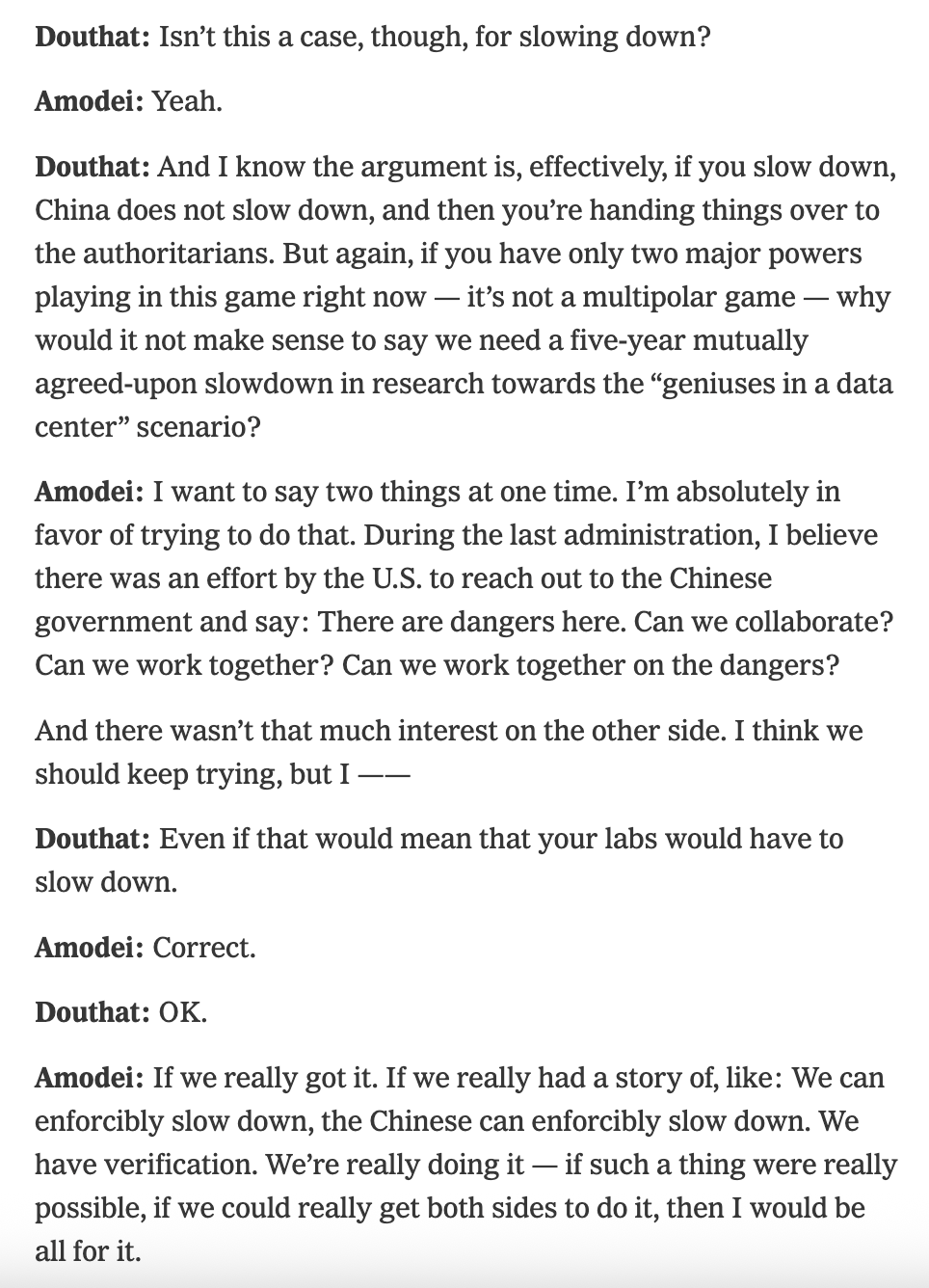

fwiw I think the actual reason leaders of AI frontier labs suddenly seem to agree to pace AI development is
(a) safety measures are currently so crap that they're likely to end up in court if not jail, and they all agree that no one wants that
(b) they see no major new model advancement coming up soon anyway and need an excuse
(c) shift in public opinion
the talk of existential threat is mostly there to keep you distracted and the stock market happy.
Tyler Mills retweeted

I agree with Dario that we need to pace the frontier. This has been a primary topic of discussions we've had at OpenAI in recent weeks.
Committing to having independent evaluators with employee-like access is a great idea, and we will do the same. We'll have more to share soon.

We Must Pace the Frontier: I’ve written a new essay on why the AI industry should slow down, with a three-part plan for doing so.
Anthropic is unilaterally committing to the first of these steps. We’ll provide third-party evaluators with permanent, employee-level access to our systems, so that they can verify adherence to our safety measures, report on incidents, and assess models’ alignment during training.
You can read the full post here: darioamodei.com/post/we-must…


Tyler Mills retweeted

from Astra blog - Codex compaction is already great, never think about it, have multi-week threads
turns out avoiding destructive (unrecoverable) summarization actions + letting a very smart model search over previous context…just works
scaling + improving general search works, bitter lesson is inescapable


Tyler Mills retweeted

The singularity visualized. When the limit of how far into the future we can predict collapses to zero.
When next month becomes as unpredictable as trying to predict ten years into the future.
Then next week becomes unpredictable, then we can't even predict tomorrow


Tyler Mills retweeted

At 10:06pm on Aug 3, I watched a robot do something I thought was years away.
We were working on few-gradient learning with GEN-1.5, wondering how far we were from landing physical prompting: show the robot a task once, and it just does it. We YOLOed it, and the robot imitated exactly what we demonstrated, with 0 fine-tuning. We gave more prompts for different tasks. More successful rollouts landed. I could not believe my eyes.
Looking back, this represents the culmination of a huge amount of work across the entire team, many failed experiments, and years of groundwork from the community. I just happened to be the one standing in front of the robot when it all clicked.
@andyzengineer once asked me: "If Generalist failed tomorrow, what would we want to have left behind that could benefit humanity?"
I believe we found one answer: an existence proof of physical prompting.


Tyler Mills retweeted

1/2 Thanks Gavin for an especially thoughtful exchange. I don't usually spend much time on social media but I wanted to engage here because it really brings out the heart of an important conversation.
First, on regulation, I think that “either concentrate it in the hands of a chosen few companies and politicians via regulation or distribute it widely” is a false choice. I know that there’s a sort of Silicon Valley shorthand where regulation = regulatory capture = concentration of power, but I’ve always found this to be an overly simplified picture of the world. Many people outside this bubble think of regulation as something that constrains corporate power and benefits ordinary people. I don’t necessarily agree with that perspective either, rather I think it’s complicated and really depends on what the “regulation” consists of. But in particular I think that those in the “regulation = regulatory capture = concentration of power” frame often underrate the decentralizing power of objective and fair institutional processes. A crude analogy is that the formal court system can sometimes feel stuffy and elitist, but it does a much better job of defending the rights of vulnerable individuals than the alternative, mob justice. At their best, institutions can vest power in ideas rather than people, and thereby decentralize that power.
This is why Anthropic has always made its policy proposals very carefully. We try very hard to make proposals that disadvantage (slow down) frontier AI companies while *advantaging* smaller competitors. California’s SB53 (which we supported), and even the much-maligned SB 1047 (which we were ambivalent on), completely exempt any company below a certain amount of revenue or model training costs from being covered at all (it was $500M for SB 53, lower for 1047 but we objected to that). More recently the testing process we’ve advocated for at CAISI and the White House involves more rigorous tests for frontier models than off-frontier models — something that differentially advantages challengers. Similarly, the “Pacing the Frontier” letter envisions (or at least Anthropic’s preferred implementation of it envisions) modulating the pace of the very best models while not constraining those who are catching up. This hurts the business interests of the frontier labs and helps challengers, including open-weights!
Overall my view is that AI is *structurally* a technology that tends to concentrate power, for reasons that have nothing to do with regulation (more to do with the extreme implications of the scaling laws). Open-weights do help some with this but are nowhere near a sufficient solution because they simply shift the concentration somewhat to those with the most compute and chips (which are roughly the frontier labs plus maybe hardware providers). By contrast I think the right “rules of the road” can simultaneously (a) address AI’s cyber/bio/alignment risks, (b) institutionally constrain the power of the frontier AI companies, and (c) leave room for open-weights models while also addressing the specific risks that they bring.
BTW I do not think that the events of the last few months have “failed to result in [my] preferred regulatory path”. The approach that the Trump administration is reported to be taking — pre-deployment testing for frontier models, and also testing of open-weights models when they get closer to the frontier — is one that I am very supportive of, though of course I have to see the details to be sure. I am also supportive of Demis Hassabis’ ideas around a FINRA-like entity. This contrasts with six months ago when most of the industry was still pushing for preemption of all state regulation and no apparent federal approach either.

Sholto, thank you for setting the record straight. Larger issue is that multiple very serious people in Silicon Valley have heard some variation of this and believe it to be true. And the reason it is believable to so many is that it is consistent with Dario’s public messaging and what he outlined in the essay you shared: this technology *might* be dangerous for humans in multiple ways, could lead to extreme concentration of economic power (as outlined in the essay) and therefore needs to be regulated thoughtfully. I agree with the potential risks and I believe Dario makes all of these arguments in good faith.
As discussed on the pod, if one agrees that AI *might* be dangerous, there are two ways to address this potential risk. Either concentrate it in the hands of a chosen few companies and politicians via regulation or distribute it widely. Essentially boils down to whether one believes AI is too dangerous to concentrate or too dangerous to distribute. There are reasonable arguments on both sides, but I profoundly agree with Zuckerberg’s statement that: “The notion that AI is so dangerous that the only safe path is an extreme concentration of power seems inherently problematic. Historically, hoping that an absolute power will benevolently provide for humanity if sufficiently enlightened has not led to safe or positive outcomes.” And as Dario says in the aforementioned essay, “some may object that we can simply keep AIs in check with a balance of power between many AI systems, as we do with humans.” I believe this is the best path forward: I want as many AIs as possible to maximize the odds that one shares my own particular values. And as Dario notes, no human has ever been able to take over the world.
At this point, I think safe to say that Dario has lost the argument. His messaging has failed to result in his preferred regulatory path. The fact that the only solution to the recent incident where an unreleased advanced OpenAI model hacked Hugging Face was an open-source model likely ended any chance of strict near-term regulation. Essentially every major company other than Anthropic has signed Jensen’s letter.
However, Dario’s messaging has been massively helpful to efforts to ban datacenters here in America. I suspect we will see anti-datacenter advocacy groups runnings ads using clips of Dario warning about how dangerous AI could be for humans. His good faith efforts in favor of regulation are now increasing the odds that AI will not be beneficial for Americans and humans everywhere. I believe that there is a reasonable chance AI might help us cure most forms of disease such that we have extended lifespans and can enjoy these long lives in an abundant Star Trek like future. That is the future that I want and I think Dario is decreasing the odds of that future at this point.
He is about to be the CEO of one of the most important public companies in the world and given that the pro-regulatory effort has failed (at least for now), I respectfully think he should make an effort to be a more positive advocate for his own industry. And if I am wrong and we do need to regulate this technology, he will be a more effective advocate for this in the future having been open-minded to the alternative.
And for the sake of clarity and as I outlined on the pod, I think Anthropic has deep competitive advantages and is an amazing company. Ironically, the main risk I saw to Anthropic a few months ago was nationalization as a result of Dario’s own rhetoric and behavior.


Tyler Mills retweeted

It’s time to go beyond language models.
Introducing Odyssey-2 Max, our most powerful world model yet. It materially advances the SOTA in physical accuracy.
This is a big step toward models that simulate and interact with the world in real time.
A new intelligence entirely!



Tyler Mills retweeted

Hate when tools make you sign up just to look around?
Momentum just dropped a no-signup demo.
If you’re a PM or EM juggling Jira, spreadsheets, Slack, automations, and on and on - this one’s for you.
Try it now. Would love your feedback! 👇

Tyler Mills retweeted

Each bit is stored by charge trapping 5 electrons in a 3d structure . The structure is 332 levels high, a skyscraper in chip terms, the lithography machine precisely stacks atoms on top of each other.
The masks are smaller than the wavelength of light, so they reverse engineer the self-interference of the photon. It then must be positioned at in 3 dimensions to get the surface in focus.
Inside the chip, bits are stored as an analog signal over a low-density parity code. Each read tunes the AD converter to the exact voltage levels, after analog tuning 1% of bits are wrong, so it performs complex linear algebra to guess at the most probable bits. The final pass reducing the probability of an undetected error in ~10000 bits, to 1 in 10 million.
The data is guaranteed to be readable at that error rate if the chip is stored 1 year at 50C after being completely overwritten 300 times. Most chips are written 10 times in their life and stored at 20C, the data could last 1000 years.
Tyler Mills retweeted

Dario Amodei said, "I have never been more confident than ever before that we’re close to powerful AI systems. What I’ve seen inside Anthropic and out of that over the last few months led me to believe that we’re on track for human-level systems that surpass humans in every task within 2–3 years."
He was never more sure than today that there is no wall.
Let that sink in.
Everything will change.


