

Localized pricing automation for #MobileApps Push smarter prices to Apple & Google Play 190+ countries | PPP adjustments
Joined February 2026
- Tweets296
- Following3
- Followers50
- Likes59





Pinned Tweet
Hello X 👋
PricePush is a tool for mobile app publishers who want to localize pricing properly, without living in spreadsheets.
PRICEPUSH 2.0 IS OUT 🌍
Localize all: every product of your app, priced for 190+ countries and pushed to the App Store and Google Play in one run.
Preview each country's new price, check the impact on a world map, then push in one click.
PricePush retweeted

PRICEPUSH 2.0 IS OUT 🌍
New: Localize all.
Every product of your app, priced for 190+ countries and pushed to the App Store and Google Play IN ONE CLICK!
A typical app means 1,750 prices to set by hand. I made it one click.
#indiedev #appstore #googleplay #pricing #buildinpublic
LOCALIZE YOUR PRICES 🌍
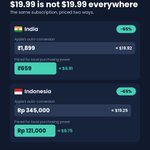
A $19.99 sub, auto-converted by Apple:
🇮🇳 ₹1,899 (≈ $19.92)
🇮🇩 Rp 345,000 (≈ $19.25)
Priced for local purchasing power:
🇮🇳 ₹659 (≈ $6.91)
🇮🇩 Rp 121,000 (≈ $6.75)
65% lower. PricePush automates it on both stores 👉 pricepush.app

PricePush retweeted
One base price in. Fair prices for 193 countries out.
The Price Localizer maps your number across 193 countries on a globe and a country-by-country table, using purchasing-power tiers, not a flat currency swap. No account.
Try it: pricepush.app/price-localize…
Netflix doesn't run one global price. In India it sells a mobile plan from about Rs149/month.
That's not a discount. It's a different price for a different wallet.
Here's what most indie devs get wrong. They let the App Store auto-convert their price into rupees and call it localized. It isn't. The exchange rate tells you what a currency is worth on a trading desk. It tells you nothing about what a person in Mumbai can actually spend.
So your $4.99 becomes about Rs415, a local user does the math against their own budget, and they close the tab. You never see the lost sale. It just looks like India doesn't convert.
Netflix priced into India instead of converting into it. The Rs149 mobile tier was built for the budget first, then the product was shaped to match.
You are not Netflix. You don't need to be. The same logic works at indie scale: pick a base price, then set each country by purchasing power, not by the exchange rate. India, Brazil, Turkey, and Indonesia usually want to sit well below the converted number.
That gap, between the converted price and the price people can actually pay, is revenue most apps never collect.
(Netflix is a public example, not a PricePush customer.)
PricePush sets and pushes that per-country price across 190+ countries: pricepush.app

'You're not Microsoft.'
Best answer I've heard to the fear of price arbitrage, people VPN-hopping to your cheapest country.
At Microsoft scale, moving 1,000 seats to a cheaper region is real money. At indie scale it's a rounding error, and that person was a motivated buyer anyway. They still bought. Stop guarding revenue you were never going to get.
Apple auto-converting your USD price into local currency is not localized pricing. It's a currency calculator with extra steps.
The gap, in numbers:
1/ Apple's own suggested price for India sits about 21% below the US. Sounds reasonable, until you see what apps that actually localize do.
2/ Apps that localize for India go 50 to 80% below the US price. Not 21%. Up to 80%. The auto-converted number and the market-correct number are in different leagues.
3/ You can see the right answer in the giants. Spotify India is ~$2.2 vs ~$12 in the US. Netflix runs India-only mobile plans from ~Rs149/mo. Those are 70 to 80% gaps, nowhere near Apple's 21%.
4/ And plenty of devs never touch the default: take USD, let the store convert, ship. That leaves the India price roughly 3x too high versus what works.
The fix isn't complicated: per-market prices based on purchasing power, pushed to every store. I built PricePush to do exactly that in one click.
(Sources are independent research, not PricePush customers.) pricepush.app/#case-studies
Google Play named the 3 ways developers actually pick a localized price (Playtime 2019). Most devs use the worst one.
A thread on choosing the number, not just translating the currency.
Method 1: copy your competitors' price in that market.
Google's own warning: you have no idea if their price is even converting. And price discovery is brutal, devs 'scouring Reddit, going on random blog posts, VPNing into every market' to read a number that might be wrong.
Method 2: anchor to a universal benchmark. Not competitors, the local monthly phone plan, cable, the newspaper subscription.
A user won't pay more for your app than they pay for their phone plan. They know that number. You should too.
Method 3: index to GDP per capita, PPP-adjusted. The one the Google BD manager recommended most. Scale the price to local disposable income.
US GDP per capita ~$62K. India ~$7K. India indexes to 12% of the US. So the price shouldn't be 100% of the US either.
The catch he was honest about: pure GDP can UNDERprice you. Play buyers spend more than GDP predicts, 2x to 3x higher willingness to pay in India, Brazil, Mexico. Indonesia, Russia, Turkey went the other way.
So the rule he landed on: start high, test your way down. Easier to drop a price than raise it on existing subscribers.
PPP gets you a defensible starting number for 175 countries. Then you tune. PricePush does that first 95% in one click: pricepush.app
What is a good free trial conversion rate? There is no single answer, but there is a ladder.
By trial length, median trial-to-paid in 2026:
- 4 days or less: 25.5%
- 5 to 9 days: 37.4%
- 17 to 32 days: 42.5%
Compare against your own band, not the overall median.
pricepush.app/blog/trial-to-…
#SubscriptionApps #AppMarketing #IndieDev

"The first barrier is the language. The second is the price."
Rubén from @khanjischool (10+ Chinese learning apps), to a dev who just shipped in 14 languages.
AI made translating cheap. Pricing for 175 countries is still the manual half.
#indiedev #localization

A few Shipaton 2026 numbers you might not expect:
Only 7 of 2,139 apps charge up front. 62 ship an Apple Watch app. 1 runs on Vision Pro. And Firebase vs Supabase is 650 vs 632.
The rest are in the chart 👇


Shipaton 2026, part 2, built from your replies.
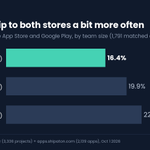
Do solo builders ship to both stores less than teams? A bit: 16.4% vs 20.5%.
Plus Hitoiro's numbers, Joe's KMP story and 10 new data points 👇
Thanks @plahteenlahti @RevenueCat @Shipaton #Shipaton
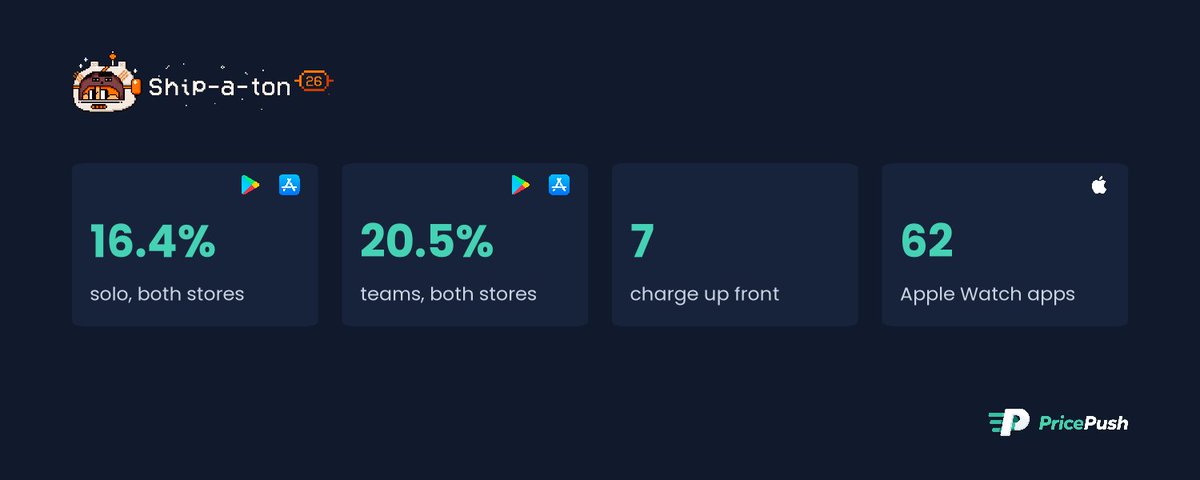
Do solo builders ship to both the App Store and Google Play less often than teams?
Across 1,791 Shipaton 2026 apps, a little: 16.4% of solo apps are on both stores, 20.5% of team apps.
Most apps ship to one store either way.

Shipaton 2026, part 2, built from your replies.
Do solo builders ship to both stores less than teams? A bit: 16.4% vs 20.5%.
Plus Hitoiro's numbers, Joe's KMP story and 10 new data points 👇
Thanks @plahteenlahti @RevenueCat @Shipaton #Shipaton
macro, a calorie tracker built for the Philippines, reports about 20,000 paying customers and $88K in revenue.
It sells a lifetime unlock for 299 pesos, about $5. Most of that came before Shipaton, through one large partner.
From the Shipaton breakdown 👇
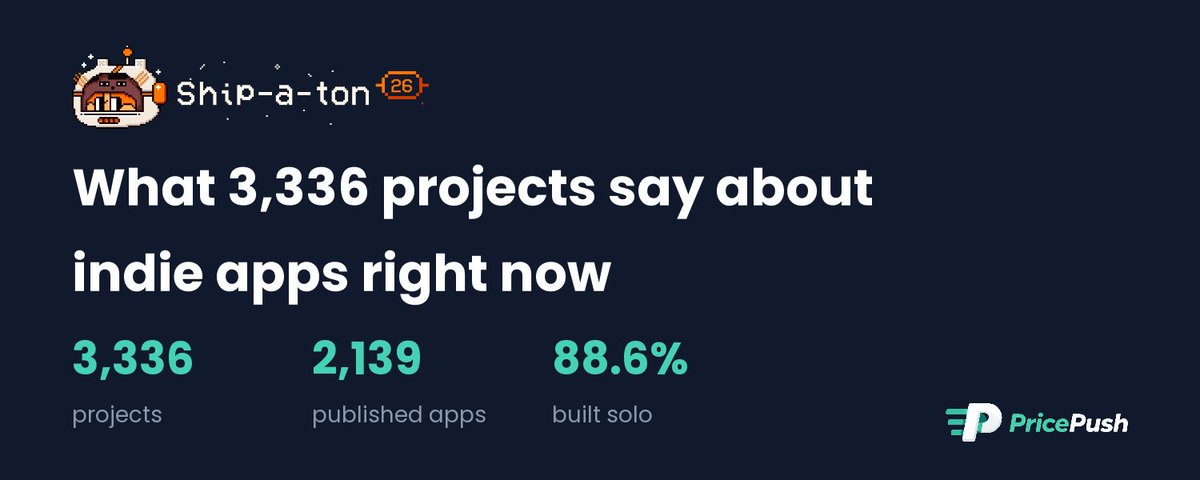
I went through all 3,336 Shipaton 2026 projects.
88.6% built solo. Health & Fitness passed Productivity. Claude is the most-listed AI model. Only 18.4% shipped to both stores.
Thanks @plahteenlahti @RevenueCat @Shipaton
#Shipaton #indiedev
A Shipaton builder ran ads and wrote down the results.
Kazakhstan: 50 installs at $0.67 each, no revenue.
US and UK: 7 installs at $3.05, and both traceable purchases.
Want to see what your price looks like in Kazakhstan? The Price Localizer is free: pricepush.app/price-localize…

I went through all 3,336 Shipaton 2026 projects.
88.6% built solo. Health & Fitness passed Productivity. Claude is the most-listed AI model. Only 18.4% shipped to both stores.
Thanks @plahteenlahti @RevenueCat @Shipaton
#Shipaton #indiedev
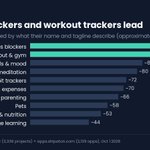
The most common kind of app at Shipaton 2026: screen time and focus blockers, about 105 of them.
Then workout trackers (~100), journals (~84), sleep and meditation (~80) and habit trackers (~72). 229 apps put "AI" in the name or tagline.

I went through all 3,336 Shipaton 2026 projects.
88.6% built solo. Health & Fitness passed Productivity. Claude is the most-listed AI model. Only 18.4% shipped to both stores.
Thanks @plahteenlahti @RevenueCat @Shipaton
#Shipaton #indiedev
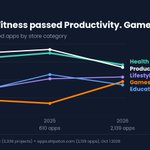
Health & Fitness is now the biggest category among Shipaton apps: 304 of the 2,139 published this year, just ahead of Productivity (288).
Productivity led in both 2024 and 2025. Games nearly tripled their share, from 3.4% to 9.5%.

I went through all 3,336 Shipaton 2026 projects.
88.6% built solo. Health & Fitness passed Productivity. Claude is the most-listed AI model. Only 18.4% shipped to both stores.
Thanks @plahteenlahti @RevenueCat @Shipaton
#Shipaton #indiedev
Affordable is a different number in each country.
The stores convert your prices into each local currency, but that conversion is only the exchange rate. It does not make the number affordable.
An affordable price respects what the country can actually pay, and how that country writes prices.
Because charm prices ending in .99 are not universal.
Türkiye, Ukraine and the UAE write prices ending .09, .49 or .89.
Japan, Indonesia and Colombia use whole numbers.
Nigeria rounds to the nearest 100.
An index is a decent starting point, but most of them are measuring somebody else's business. A Netflix or Spotify index carries their content licensing costs. A Big Mac index carries beef and local sourcing. None of that is your app.
Purchasing power parity gets closest. On its own it is still not enough.
PricePush is based on hundreds of pricing experiments and a lot of rounding tests.
220+ apps are localized with it now, and the revenue uplift in international markets lands between 20 and 50%, depending on category and audience.
Today is the last day of the Shipaton sale. 60% off the first year of the yearly plan, code SHIPATON26 at checkout.

Three things we see in indie pricing threads almost every week:
"Doesn't the App Store handle regional pricing already?"
"I set USD and trust Apple to convert it fairly."
"Isn't auto-converted the same as localized?"
Apple and Google both do FX conversion. That is currency maths, and it answers a different question than what someone in that country can reasonably pay.
The conversion is accurate. It is just not a pricing decision.
The blast radius of a bad price push is wider than most code bugs, and you find out much later.
Under-price by 80% in Brazil for 24 hours and those subscribers are locked in at the wrong rate for a year.
Over-price 3x in India for a week and you see flat conversions three months later, churn at six.
A crash gets reported within the hour. A wrong price just quietly changes your numbers.
pricepush.app/blog/app-price…
"Auto-generate prices" in App Store Connect and Google Play Console gives you FX conversion. Purchasing power is a different question entirely.
FX asks: what is $19.99 worth in Brazilian reais today?
PPP asks: what should this app cost a buyer in Sao Paulo relative to what they earn?
FX lands around R$120. PPP lands closer to R$49.
Conflating those two is the most common pricing mistake we see.