

Evidence-based investigative interviewing & deception detection training.
Washington, DC
Joined January 2026
- Tweets111
- Following90
- Followers11
- Likes56








Protect a witness’s memory as carefully as physical evidence. Read my article on trauma, alcohol and memory:
truthintelligence.com/blog/
#TruthIntelligence #JacquelineEvans #FloridaInternationalUniversity #InvestigativeInterviewing
🤖 Made with AI

Law enforcement should stop teaching body language as a test of truthfulness.
My new article examines 3 pitfalls: mistaking discomfort for dishonesty, misplaced confidence, and biased questioning.3 Reasons Law Enforcement Should Stop Teaching Body Language as an Interviewing and Lie Detection Tool
Read the full article, including research references:
truthintelligence.com/stop-t…
🤖 Made with AI

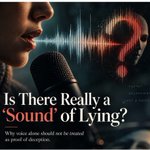
Can you hear a lie?
A 2026 study found that pitch, intonation and other vocal characteristics carried some information about deception—but the signals changed across people and situations.
There was no universal vocal “lie signature.”
Voice can provide clues. It should not be treated as proof.
Source: Capra et al., 2026.

When AI (SI) Makes a Lie Sound More Believable
truthintelligence.com
Who’s Lying—and How Can You Tell?
We train you to ask better questions, assess credibility, and get to the facts. Explore our science-based interviewing and deception-detection training.
truthintelligence.com

Federal Testing Reported “Sub-Par Performance” for EyeDetect
The Defense Counterintelligence and Security Agency (DCSA) reported that an independent Oak Ridge National Laboratory evaluation of commercial ocular-motor deception testing produced “sub-par performance,” consistent with an earlier pilot evaluation.
That is an important finding when assessing claims about EyeDetect and other ocular-motor deception-detection systems.
DCSA subsequently funded additional testing, including research involving Texas A&M/ARLIS. What remains difficult to evaluate publicly are the underlying performance details: sample size, sensitivity, specificity, false-positive rates, ground-truth methodology, and the complete technical reports.
Laboratory classification accuracy should not be treated as established real-world screening accuracy—particularly for employment, intelligence, law-enforcement, or national-security screening—without independent field validation.
Sources:
DCSA FY2024 R&D Budget Justification
comptroller.war.gov/Portals/…
DCSA FY2026 R&D Budget Justification
comptroller.war.gov/Portals/…

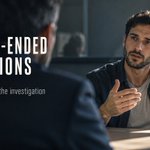
How Close Ended Questions can affect the investigation
“Did you witness the incident?” sounds straightforward, but it asks the person to decide whether their observations qualify them as a witness. Someone who answers “no” may still have heard an argument, noticed a vehicle leaving, or observed activity beforehand. If the investigator accepts that answer and moves on, potentially relevant information may never emerge. Starting with “Tell me what you were doing that evening” gives the person an opportunity to describe their experience before the investigator narrows the inquiry.
Closed-ended questions serve a useful purpose: confirming specific facts, checking understanding, and resolving details. Their value depends on when and how they are used. After someone describes a vehicle leaving, “Were its headlights on?” can clarify a particular observation. Asking only narrow questions from the outset, however, can leave the investigator with answers to the questions they anticipated, while missing information they never thought to ask about. Allow the account to develop, then use focused questions to clarify it.
🤖 Made with AI

FDNS Quiet Professionals. Deeper Interviews. Stronger National Security.
FDNS’s mission: detect, deter, and administratively investigate immigration-benefit fraud—while identifying/mitigating national-security and public-safety threats in adjudications.
As an HSI Special Agent focused on national security, I’ve seen FDNS be an invaluable partner—quiet professionals who conduct longer, structured interviews when warranted and bring deep country-conditions and cultural insight to complex cases.
#FDNS #HSI #BenefitFraud #NationalSecurity #USCIS #LawEnforcement

TRUST IS BEHAVIORAL.
Rapport can create connection. Trust requires something more.
Read the full article:
truthintelligence.com/trust-…

ALT **TRUST IS BEHAVIORAL.** Rapport can be established quickly. Trust has to be earned. In investigative interviewing, your behavior is part of the interview. Read the full article: https://truthintelligence.com/trust-is-behavioral/ #InvestigativeInterviewing #LawEnforcement #TruthIntelligence

Does your organization provide HR personnel with formal training for interviewing potentially violent or high-risk employees? #SHRM #HumanResources #WorkplaceViolencePrevention #EmployeeSafety #CrisisCommunication
Effective Use of Silence in Investigative Interviewing youtu.be/02_vFECrOy8?si=7baG… via @YouTube

MAGNET FORENSICS
linkedin.com/posts/john-gerv…