

Building Hologram
Hologram
Joined April 2013
- Tweets1.6K
- Following509
- Followers753
- Likes1.2K





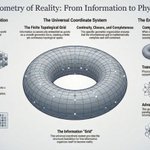

Pinned Tweet
What if information isn’t just data we organize,
but a physical quantity with its own laws?
ATLAS explores a radical idea.
Information has intrinsic structure, geometry, and conservation.
🧵👇


Ilya Paveliev retweeted

Today, we’re announcing Bonsai 27B: the first 27B-class model to run on a phone.
Bonsai 27B is the new multimodal flagship of the Bonsai family. Based on Qwen3.6 27B, it brings a new capability tier to local AI: multi-step reasoning, structured tool use, long-context workflows, and coherent agentic loops.
Until now, models in this class have been impractical to deploy locally. A 27B model occupies roughly 54 GB in 16-bit precision, and even a strong 4-bit build is around 18GB - too large for a phone and for most laptops.
Bonsai 27B changes that.
It comes in two variants:
• Ternary Bonsai 27B: 5.9 GB, 1.71 effective bits per weight, optimized for laptop-class quality.
• 1-bit Bonsai 27B: 3.9 GB, 1.125 effective bits per weight, optimized for phone-class footprint.
Everything is open-sourced today under the Apache 2.0 license.


Looks simple.
Tried @qvac?


Local AI that you control, free to use and works offline is the goal.
Still way to go to make it less complex and as perfomant as API-based solutions.
The hardest paths often lead to the most beautiful destinations.
Excellent job @ggerganov

llama.cpp now has an official website: llama.app
Our goal is to make local AI accessible to everyone, and improving the user experience is a big part of that. On the new landing page you’ll find a single-line cross-platform installer. The installation provides a single unified `llama` entrypoint which you can use to run/serve models and interface with 3rd-party agentic applications.
While oriented towards simplified user experience, the new `llama` application also provides all the advanced functionality of the existing llama.cpp tooling with which experienced users are already familiar. Also note that all GGUF models that you might have already downloaded with llama.cpp in the past will be automatically available to use without downloading again (they are stored in the common HF cache on your machine).
We have many improvements in the pipeline both at the UX and at the engine level and we plan to iteratively ship new things over the coming months. One of the main focuses will be seamless integration with local-friendly 3rd-party agents (such as Pi). In the meantime, we’ll continue to listen for feedback from the community and adjust accordingly, so keep letting us know what you think and need.

Sovereign AI.

This may seem like the culmination of a year+'s worth of work. In reality, it's just the beginning.
We built this SDK to make local, sovereign AI easy, for everyone. Because AI should be in your hands, not in the hands of a few. I wrote more about this here: qvac.tether.io/blog/the-futu…
The future of intelligence is decentralized and fully self-custodial. And that's not happening overnight. Back to work.
Ilya Paveliev retweeted

New post on my blog:
Geometrodynamics and the Brain 🧠
In 1970, John Archibald Wheeler — the legendary physicist who coined “black hole” and “wormhole” — filled a blackboard with the deepest unsolved problems in physics: the destruction of information by black holes, the impossibility of quantizing spacetime geometry, the quantum foam at the Planck scale, and the roles of Gödel’s self-reference and Leibniz’s monads in a participatory universe.
Behind it all was his program of geometrodynamics — the radical claim that everything in physics, including matter itself, is nothing but the dynamics of spacetime geometry, and that geometry ultimately reduces to information (“it from bit”).
Half a century later, physicist Anirban Bandyopadhyay (@anirbanbandyo) at Japan’s National Institute for Materials Science has extended Wheeler’s framework into the brain. His forthcoming book, Symphony of the Helix, argues that the brain is not a chemical system driven by slow ionic currents but a geometrodynamic system in which information travels as electromagnetic vortex structures at the speed of light through nested helical architecture — from protein alpha-helices to microtubules to whole-brain circuits.
The structural parallels to Wheeler are exact: where Wheeler had spacetime foam, Bandyopadhyay has a multi-scale vortex hierarchy; where Wheeler had “charge without charge,” Bandyopadhyay has “thought without ions”; where Wheeler’s universe observes itself into existence, Bandyopadhyay’s consciousness is a self-referential resonance chain spanning every scale of the cosmos.
josephjacks.com/2026/04/05/g…

Ilya Paveliev retweeted

Love seeing this framework come out and be used for Ai Agents, Curious your thoughts @elder_plinius if if could help with prompt injection attacks/ jail breaks? uor.foundation/api
Every great library in history had one problem.
The books knew where they were. But they didn't know what they were.
Move them, and they're lost. Copy them, and you don't know which one is real. Send them somewhere new, and half the meaning disappears with them.
We've been building the internet the same way. For thirty years.
Today, that changes.

This isn't finished. It's a beginning.
And we're putting it in your hands. Open source. Fully documented. Yours to read, to challenge, to build on.
Because the best ideas don't come from one person in a room. They come from thousands of people who care enough to push back.
This is your space.
📖 Read about it: uor.foundation/blog/uor-fram…
💬 Discuss it: discord.gg/ZwuZaNyuve
💻 Build with it: github.com/UOR-Foundation/UO…
One more thing. We think this might be the most important data infrastructure built in a generation.
We could be wrong. Come tell us why.
What is the next evolution of MCP to power the era of safe, interoperable and energy-efficient Agentic AI?
Meet:
Unified Computational Substrate.
uor-foundation.github.io/UOR…
by @uor_foundation
Ilya Paveliev retweeted

1/
Transformers don't count like computers. We assume they have hidden "registers" to track variables. We were wrong.
New research by @AnthropicAI reverse-engineered Claude 3.5 Haiku and found it works with 6D helical manifolds.
It's geometry, not math. 🧵

Ilya Paveliev retweeted

"Music is liquid architecture; architecture is frozen music."
—Johann Wolfgang von Goethe

Ilya Paveliev retweeted

Plasma inside the ST40 fusion reactor, filmed in color for the first time
xitter.cf/fluxfolio_/status/1979…

What if symbolic in-memory lookup is the path to AGI?
Converging processor and memory in the same space makes total sense. That's how our brains work, on energy-content of a MilkyWay bar.
The only thermodynamic cost of compute is deleting information. What if could precompute most often used operations and store as hashed values for instant in-memory lookup. It's like having the answers cheat sheet at the back of your math book.
This will also enable us to reimagine "compute". Beyond binary, Shannon, Von Neumann, digital-only, floating-point variables, matrix representations and energy-inefficient iterative bits shuffling. Its time to look beyond.
Analog quaternion computation is pretty cool, so is geometric AI w/ abductive reasoning capacities to mirror the most impressive Architect of all.
Nature. The great Geometrician of the universe.
To achieve this we need a clearly defined thermodynamic theory of information, which will enable us precise and energy-efficient in-memory management information beyond lossy data representation.
What we need is a universal coordinate system for information, akin to GPS.
GPS gave every physical location a unique address. Before it, maps were local and incompatible. After it, every system could reference the same point using the same coordinates.
Introducing PRISM, by @uor_foundation .
PRISM is your universal coordinate system for information.
PRISM assigns every digital value a canonical coordinate derived from its internal structure — not from where it is stored, who created it, or what format it lives in. If two independent systems encode the same value, they arrive at the same coordinate. Automatically. No negotiation. No translation layers. No ambiguity.
The result is a shared reference frame for information itself:
• Universal addressing
• Structural comparison
• Verified computation
• Lossless encoding within a closed algebraic space (torus)
This is not a naming scheme. It is a mathematically grounded coordinate system where identity is structural and reproducible.
One coordinate system. Every value. Every scale.
PRISM is your telescope to map out our informational universe. MilkyWay and beyond.
Its time to explore, together!
github.com/UOR-Foundation
---
“The book of nature is written in the language of mathematics.”
— Galileo Galilei

Ilya Paveliev retweeted

DeepSeek's Engram succeeds where others failed in this endeavor to replace a transformer's crappy FFN with a symbolic-ish lookup table. And in the process, it reveals what I think is a truly gorgeous, monumental even, paradigm shift in our understanding of transformer capability 🌹 🚨
To begin the story, explicitly replacing an FFN with a symbolic lookup table fails catastrophically (desirable as it may be, rather than wasting training compute to do this through FFN layers) because language explodes, guaranteeing collisions and polysemy that a rigid lookup cannot resolve.
Engram's cool solution to this relies on 3 complementary ingredients:
1) Learnable "Superposition" Embeddings. Because the table is co-trained rather than fixed, the optimizer learns a dense vector that mathematically represents a "superposition" of multiple concepts. It minimizes the global loss for all colliding inputs simultaneously rather than storing a single rigid value. Therefore, even though collisions are guaranteed, you can learn the superposition of the most useful memories.
2) Context-Aware Gating. This seems to be a further "fail-safe" that makes this learned hashing viable, via the dynamic gate $\alpha_t$. Even after you have retrieved the memory, it forces the backbone to check the retrieved memory against the current semantic context; if the hash returns noise (a collision) or irrelevant polysemy, the gate snaps shut ($\alpha ~ 0$), effectively filtering the signal.
3) it is placed in a middle layer: If you place it at Layer 0, you force the model to decide how much to trust the memory before it has read the rest of the sentence. But if you place it in a middle layer, it can then use its Gate ($\alpha_t$) in a way that is not simply a dictionary but rather a context-dependent memory.
And here is the crux:
this study reveals a monumental critical inefficiency in modern architecture: standard Transformers waste valuable sequential depth and attention capacity ... effectively simulating ... static lookup tables for local patterns.
The authors demonstrate that if one simply offloads these trivial dependencies to the Engram module, the model stops "polluting" its attention heads with basic dictionary work ( it really is basic 2-3 token dictionary work), and -- makes it suddenly able to perform signficantly better on very long context tasks. It is almost as if a burden had been relieved!
Crucially - this offloading was achieved not through expensive semantic retrieval, but via "dumb," deterministic hash lookups. This compels us to ask:
Have we been over-engineering memory by assuming retrieval must be semantic?
If a 'fractured' lexical lookup can outperform deep neural computation, should future architectures abandon the expensive vector database paradigm in favor of massive, dumb hash tables? (provided we have a smart context-aware filtering)
Let me know, friends, what you think! 🧙♂️


DeepSeek is back!
"Conditional Memory via Scalable Lookup: A New Axis of Sparsity for Large Language Models"
They introduce Engram, a module that adds an O(1) lookup-style memory based on modernized hashed N-gram embeddings
Mechanistic analysis suggests Engram reduces the need for early-layer reconstruction of static patterns, making the model effectively "deeper" for the parts that matter (reasoning)
Paper: github.com/deepseek-ai/Engra…


