
Transforming Anthropology is the flagship journal for the Association of Black Anthropologists
Cambridge, MA
Joined July 2015
- Tweets2.2K
- Following256
- Followers4.7K
- Likes777






Pinned Tweet
Our spring issue is out now! With articles on Black geographies and ecological care, educational reform, institutional exclusion, and residential segregation, this issue moves across sites of US Empire while insisting on conjuring geographies of our own.

From 2022-2024, co-authors Wan R. Smith and Kristin D. Phillips led an energy justice initiative to address governance issues and racial segregation within rural electric cooperatives, “support[ing] Black Georgians to reach the levers of power and to leverage change.”


Learn more about the initiative and larger movement for energy justice in rural Georgia here:
journals.uchicago.edu/doi/10…

In Against the Carceral Archive: The Art of Black Liberatory Practice, author Damien M. Sojoyner draws on the collections at the Southern California Library to examine “carcerality as an archival modality.”


Investigating the mechanics and institutional sites of what he names the “carceral archive project,” Sojoyner offers an “ambitious theory... grounded in ethnographic humility.”
Read Sameena Mulla’s review here: journals.uchicago.edu/doi/10…

In her timely article in our current issue, Melinda González offers an important critique of academia and call to action.
Read the full article here: journals.uchicago.edu/doi/10…


Drawing from the tradition of testimonio, González shares her journey navigating graduate training, funding, publishing, and ethnographic writing to show how hidden institutional scripts and structures continue to exclude “nontraditional” and racialized researchers.
In Tackling the Everyday: Race and Nation in Big-Time College Football, Tracie Canada draws on rich ethnographic research to examine the lived experiences of Black college football players navigating an industry shaped by exploitation and racial inequality.


Read the full review written by Chelsey R. Carter and Maurice Rippel in our most recent issue.
journals.uchicago.edu/doi/10…
#transforminganthropology #RaceAndSports #Care #Kinship #Anthropology
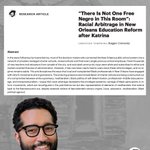
In our current issue, Christien Tompkins examines the landscape of education reform in New Orleans after Hurricane Katrina, with a specific focus on how Black professionals have engaged with reform movements and organizations.

In this article, Tompkins argues that “racial arbitrage represents the privileged epistemic vantage of Black participants in reform movements.” Read the full article here! journals.uchicago.edu/doi/10…


In our current issue, Alexandria Casteel examines practices of Black ecological care in Baltimore, asserting a counter-institutional presence of black conservation practices that “remake conservation in the image of what Black communities have already been doing all along.”

Check out the full article here! journals.uchicago.edu/doi/10…

Check out this book review in our new issue!
Unseen Flesh is an ethnographic account of Black lesbian experiences with health, well-being, and medical discrimination in Brazil.


The book offers important insights into race, sexuality, embodiment, and care while centering Black queer resilience and community.
journals.uchicago.edu/doi/10…
#Anthropology #MedicalAnthropology #BlackQueerStudies
Check out Daniel Ferman-Leon’s new article featured in our Spring 2026 TA issue.
#TranformingAnthropology #blackgeographies #antiblackness #financialization
Drawing on ethnographic research, Ferman-Leon examines how developers and real estate actors use market data to shape rental prices, target middle-class white residents, and reinforce racial segregation by excluding Black and lower-income communities.
journals.uchicago.edu/doi/ep…
