

Think Physics; think differently!
Joined September 2014
- Tweets1.7K
- Following183
- Followers247
- Likes70



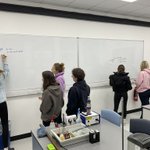



Physics workshop in Activities Week Science Camp - making mini motors and rocket-propelled cable cars.


TormeadPhysics retweeted

Here is Gemini's nice answer:
This question, famously posed by physicist Richard Feynman, has sparked much debate and diverse answers. There's no single "best" sentence, as it depends on what knowledge you deem most vital. Here are some contenders:
Feynman's suggestion: "Everything is made of atoms, little particles that move around in perpetual motion, attracting each other when they are a little distance apart, but repelling on being squeezed into one another." This captures the fundamental building blocks of matter and their basic interactions.
Other compelling options:
"Question everything, experiment constantly, and be skeptical of any conclusions that cannot be reproduced." This fosters a scientific mindset and encourages critical thinking.
"Energy can neither be created nor destroyed, but can only change form." This fundamental law underlies much of physics and chemistry.
"Evolution drives diversity and adaptation, leading to life's complexity." This summarizes the core principle of how life came to be and thrives.
"Observe the universe objectively and record your findings diligently." This encourages observation and documentation, crucial for any future knowledge building.
However, each suggestion has limitations. Some lack context, some focus on specific domains, and others might be ambiguous to future beings. Ultimately, the "best" sentence depends on your assumptions about the capabilities and environment of these future creatures.
It's also worth noting that single sentences might not be the most effective medium for knowledge transmission. Symbols, illustrations, or even a collection of concise statements could carry more information and nuance.
This thought experiment highlights the immense scope of scientific knowledge and the difficulty of encapsulating it in a single phrase. It challenges us to consider what truly matters and how we might communicate it beyond our current understanding of the world.
Sources
linkedin.com/pulse/which-you…
TormeadPhysics retweeted

In 1961, Richard Feynman stepped in front of a Caltech lecture hall and posed this question to a group of undergraduate students: "If, in some cataclysm, all of scientific knowledge were to be destroyed, and only one sentence was passed on to the next generation of creatures, what statement would contain the most information in the fewest words?"
His answer was: "all things are made of atoms—little particles that move around in perpetual motion, attracting each other when they are a little distance apart, but repelling upon being squeezed into one another"
What would be the 2024 answer to Feynman's thought experiment?

Competitive solving of Faraday’s Law equations by U6 Physicists in the refurbished Sixth Form Science lab.

72

Delighted to welcome alumna Jemima back to Tormead. She gave a fascinating talk to our scholars about her particle Physics PhD work hunting for dark matter deep in mine!

2
97


