

Constitutional Lawyer and Human Rights Advocate
Lagos, Nigeria
Joined July 2011
- Tweets508
- Following784
- Followers1.5K
- Likes296






Today it may be a journalist. Tomorrow it may be a lawyer. The next day it may be a political activist, a business owner, a student or an ordinary citizen.
The challenge before Nigerian jurists, legislators and judges today is not whether social media companies should moderate content. They should.
The real challenge is to nail down the constitutional and jurisprudential principles that should govern the exercise of such enormous digital power without undermining innovation or digital safety; principles that preserve community protection while safeguarding democratic participation, fairness and freedom of expression.
Constitutional history teaches us that every generation encounters its own moment of natality, its opportunity to begin anew by rethinking inherited assumptions in the light of new realities.
Perhaps the rise of digital power presents Nigeria with such a moment today.
To be continued next Monday.
Tope Temokun
3 August 2026
_A Weekly POLI-DUCATION Series
Political Education for the Thinking Citizen._
Published on:
Facebook: @Tope Temokun | @Tope Temokun Chambers Lagos
X: @Tope Temokun | @Tope Temokun Chambers Lagos
Website: topetemokunchambers.com
Facebook Channel: Tope Temokun Public Advocacy
_If you found this insightful or enlightening, share it with others. Our political education is a shared responsibility._
42
POLI-DUCATION SERIES 3
WHO CONTROLS YOUR VOICE?
A government can silence you.
Today, so can a private digital platform.
But should either exercise that power without accountability?
A thread. 🧵👇
WHO CONTROLS YOUR VOICE?
Digital Mobs, Social Media Giants and the Future of Free Expression!
There was a time when governments alone possessed the power to silence citizens. They shut down newspapers, proscribed organisations, banned public meetings, confiscated publications and imprisoned critics.
Today, a different centre of power has emerged. In many respects, it appears to exercise an influence that exceeds that of the State in one critical domain.
Without a police officer, a courtroom or an Act of Parliament, a single decision by a digital platform can erase years of work, disconnect a journalist from hundreds of thousands of followers, cripple a business, remove a human rights advocate from one of the world's largest public squares and silence a political voice painstakingly built over many years.
As part of our POLI-DUCATION, it is time we began to interrogate and elucidate this phenomenon. This is no longer merely a technology issue. It is a democratic issue. It is a constitutional issue. It is a jurisprudential issue. Above all, it is a political issue because public square has changed and political debates no longer occur only in newspapers, legislative chambers or public rallies. They now take place on Facebook, X, YouTube, TikTok and other digital platforms. Elections are debated there. Governments are criticised there. Journalists break stories there. Lawyers educate citizens there. Human rights defenders expose abuses there. Businesses survive there. Communities are built there.
The digital platform has become one of the most important arenas of democratic participation. Yet something equally significant has emerged. Increasingly, those who express courageous, unpopular or dissenting opinions complain that they become targets of coordinated reporting by persons who disagree with them. Whether every such complaint is justified is not the immediate point. The deeper concern is whether a digital mob can, intentionally or otherwise, trigger processes capable of silencing voices before any meaningful opportunity exists to challenge the decision.
That possibility should concern every modern citizen. Certainly, social media companies have the right and indeed the responsibility to establish Community Standards and remove genuinely harmful or unlawful content. No serious advocate of free expression argues otherwise. Every responsible digital platform must also ferret out terrorism, organised fraud, child exploitation and other serious abuses that threaten the safety of its users.
But every power must have limits. Can a digital platform permanently disable an account built over many years without identifying and verifying the alleged misconduct? Can it disconnect a citizen from hundreds of thousands of friends and followers without giving adequate reasons or notice? Can it remove a journalist, lawyer or activist from his or her reach or business owner from his or her business world and lifeline, which the modern public square is without providing a meaningful opportunity to be heard?
These are no longer mere contractual questions between a company and its users. They are questions about the relationship between private power and democratic freedom.
For decades, constitutional lawyers have focused on preventing the abuse of public power by public office holders. But now the history of constitutionalism teaches us that liberty is not threatened only by governments. The digital age now invites us to ask whether private power, where it profoundly shapes public life, should also be exercised according to principles of fairness, transparency and accountability.
This conversation is bigger than any individual whose account has been suspended or disabled.
1
60
A new week is not a promise that things will get better easily. It’s just a reminder that if we push harder and we do not give up, we can change the story!
Happy New Week!

PRESS STATEMENT
DSS Attempt to Censor Sowore on Twitter is Illegal and Unconstitutional!
We have been put in possession of the notice from X (formerly Twitter) informing Omoyele Sowore that the Department of State Services (DSS) wrote to @X requesting the removal of one of his


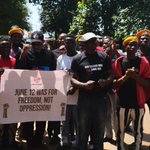
Democracy means nothing if the voice of the people is not heard! Political office holders are servants of the people. The servant must never outgrow his masters. #Socialwelfare #June12 @sowore


Live at Crest FM for the Democracy day Protest. The day we choose to be silent, is the day we start to lose to oppression. Oppression has no ears, so you have to communicate with it by action @sowore
Democracy is a government of the people, and the people must #TakeItBack. The TIB movement in Akure Ondo State at the CP office today is a move to retrieve power from the few and to fight for a government for all.


Earlier today, the police attacked peaceful protesters at Cathedral Junction Akure today. We have decided to take the grievances to the Commissioner of Police at the HQ. #Sowore #DemocracyDay #June12
The Cybercrime Act is still the oppressor’s power bank.
Even after amendment, Section 24 remains a threat to free speech & liberty.
The police still abuse it to silence critics.
We must intensify the call to repeal it completely.
#RepealSection24 #FreeSpeech
This is executive rascality at its peak.
A court order was in place. Yet, agents of government moved in with bulldozers, with gutless pretense and intimidation.
This is not just a breach of law —it is a brutal assault on justice. We will not fold our arms. Justice must be served.

URGENT: Oluwa Forest Reserve Under Threat-- TTC UPDATE
Despite a valid court injunction obtained by our team, farmers in Odigbo were ambushed yesterday by bulldozers allegedly backed by govt agents — while their leaders were lured to a fake peace meeting.
#RuleOfLaw #OluwaForest
Worker's right is human right! Not just a mere right but a fundamental right that must be respected. A threat to Worker's right is as grave as a threat to life, dignity, and liberty!
At TTC, we join all workers in Nigeria to stand against unfair labor practice.
Fair work= Fair pay & Fair worker's treatment!
That is the ideal law on worker's welfarism!
#JusticeIsARightNotAPrivilege
#NigeriansDeserveBetter
#workersrights #Workersday #RevolutionNow RT/Like.


His legacy lives and thrives forever!
As April closes, we honor Chief Gani Fawehinmi (b. April 22, 1938) — an icon of justice and human rights. His fearless advocacy for the oppressed lives on in our work at TTC under Tope Temokun’s leadership.
We walk in the path of a legend. #GaniFawehinmi #LegacyOfJustice #TTC


48