

Founder Los Senderos and Solterra Solar Ranches. @Dieste @SapphireBMarina- Investing in extraordinary people, bold ideas, and problems worth solving.
Joined March 2012
- Tweets8.4K
- Following3.1K
- Followers5.9K
- Likes10.8K





Tony Dieste retweeted

"The 1850s were a time of building and learning to manage the railroads as the nation's first modern business enterprise; the 1860s and 1870s were a period of coordinating and competing for the flows of through traffic; the 1880s and 1890s were the years of system-building." Visible Hand by Alfred Chandler
Tony Dieste retweeted
Many legacy businesses share the same problem. The mental model gets handed down from leader to leader and employee to employee, and nobody challenges it. Why? Because changing it takes courage, a willingness to risk losing money, and a lot of very, very hard work. Most people don’t have all three. That’s usually what’s behind the question I get asked most: why do I do what I do?
Tony Dieste retweeted
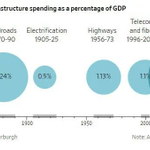
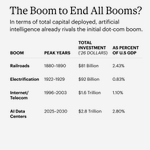
I often use the analogy of railroads + electrification + industrialization all wrapped in one. If we slow or shut this down, America will lose its competitive position in the world and it would throw the global economy into a deep recession.


Tony Dieste retweeted
Be a net contributor to society. Make more than what you take, and the chances that you’ll be happier should be greatly increased.
Tony Dieste retweeted
With AI ambition now nearly universal, execution speed is the differentiator. Looking at JP Morgan’s report today on compute supply/demand/gap we’re still in the very early innings of this transformative build out. #ai #AIInfrastructure #globalaiadoption

With AI ambition now nearly universal, execution speed is the differentiator. Looking at JP Morgan’s report today on compute supply/demand/gap we’re still in the very early innings of this transformative build out. #ai #AIInfrastructure #globalaiadoption
Amen! I can’t even imagine the size and scope of the fraud in this area of government.

BREAKING: The Social Security Administration confirms to @FoxNews that it has just undertaken its largest cleanup of Social Security Numbers in the agency's 91-year history, correcting nearly 15% of all U.S. citizen SSNs (roughly 50 million out of 330 million). The changes include:
- Adding 17 million dates of death to files that previously didn't have them w/ help from State Dept.
- With help from DHS, updating 25 million files that had missing citizenship information.
- Correcting an additional 8.5 million records with inaccurate citizenship data.
SSNs are referenced by agencies across the federal government and in states to validate identities and prevent improper payment of tax dollars.
SOCIAL SECURITY ADMINISTRATION STATEMENT TO FOX:

Tony Dieste retweeted

JPMorgan just dropped an ABSOLUTELY INSANE forecast for AI compute.
According to JPMorgan, global AI compute demand is expected to reach roughly 530 GW by 2031, while available supply is projected to reach just 250 GW. That leaves us with a staggering 280 GW shortfall, even after the industry spends hundreds of billions of dollars expanding capacity. We're talking about global AI compute supply potentially QUADRUPLING between 2025 and 2031, yet the shortage is expected to get even WORSE. In fact, JPMorgan estimates the gap between supply and demand could expand from roughly 50 GW today to nearly 280 GW by 2031.
And here's why this matters so much. When demand consistently outpaces supply, the companies controlling scarce compute capacity gain enormous pricing power. This is especially important for neoclouds like $NBIS and $CRWV, which are building out GPU infrastructure to serve customers that simply cannot secure enough compute capacity through traditional hyperscalers. If JPMorgan's projections are even remotely accurate, GPU rental pricing could remain stronger for much longer than investors currently expect, supporting higher utilization rates, long term contracts, and potentially stronger returns on deployed infrastructure. But the opportunity extends FAR beyond neoclouds. Companies like $NVDA and $AMD benefit from the continued need for accelerators, memory manufacturers like $MU benefit from increasing demand for high-bandwidth memory, and networking, storage, power, and cooling providers all become increasingly important as the industry attempts to close this gap.
And this is where I think the market is making a BIG mistake. Investors are so focused on whether AI companies are spending TOO MUCH money that they're overlooking the possibility that the industry STILL isn't spending enough to satisfy future demand. The real constraint isn't necessarily a lack of customers willing to pay for compute. It's the ability to manufacture enough chips, secure enough electricity, build data centers fast enough, and actually bring that capacity online. And that is EXACTLY why I continue to believe the biggest winners in AI won't necessarily be the companies building the models, but the companies supplying the infrastructure required to run them.


How could you POSSIBLY be bearish on compute right now when GPU rental prices are doing THIS?
According to data from FastGPU, GPU rental prices increased as many as 81 times across providers over the past 60 days, with some of the most important chips used for AI training and inference seeing MASSIVE price increases. NVIDIA B300 rental prices increased 52.8%, going from $8.50 to $12.99 per GPU hour. H200 prices jumped 33.3%, B200 prices increased 27.8% and H100 prices rose 30% and the RTX PRO 6000? Rental prices surged an absolutely INSANE 307%.
We're watching AI infrastructure companies get absolutely DESTROYED in the stock market, with investors freaking out about debt, financing costs, oversupply, and whether these companies will ever generate attractive returns on their investments. Meanwhile, the actual cost of renting the underlying compute is going UP.
If we were genuinely heading toward a massive compute oversupply, you would expect rental prices to start collapsing as providers competed to fill their available capacity. Instead, we're seeing pricing strength across some of the most important GPUs powering the AI industry. And remember, we're still in the EARLY stages of AI adoption. Frontier labs are scaling their training clusters, inference demand is exploding as more people and businesses adopt AI, and the amount of compute required to serve increasingly sophisticated models continues to grow.
This is EXACTLY why I've been so bullish on companies like $NBIS , $MU , $CRDO , $IREN etc. I genuinely believe compute will remain one of the most valuable resources in the AI economy for years to come. And while Wall Street continues panicking over the short term volatility, I'm BUYING THE DIP.
If you want to know exactly what I’m buying on this dip and how I’m positioning across the compute buildout, check out portfolio below.
link.milkroad.com/tx5qip

Tony Dieste retweeted

Elon Musk says there's no AI demand issue and explains why SpaceX rents its compute on short-term contracts: AI compute is worth more per watt every year, renewals are coming in at higher prices, and the market is a “cheese shop” with no chips left
“Our belief is that the value of compute per watt will increase over time, not decrease. And the reason for that, I think it should be obvious to people really, is that as you improve the AI software, as the models get better and better, they’re able to, you get more useful intelligence per watt. And the value of that compute is proportionate to the useful intelligence per watt. And that’s why you see things like even old computers like H100s renting for more than they rented when they were new.”
“And I think that’s likely to continue. I think we’re going to face a shortage of superintelligence compute. And that shortage is going to remain for a long time. So, I think the smart move is to do short-term contracts and to essentially place the bet on useful intelligence per watt increasing rapidly, which obviously is done, so that’s what’s happened so far.”
“And also if you look at, say, how are our short-term contracts renewing? Are they renewing at higher dollars per watt or lower? And we see them renewing at higher dollars per watt, not lower dollars per watt. We are also frankly hounded relentlessly by every hyperscaler and by dozens of smaller companies to rent more of our compute. So we could rent out our compute several times over if we said yes to everyone. That’s just the situation here.”
“That’s why I posted that sort of video meme of the Monty Python cheese shop sketch where the guy goes into a cheese shop to get some cheese and they actually have no cheese. And so he goes like, what about this kind of cheese? What about that kind of cheese? And they really just don’t have any cheese.”
“So we’ve actually tried to offload some of our inference compute to other cloud providers so that we can use more compute for training. And we get the cheese shop sketch. You know, they’ll say, like, well, we’ll ask them about what about some, you know, GB300s? Nope, don’t have any of those. What about, you know, some GB200s? Nope, don’t have any of those. What about some TPUs? Nope. What about some Trainiums? Nope. What about some, okay, how about some H100s? And like, well, we might have some overseas somewhere and then they’ll check and come back and say, nope, we don’t have that either. So it’s like ridiculous.”
“Yeah. So I don’t think we’re going to have a demand issue here. And like, it’s not impossible. I’m not saying this will happen. It’s not impossible that we will have a six-month payback period for compute next year.”

Elon Musk says Starlink connectivity revenue has “a clear path to several hundred billion dollars,” and promises a separate presentation on the plan
“Yeah, I think we probably should do a longer presentation on the game plan for Starlink connectivity and why we think it will ultimately be a business that generates several hundred billion dollars in revenue a year."
"Because you are missing some of the pieces that we know about internally. I can say we do see a clear path to several hundred billion dollars a year in connectivity revenue."
"But I think we should probably describe that in more detail in a forum that’s not limited to a few minutes at an earnings call.”
Tony Dieste retweeted

$META just revealed that its Prometheus supercluster (which trained its new Muse AI models) already runs hundreds of thousands of $NVDA GPUs and is scaling toward roughly 1 million using GB200, GB300 and eventually Vera Rubin systems.
And the scale of this infrastructure is pretty insane because Meta needs ~4,900 additional GPUs to support a 32,768-GPU training run through hardware failures.
That's on top of millions of optics connecting facilities more than 100 km apart and power swings of ~40% during training showing how Meta's AI expansion is driving demand well beyond GPUs into networking, energy storage and liquid cooling.


Be a net contributor to society. Make more than what you take, and the chances that you’ll be happier should be greatly increased.
I often use the analogy of railroads + electrification + industrialization all wrapped in one. If we slow or shut this down, America will lose its competitive position in the world and it would throw the global economy into a deep recession.
Many legacy businesses share the same problem. The mental model gets handed down from leader to leader and employee to employee, and nobody challenges it. Why? Because changing it takes courage, a willingness to risk losing money, and a lot of very, very hard work. Most people don’t have all three. That’s usually what’s behind the question I get asked most: why do I do what I do?
Tony Dieste retweeted
$META Muse Spark and $GOOGL Gemini cost just ~$0.40 per AI task versus $2.34 for Anthropic Opus 5 showing a nearly 6x gap in the cost of intelligence.
The advantage for Google and Meta is that they can monetize AI through Cloud, ads and commerce giving them a ton more flexibility to price models aggressively without relying entirely on subscriptions.
I also think AI agents will start choosing the cheapest model that gets job done which puts pressure on premium models to justify their pricing while more of AI value shifts toward companies controlling AI infrastructure and distribution.

Tony Dieste retweeted

The late MIT prof. Patrick Winston explains how to speak & get your ideas valued & accepted.
The famous lecture in full: tinyurl.com/2p592kya
v/@MITOCW
Tony Dieste retweeted

I don't think people realize just how ridiculous AI infrastructure spending is about to get over the next few years.
Just 12 months ago, Wall Street expected the five largest hyperscalers to spend around $495 BILLION in 2027. Today? That estimate has jumped to $1.13 TRILLION. That's an additional $636 BILLION in expected spending for the SAME year, and we're still more than a year away from 2027 and look at how much the individual estimates have changed.
$AMZN: $140B → $296B
$GOOGL: $103B → $335B
$META: $107B → $210B
$MSFT: $98B → $194B
$ORCL: $47B → $96B
What's even crazier is that 2026 estimates have nearly doubled as well, going from $465B to $892B. Think about what this actually means. We're talking about hundreds of billions of additional dollars flowing into GPUs, custom AI chips, memory, networking equipment, optical components, power infrastructure, cooling systems, and data center construction. And remember, these are just FIVE companies. This doesn't even include the spending coming from frontier labs, neocloud providers, sovereign AI projects, enterprises, and other companies building their own AI infrastructure.
The big takeaway here is that Wall Street has consistently underestimated how much infrastructure this AI buildout is going to require. And considering how much these estimates have already changed in just 12 months, I wouldn't be surprised if we're still underestimating where spending ultimately ends up.

Tony Dieste retweeted
BofA sees global AI data center capacity growing ~5x to 219 GW by 2030:
• $AMZN +42 GW
• $GOOGL +27 GW
• $MSFT +24 GW
• $SPCX +24 GW
• $META +18 GW
• $ORCL +12 GW
• $CRWV +7 GW
• $NBIS +5 GW
• $IREN +3 GW
What’s really interesting is that neoclouds will be accounting for ~40% of new capacity added in 2030.

Tony Dieste retweeted
Big ideas unlock big business problems. The rest is execution.
The best CEOs and entrepreneurs our new Ai-era will be those who can develop great new businesses, but are also systems thinkers. who can connect seemingly(and previously viewed) unconnected businesses into large synergistic connected systems.